Why War Time Is Opportunity Time for Some Brands?
War is frightening. Markets shake. Supply chains break. Consumers panic.
For most businesses, it feels like survival mode.
Yet history quietly tells a different story.
Some brands don’t just survive wars. They grow faster than ever.
If you are an Indian entrepreneur or decision-maker, this is not about glorifying conflict.
It is about understanding how uncertainty reshapes demand, strategy, pricing power, and brand perception.
Because in business reality, disruption always creates both risk and opportunity.
When Fear Changes Buying Behaviour
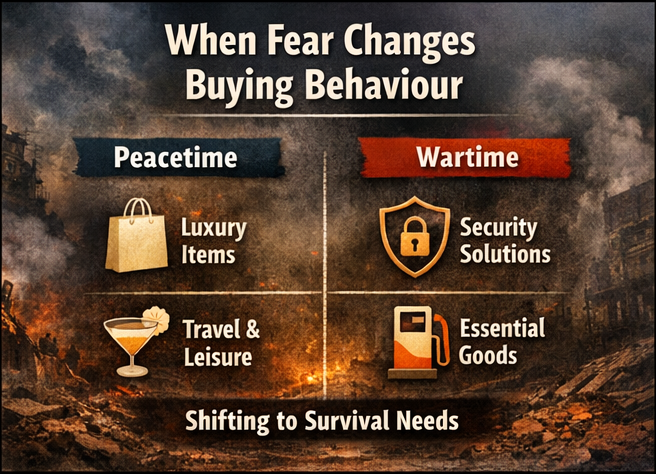
During war or geopolitical tension, consumer psychology shifts overnight.
People stop buying “nice-to-have” products and move toward “must-have” solutions.
For example, during the Russia-Ukraine conflict in 2022–24, global defence spending crossed $2.4 trillion in 2024, the highest ever recorded.
Energy prices also surged sharply. Brent crude crossed $120 per barrel in phases.
This fear-driven consumption is predictable.
Security, survival, and stability suddenly become top priorities.
Indian businesses saw similar patterns. Demand for cybersecurity services, fuel alternatives, logistics efficiency tools, and financial hedging solutions increased.
Even FMCG brands noticed pantry stocking behaviour returning in urban India.
Scarcity Creates Pricing Power
One harsh truth of wartime economics is that scarcity increases value.
Brands that control supply chains or offer substitutes gain pricing strength.
Consider how shipping container rates jumped by more than 300% amid global conflict-driven disruptions.
Logistics companies with strong fleet ownership earned record margins.
In India, cement and steel players have historically benefited during global instability phases because infrastructure spending rises as governments try to stabilize economies.
A simple comparison makes this clearer.
| Situation | Brand Without Supply Control | Brand With Supply Control |
| Raw material shortage | Margin erosion | Price increase possible |
| Transport disruption | Delivery delays | Priority routing advantage |
| Demand panic | Stockouts | Revenue spike |
| Investor sentiment | Valuation drop | Strategic premium |
This shows why vertically integrated businesses often grow during uncertain times.
Governments Spend More Than Ever
War does not just destroy.
It also triggers massive government spending.
Defence budgets rise. Infrastructure projects accelerate. Energy investments expand.
India’s defence budget reached ₹6.21 lakh crore in FY2025, making it among the world’s largest.
Domestic defence manufacturing is also growing under the “Atmanirbharp Bharat” initiative, opening doors for Indian MSMEs in electronics, drones, precision engineering, and software.
Brands aligned with national priorities often gain long-term contracts and policy support.
Compared to consumer startups dependent on VC funding cycles, these businesses experience more predictable revenue flows.
Innovation Happens Faster Under Pressure
Many technologies we use today were accelerated by wartime urgency.
GPS systems, jet engines, advanced semiconductors, and cybersecurity frameworks all saw rapid evolution during global conflicts.
Today’s version of this trend includes AI defence tools, satellite imaging startups, and resilient cloud infrastructure.
Indian SaaS companies are already competing globally here.
While Western competitors may have scale advantages, Indian firms often win on cost efficiency and engineering depth.
War creates urgency. Urgency removes bureaucracy.
And when decisions become faster, innovation timelines shrink dramatically.
Media Attention Builds Unexpected Brands
War increases global media consumption.
People constantly track news, analysis, social media updates, and expert commentary.
This creates sudden growth opportunities for content platforms, digital publishers, telecom operators, and even fintech apps.
During major geopolitical events, Indian news apps have reported traffic spikes of 40–70%.
OTT platforms also benefit because people spend more time indoors.
Compared to peace-time marketing, where brands spend heavily to gain attention, wartime visibility can come organically through relevance.
Energy Brands Often Enter Supercycles
Energy is the lifeline of modern economies.
When war disrupts supply, prices surge.
A line graph showing crude oil prices would show them rising sharply during major conflicts such as the Gulf War, the Iraq War, and the Russia-Ukraine crisis.
Each spike is followed by increased profits for upstream energy companies and volatility for downstream players.
Indian companies like ONGC, Reliance Industries, and even renewable startups experience strategic shifts during such periods.
Interestingly, renewable brands gain faster adoption because governments seek energy independence.
This creates a competitive race between traditional fossil players and clean energy innovators.
Read more: Oil Price Spikes During Global Conflict
Small Businesses Also Find Windows of Growth
Opportunity is not limited to billion-dollar corporations.
Indian MSMEs often pivot successfully during crises.
Textile units start defence uniform production.
Auto component makers move into drone parts.
IT freelancers shift toward cybersecurity consulting.
The difference lies in agility.
Large companies move with process. Small businesses move with instinct.
A survival mindset can quickly become a growth mindset when entrepreneurs closely monitor demand signals.
Investors Look for “War-Proof” Sectors
Capital does not disappear during wars.
It simply changes direction.
Defence tech, commodities, logistics tech, cybersecurity, agri-tech, and essential consumption brands usually attract funding faster.
Compared to lifestyle startups or luxury brands, these sectors show stronger revenue predictability.
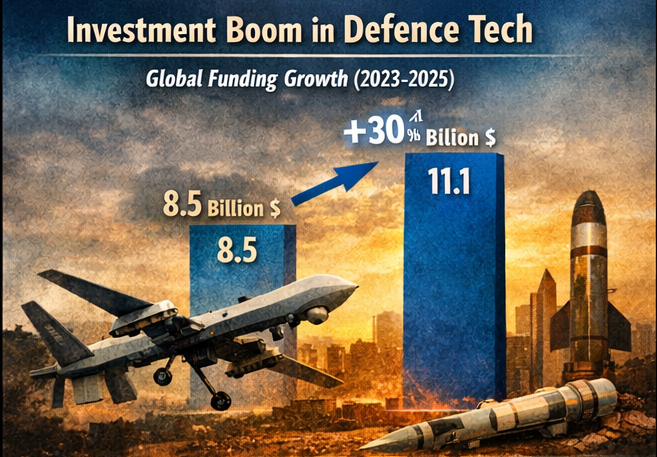
Global venture data suggests that investment into defence and dual-use technology startups increased over 30% between 2023 and 2025.
Indian founders who understand this shift in capital flows can position their business narratives more strategically.
Brand Trust Gets Redefined During Crisis
War tests reputation like nothing else.
Brands that support communities, maintain supply consistency, and communicate transparently earn deep trust.
During global disruptions, Indian consumers increasingly reward reliability over price.
This is why established brands often gain market share while weaker competitors fade.
Trust built during uncertainty lasts long after peace returns.
And that trust eventually converts into premium pricing, customer loyalty, and stronger valuation multiples.
Strategy Matters More Than Luck
Not every brand grows during wartime.
Those who succeed usually share a few strategic traits.
They understand macroeconomics.
They diversify revenue streams.
They build operational resilience.
Most importantly, they observe human behaviour carefully.
Because war changes markets.
But markets are ultimately reflections of people.
- government schemes
- Business in War



Rahul Malodia is a leading business coach in India, a Chartered Accountant, and the creator of the transformational Vyapari to CEO (V2C) program. With a mission to empower MSMEs, he has trained over entrepreneurs to systemize operations, manage working capital, and scale their businesses profitably.
Known for transforming traditional business owners into confident CEOs, Rahul delivers India’s top business coaching programs through bootcamps, workshops, and online courses. His practical strategies and deep industry insights have made him a trusted name among entrepreneurs seeking sustainable and scalable growth.
