How Businesses Can Survive Sudden Oil Price Spikes During Global Conflicts
Global conflicts often look like distant headlines. Yet for Indian businesses, the impact arrives quietly through rising fuel bills, shrinking margins, and anxious customers. One sudden spike in crude oil prices can change monthly cash flow plans overnight.
India imports nearly 85 percent of its crude oil needs, which makes businesses highly sensitive to global supply disruptions.
During the Russia–Ukraine conflict in 2022, Brent crude briefly crossed 120 dollars per barrel, pushing diesel and petrol prices up sharply. This was not just an energy story. It became a business survival story.
Entrepreneurs who understand this chain reaction early often stay calm. Those who react late usually struggle.
Why Oil Prices Hit Indian Businesses Harder Than Expected
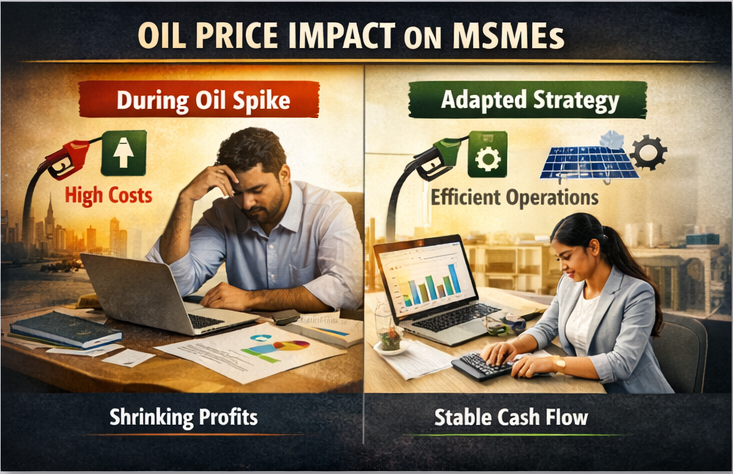
Oil is not just fuel. It is transport cost, packaging cost, electricity cost, and even marketing cost. When diesel prices rise, logistics firms increase freight rates. When freight rises, retailers raise prices. When prices rise, demand slows.
For Indian MSMEs, this effect is stronger. With over 6.3 crore MSMEs contributing nearly 30 percent to India’s GDP, even small margin changes can impact national growth trends. Unlike large corporations, many smaller firms operate with limited reserves.
This makes oil volatility not just an economic risk, but a psychological one for business owners.
The Hidden Margin Killer: Logistics Inflation
Most entrepreneurs first notice oil spikes in their transport invoices. In sectors like e-commerce, FMCG distribution, and manufacturing, logistics costs can form 15 to 25 percent of total expenses.
After global conflicts disrupt supply chains, logistics companies often increase diesel-linked surcharges. Compared to Western markets, where rail and inland waterways reduce fuel dependency, India still relies heavily on road transport for last-mile delivery.
Businesses that fail to adjust pricing or routing strategies during such periods often see profits vanish quietly.
Smart Moves vs Risky Reactions During Oil Spikes
When oil prices rise suddenly, business decisions fall into two broad categories. Some protect long-term growth. Others only offer temporary relief.
| Risky Reaction | Smart Move | Business Impact |
| Sudden price hikes for customers | Gradual dynamic pricing adjustments | Protects demand stability |
| Cutting marketing completely | Optimizing performance marketing spend | Maintains brand visibility |
| Switching to the cheapest suppliers blindly | Building multi-location sourcing | Reduces supply disruptions |
| Ignoring fuel-linked contracts | Negotiating variable logistics agreements | Improves cost control |
Indian startups adopting dynamic pricing models, similar to airline and ride-hailing strategies, have shown stronger resilience compared to traditional fixed-price businesses.
Fuel Hedging vs Flexible Strategy: What Works Better
Large companies like airlines and oil marketing firms often use fuel hedging, a financial strategy that locks in future fuel prices. This reduces uncertainty but needs capital and expertise.
In contrast, most Indian MSMEs cannot hedge in global commodity markets. Their competitive advantage lies in operational flexibility. Businesses that shift suppliers, redesign delivery routes, or adopt hybrid work models reduce fuel dependency faster than those waiting for prices to fall.
Interestingly, startups in India’s quick-commerce space have started using AI-based route optimization, reducing delivery fuel consumption by up to 12 percent, according to logistics tech reports in 2025.
The Power of Localisation in Uncertain Times
Global conflicts remind businesses of one simple truth. Distance increases risk.
Companies sourcing raw materials locally often experience smaller cost shocks. For example, Indian textile firms that rely on domestic cotton supply faced less disruption compared to exporters dependent on imported synthetic inputs linked to crude oil derivatives.
This shift toward localisation is also supported by government policies like Production Linked Incentive schemes and infrastructure investments, which aim to strengthen domestic manufacturing resilience.
Renewable Energy Is No Longer a CSR Story
A decade ago, solar panels were seen as sustainability branding. Today, they are a survival strategy.
India’s renewable energy capacity crossed 190 GW in 2025, making it one of the fastest-growing clean energy markets globally. Manufacturing units using rooftop solar have reported electricity cost reductions of 20 to 30 percent, cushioning them during fossil fuel price shocks.
Compared to European businesses, which face stricter carbon taxes but have stronger green subsidies, Indian firms are still in transition. Those who move early often gain cost advantages.
Visualising the Pressure: Oil Price vs MSME Margins
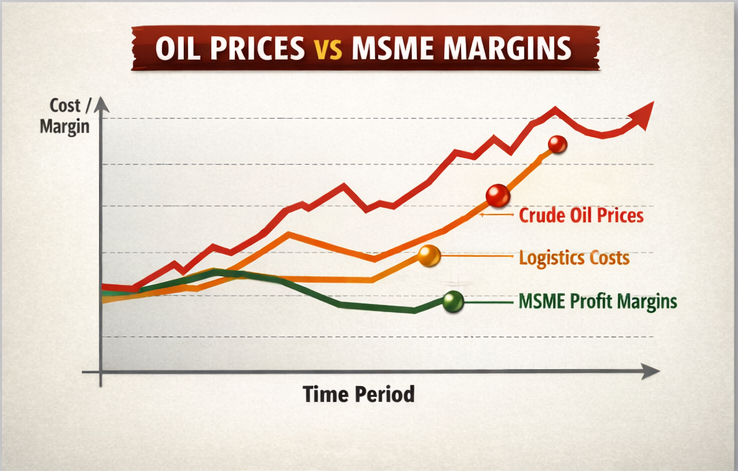
Imagine a simple line graph. On the horizontal axis is time across three years of global tension. On the vertical axis are three lines.
The first line shows crude oil prices rising sharply during conflict periods. The second line shows logistics costs, following with a slight delay. The third line shows MSME profit margins slowly declining.
This visual tells a powerful story. Oil spikes do not destroy businesses instantly. They erode them gradually. Entrepreneurs who track such trends monthly rather than yearly make better decisions.
Customer Psychology During Price Surges
When fuel prices rise, customers also become cautious. Discretionary spending drops. Demand shifts toward value products.
Indian consumer behavior data shows that during inflationary periods, brands offering smaller pack sizes, flexible payment options, and perceived value benefits retain market share better than premium-only players.
Compared to luxury-focused strategies seen in some global markets, Indian businesses often succeed through affordability innovation. This is not a weakness. It is market intelligence.
Cash Flow Discipline Becomes a Competitive Advantage
Oil price volatility tests financial discipline more than operational strength. Businesses with strong working capital cycles survive longer.
RBI reports indicate that companies with inventory turnover cycles under 60 days manage inflation shocks better than those holding excess stock. Many Indian entrepreneurs now use digital finance tools and GST data analytics to track real-time cash positions.
This shift toward data-led decision-making is slowly narrowing the gap between startups and traditional firms.
Strategy Is Not About Predicting Wars
No business can control global conflicts. But every business can control preparedness.
Survival during oil price spikes comes from a mix of pricing intelligence, supply diversification, energy transition, and financial discipline. Companies that see fuel volatility as a recurring reality, not a rare crisis, build stronger long-term models.
- Business in War



Rahul Malodia is a leading business coach in India, a Chartered Accountant, and the creator of the transformational Vyapari to CEO (V2C) program. With a mission to empower MSMEs, he has trained over entrepreneurs to systemize operations, manage working capital, and scale their businesses profitably.
Known for transforming traditional business owners into confident CEOs, Rahul delivers India’s top business coaching programs through bootcamps, workshops, and online courses. His practical strategies and deep industry insights have made him a trusted name among entrepreneurs seeking sustainable and scalable growth.
