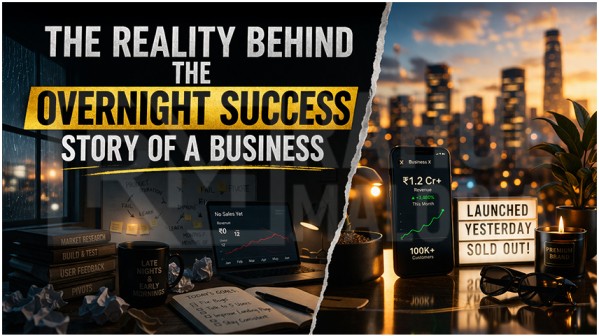
The Reality Behind the Overnight Success Story of a Business
You see the headlines and the flashy posts. Zomato’s app lights up every street corner in India. Rapido bikes weave through traffic like they were always there. Minimalist skincare flies off shelves, and BGMI keeps millions glued to their phones.
It all feels like pure magic, an overnight explosion of fame and revenue. But if you have ever built something yourself as an Indian entrepreneur, you know better.
These stories hide long stretches of invisible effort, quiet failures, and deliberate choices. The reality is far more human, far more relatable, and honestly, far more encouraging once you see it clearly.
The Allure of the Overnight Success Story
We love the shortcut narrative. In a country where over two lakh DPIIT-recognised startups now exist and forty-four thousand more joined in 2025 alone, the dream of sudden scale feels within reach.
Social media shows valuations spiking and apps trending, so it is easy to believe success arrived in a flash. Yet every major player you admire followed a different script.
The public eye catches only the final scene. The years of scripting, rehearsing, and rewriting stay backstage.
Zomato’s Decade of Quiet Building
Zomato started in 2008 as a simple menu-scanning site for office workers in Delhi. For the first eight years, profitability felt distant.
The team spent countless nights updating restaurant data, fixing delivery glitches, and listening to customer complaints that never made the news. By 2025, annual revenue crossed twenty-one thousand crore rupees.
That jump looks sudden only if you ignore the slow compounding of trust built city by city. Zomato did not chase virality first. It chased accuracy and reliability until the market rewarded the foundation.
Rapido and the Indian Mobility Revolution
Rapido launched in 2015 with a simple idea: bike taxis for Indian roads that cars cannot navigate fast enough. Founders faced early rejections and regulatory hurdles while competing head-on with Uber.
Today, Rapido holds over 60% of the bike-taxi market and recently touched a $2.3 billion valuation.
The “overnight” tag ignores the decade of rider onboarding, route mapping in monsoon chaos, and daily tweaks to pricing that kept drivers loyal. Rapido grew by solving real Indian pain points, one commute at a time, not by blindly copying global models.
Minimalist’s Rapid Rise Wasn’t Really Rapid
Minimalist, the Jaipur-born skincare brand, posted 517 crore rupees in revenue for FY25, a healthy 48% jump. It feels like a D2C rocket.
Yet the brand began in 2018 with transparent ingredient lists and zero hype budgets. Founders tested formulations in small batches while learning supply-chain realities that legacy players like Dove had mastered over decades.
The recent acquisition interest from Hindustan Unilever came only after years of proving science-backed results to sceptical Indian buyers who now trust clean beauty more than ever.
What BGMI Teaches About Market Timing
BGMI entered the scene in 2021 after the PUBG ban created a vacuum. Paying users jumped 27% year-on-year in 2025, helping Krafton hit record revenue.
The game seems to have exploded from nowhere. In truth, the parent company had refined battle-royale mechanics globally for years.
BGMI simply timed the Indian mobile-gaming surge perfectly, when affordable 5G and rising disposable incomes met a ready audience craving local tournaments and familiar controls.
Global Lessons from Apple, Tesla, and Netflix
Look beyond India, and the pattern repeats. Apple, founded in 1976, waited until the 2007 iPhone launch for its biggest leap.
Tesla took eighteen years from 2003 to achieve consistent profits. Netflix spent six years after its 1997 start before streaming truly paid off. Each brand faced early doubts, product flops, and cash crunches that never trended on Instagram.
Their “overnight” moments rested on patient engineering and market readiness that outsiders rarely notice.
The Hidden Grind Behind Instagram, Spotify, and Airbnb
Instagram launched in 2010 and was sold to Facebook within two years, yet its founders had already tinkered with photo apps for years. Spotify began in 2006, battling licensing wars long before playlists became cultural currency.
Airbnb started in 2008 with air mattresses in a San Francisco apartment; it survived the 2009 recession and trust issues before travel rebounded.
Each story shows the same truth: viral growth arrived only after solving invisible problems like server costs, creator tools, and host safety.
Red Bull, Google, and Nvidia: Innovation Over the Years
Red Bull entered India quietly in the late nineties, building its extreme-sports image slowly before dominating energy drinks.
Google, born in 1998, refined search algorithms for years before ads scaled. NVIDIA, founded in 1993, rode the recent AI wave only after decades of GPU development. None woke up famous.
They invested in research, talent, and infrastructure while competitors chased quicker returns. Their patience turned technical edges into market dominance.
Everyday Brands Like Dove, GoDaddy, and Shopify
Even familiar names follow the rule. Dove’s “Real Beauty” campaign in 2004 felt fresh because the brand had spent decades earning trust through consistent quality.
GoDaddy, launched in 1997, grew domain registration by listening to small businesses long before Super Bowl ads.
Shopify, starting in 2006, empowered entrepreneurs worldwide by fixing checkout friction that bigger platforms ignored. These brands succeeded by staying close to customer needs instead of chasing trending tactics.
Angry Birds and Candy Crush: Gaming’s Overnight Illusion
Angry Birds launched in 2009 and seemed to conquer phones instantly. Its parent company, Rovio, had actually built games since 2003, learning from dozens of quiet failures.
Candy Crush arrived in 2012 but rested on King’s years of matching-game expertise. Both titles rode short attention spans, yet behind the levels sat refined physics, colour psychology, and monetisation loops perfected far earlier. The downloads looked sudden. The craft was anything but.
Pitfalls Indian Entrepreneurs Face in Chasing Virality
Indian founders often face extra pressure. Startup India incentives and easy early funding can tempt teams to scale before product-market fit.
Many MSMEs, 86% of which expect growth in 2026, still struggle with cash-flow gaps when they copy flashy models instead of fixing core operations.
The same holds for D2C brands chasing Instagram reels without strong repeat purchase data. Speed without substance leads to shutdowns, which hit eleven thousand startups in 2025 alone.
Here is a clear comparison that puts every mentioned brand in perspective:
| Company | Founded Year | Perceived Overnight Moment | Actual Years of Build-Up | Key Reality in Indian/Global Context |
| Zomato | 2008 | IPO & unicorn status 2021 | 13+ years | City-by-city logistics & restaurant data accuracy |
| Rapido | 2015 | Unicorn valuation 2025 | 10 years | Solving Indian traffic & driver loyalty |
| Minimalist | 2018 | FY25 revenue surge | 7 years | Ingredient trust before big acquisition interest |
| BGMI | 2021 | Massive user spike | Parent tech 10+ years | Timed with 5G & local gaming culture |
| Apple | 1976 | iPhone era 2007 | 30+ years | Decades of product innovation |
| Tesla | 2003 | Profitability in the 2020s | 18+ years | EV technology & manufacturing scale |
| Netflix | 1997 | Streaming dominance | 15+ years | Shift from DVD to global content |
| Spotify | 2006 | Music streaming leader | 10+ years | Licensing battles before scale |
| Airbnb | 2008 | Travel rebound post-2020 | 12+ years | Trust systems after early survival struggles |
| Uber | 2009 | Global ride-hailing giant | 10+ years | Regulatory navigation worldwide |
| 2010 | Viral growth & Facebook buy | 2+ years of prior work | Photo app evolution before social explosion | |
| Red Bull | 1987 | Energy drink dominance | 15+ years in India | Slow brand building via sports |
| 1998 | Search & ad empire | 10+ years | Algorithm refinement before monetisation | |
| Nvidia | 1993 | AI chip leadership | 30+ years | GPU innovation over the decades |
| Dove | 1957 | Real Beauty campaign 2004 | Decades | Consistent quality before emotional marketing |
| GoDaddy | 1997 | Domain & hosting leader | 15+ years | Serving small businesses patiently |
| Shopify | 2006 | E-commerce platform boom | 10+ years | Fixing checkout friction for entrepreneurs |
| Angry Birds | 2009 | Mobile gaming hit | 6+ years prior | Multiple game failures before success |
| Candy Crush | 2012 | Casual gaming explosion | Years of refinement | Matching mechanics perfected over time |
This table makes one truth crystal clear: the left column is what the world sees. The right column is what actually creates lasting businesses in India and globally.
Turning Your Business Reality Into Lasting Success
Picture a line graph of Zomato’s revenue from 2010 to 2025. The line rises gradually for a decade as the team maps thousands of restaurants and trained delivery partners. Only later does it steepen with hyperlocal tech and expanded categories.
No straight vertical line, just steady, informed progress. The same curve appears in Rapido’s ride data, Minimalist’s repeat orders, and even global names like Shopify’s merchant growth. Indian entrepreneurs who accept this pattern stop burning out chasing shortcuts.
They focus on unit economics, customer feedback loops, and small daily improvements that compound.
This perspective comes from years of translating real-world business experience into clear, actionable frameworks that help founders worldwide turn everyday challenges into scalable growth.
- BusinessSuccess
- Market Analysis
- Business Ideas


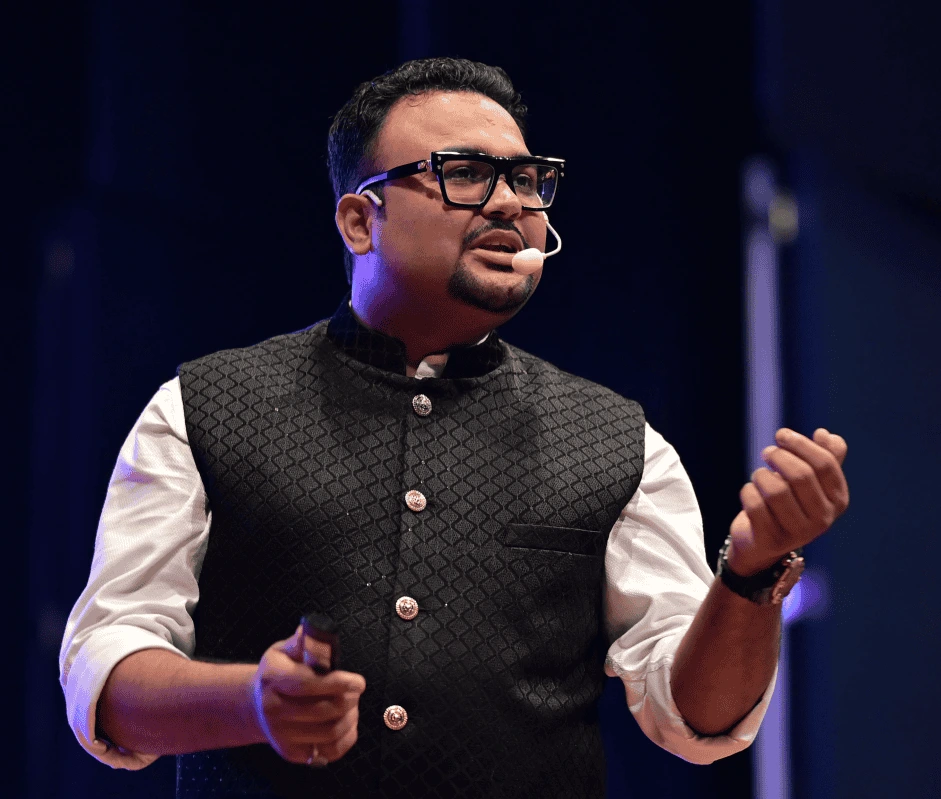
Rahul Malodia is a leading business coach in India, a Chartered Accountant, and the creator of the transformational Vyapari to CEO (V2C) program. With a mission to empower MSMEs, he has trained over entrepreneurs to systemize operations, manage working capital, and scale their businesses profitably.
Known for transforming traditional business owners into confident CEOs, Rahul delivers India’s top business coaching programs through bootcamps, workshops, and online courses. His practical strategies and deep industry insights have made him a trusted name among entrepreneurs seeking sustainable and scalable growth.
