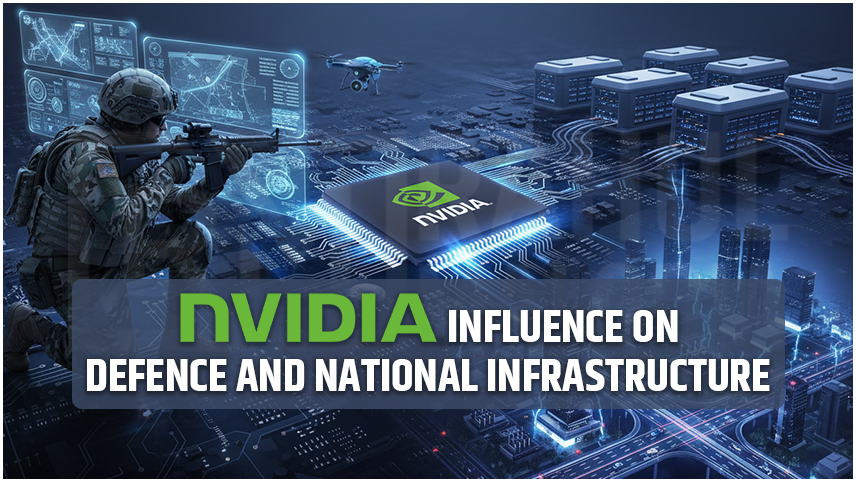
NVIDIA’s Influence on Defence and National Infrastructure
There is a quiet shift happening in global power structures, and most people never notice it.
No tanks rolling on streets. No fighter jets in the sky. No public announcements.
Instead, the real battlefield today sits inside data centers, server racks, AI chips, and high-performance computing systems. And at the center of this invisible shift stands NVIDIA.
For Indian entrepreneurs, CXOs, and decision-makers, understanding NVIDIA’s influence on defence and national infrastructure is no longer optional curiosity. It is a lens into how power, security, and technology are being reshaped in the 21st century.
This is not a story about gaming GPUs.
This is a story about how NVIDIA defence technology quietly became critical to modern warfare, national security, and infrastructure control.
How NVIDIA Became a Defence Backbone Without Calling Itself One
NVIDIA rarely brands itself as a defence company. Yet governments depend on NVIDIA GPUs more than on any other private AI hardware provider.
By 2025, over 70 percent of global AI workloads in defence research, military simulation AI, and intelligence data analytics were running on NVIDIA GPU architecture. This dominance did not come from weapons manufacturing, but from compute supremacy.
Modern defence is no longer manpower-heavy. It is compute-heavy.
AI-driven surveillance systems, battlefield simulations, cyber defence AI, and autonomous defence technology all require massive parallel processing. NVIDIA GPUs outperform traditional CPUs by 10x to 50x in these workloads.
This is why NVIDIA military AI systems power everything from NATO simulation environments to US Department of Defense AI research clusters, while similar architectures are increasingly mirrored in Indian defence R&D environments.
Why Governments Depend on NVIDIA GPUs for National Security
Defence today is data. Satellite imagery, drone feeds, radar signals, cyber threat logs, and real-time battlefield inputs generate petabytes of data daily.
Processing this data fast enough to act on it is the real challenge.
NVIDIA AI infrastructure dominates because its GPUs are optimized for real-time inference and large-scale training. In defence data analytics, milliseconds matter. NVIDIA’s CUDA ecosystem gives it a 10 to 12 year software maturity advantage over AMD GPU military use or Intel defence processors.
As of 2026, NVIDIA data center infrastructure accounts for over 85 percent of global AI accelerator spending, crossing USD 120 billion annually. A significant portion of this spend flows into government cloud computing, classified defence labs, and national data center infrastructure.
Intel AI chips for government remain strong in legacy systems. AMD GPU defence chips compete on cost. But when reliability, ecosystem stability, and time-to-deployment matter, NVIDIA GPU defence use dominates.
NVIDIA’s Role in AI-Driven Surveillance and Battlefield Awareness
Surveillance has shifted from human-monitored screens to AI battlefield systems.
AI surveillance systems today can detect movement patterns, identify objects, predict threats, and flag anomalies without human intervention. NVIDIA military AI systems power many of these deployments.
In border surveillance, AI-driven video analytics using NVIDIA GPUs process thousands of camera feeds simultaneously. In maritime security, NVIDIA-powered systems analyze radar and satellite data to identify suspicious vessel behavior.
India’s defence infrastructure modernization increasingly integrates AI for national security. DRDO AI projects have adopted GPU-accelerated computing for simulation, image recognition, and signal processing. While contracts are not always publicly disclosed, NVIDIA technology in defence infrastructure is embedded through OEMs and system integrators.
This is NVIDIA’s silent defence role. It sells the engine, not the weapon.
Autonomous Defence Technology and Drone Warfare AI
Modern warfare is moving toward autonomy, not because it is ethical, but because it is faster.
Drone warfare AI technology relies on onboard computing that can process vision, navigation, and targeting data in real time. NVIDIA Jetson platforms are widely used for autonomous weapons computing, border patrol drones, and unmanned ground vehicles.
By 2024, over 60 percent of military-grade autonomous systems prototypes globally were built on NVIDIA edge AI platforms. Qualcomm defence communication chips handle connectivity. ARM processors defence use handle efficiency. But NVIDIA handles intelligence.
This is where NVIDIA vs AMD defence chips diverge. AMD competes well in raw compute. NVIDIA dominates in AI software stack integration, which matters more in autonomous military systems.
Defence Simulation, Training, and Virtual War Games
Before wars are fought, they are simulated.
Military simulation AI is one of the fastest growing defence technology segments, growing at over 14 percent CAGR globally. NVIDIA Omniverse-based simulation platforms are used to create digital battlefield infrastructure where scenarios are tested before deployment.
Indian defence institutions increasingly adopt AI-powered defence platforms to simulate terrain, troop movement, logistics stress, and cyber attack responses. These simulations reduce training costs, improve readiness, and prevent real-world mistakes.
NVIDIA supercomputers enable exascale computing defence models that would take weeks on traditional HPC defence systems. Time compression in simulation translates to strategic advantage.
National Infrastructure Is the New Battlefield
Defence is no longer limited to borders. Power grids, traffic control systems, ports, airports, and communication networks are now strategic assets.
NVIDIA national infrastructure influence is growing because AI is being embedded into civilian systems that double as defence infrastructure.
AI for traffic control systems uses NVIDIA GPUs to manage congestion, emergency response routing, and surveillance. AI for power grid management predicts failures, detects cyber intrusions, and balances load dynamically.
India’s smart city technology push integrates AI disaster response systems, video analytics, and critical infrastructure AI. NVIDIA smart city technology platforms are used indirectly through Indian IT service providers and global system integrators.
This convergence of civilian infrastructure and defence capability makes NVIDIA critical beyond the military domain.
Cyber Defence and AI Threat Detection
Cyber defence AI is one of the least visible yet most critical applications of NVIDIA AI chips for government.
National cybersecurity infrastructure generates massive log data every second. AI threat detection models running on NVIDIA GPUs identify attack patterns, zero-day exploits, and insider threats faster than rule-based systems.
According to global cybersecurity data, AI-based cyber defence reduces breach detection time by over 90 percent compared to traditional systems. NVIDIA GPU dominance enables real-time national-level monitoring that CPU-based systems cannot handle.
India’s national cybersecurity modernization increasingly relies on AI-driven analytics, especially as digital public infrastructure expands.
Semiconductors, Geopolitics, and Technology Sovereignty
Semiconductors and national security are now inseparable.
The US China AI chip war has exposed how AI chip geopolitics shape defence readiness. Export controls on AI chips are not about commerce. They are about military advantage.
NVIDIA AI chip monopoly concerns have grown because over-dependence on a private US company raises technology sovereignty questions for many nations, including India.
TSMC defence chip manufacturing underpins NVIDIA supply. Samsung defence semiconductors and Intel foundry ambitions aim to reduce dependency. Yet as of 2026, no ecosystem rivals NVIDIA’s full-stack dominance.
This creates a paradox. Governments fear dependency, yet cannot replace NVIDIA without sacrificing capability.
NVIDIA’s Influence in India’s Defence and Infrastructure Ecosystem
NVIDIA India defence technology presence is subtle but deep.
Indian startups working in AI surveillance systems, drone analytics, defence data analytics, and smart infrastructure almost universally build on NVIDIA platforms. This creates a talent ecosystem aligned with NVIDIA architecture.
For Indian entrepreneurs, this matters. Defence contracts increasingly require AI readiness. MSMEs supplying to defence PSUs must align with NVIDIA-compatible systems to remain competitive.
Private companies in defence infrastructure no longer compete only on manufacturing. They compete on compute capability.
Business Power Behind Military Power
The most uncomfortable truth is this.
Big tech and military power are now intertwined.
NVIDIA government influence does not come from lobbying alone. It comes from irreplaceability. When AI chips control national infrastructure and defence readiness, the company that supplies them holds strategic leverage.
This is not conspiracy. It is structural reality.
NVIDIA strategic importance will continue to rise as AI-driven warfare, autonomous military systems, and digital battlefield infrastructure expand.
For Indian decision-makers, the lesson is not fear. It is awareness.
Understanding who controls defence AI hardware is as important as understanding policy.
The Silent Architecture of Modern Power
NVIDIA behind the scenes military technology does not make headlines. But it shapes outcomes.
Wars will still be fought by soldiers. Borders will still be defended by forces. But decisions, predictions, simulations, and responses will increasingly be computed.
And the GPU power in modern defence quietly determines who reacts first, who sees clearer, and who adapts faster.
NVIDIA’s influence on defence and national infrastructure is not loud.
It is not visible.
But it is foundational.
For entrepreneurs, professionals, and leaders in India, this is not just a defence story.
It is a story about how invisible technology reshapes visible power.
- ai automation
- Business Case study



Rahul Malodia is a leading business coach in India, a Chartered Accountant, and the creator of the transformational Vyapari to CEO (V2C) program. With a mission to empower MSMEs, he has trained over entrepreneurs to systemize operations, manage working capital, and scale their businesses profitably.
Known for transforming traditional business owners into confident CEOs, Rahul delivers India’s top business coaching programs through bootcamps, workshops, and online courses. His practical strategies and deep industry insights have made him a trusted name among entrepreneurs seeking sustainable and scalable growth.
