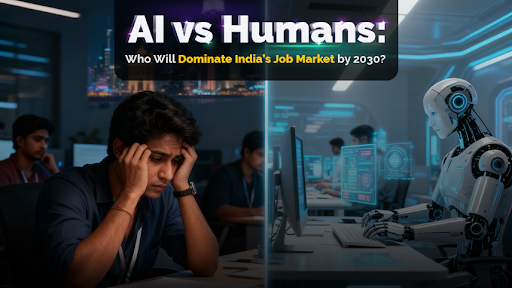
AI vs Humans: Who Will Dominate India’s Job Market by 2030?
If you look around, it feels like India is standing at a turning point. Everywhere you go, people talk about automation, artificial intelligence, job losses, new skills, and a future that seems exciting but also a little scary. The question keeps coming up in every office, every startup, and every business meeting: Will AI replace humans by 2030? Or will humans find a way to grow even faster with AI?
The truth is more layered than it appears, and as you read ahead, you will feel the same suspense that every entrepreneur, professional, and business owner in India is feeling right now.
A Rapid Shift Already Happening Around Us
Think about your last customer support call. There is a high chance you spoke to a chatbot first. According to Nasscom, almost 30% of customer service interactions in India are now handled by AI, and this number is growing every quarter. Walk into any bank, and you will see AI checking documents, spotting fraud patterns, and approving loans faster than a human ever could.
But even with this major shift, something interesting is happening at the same time. Companies are not removing people outright. Instead, they are reshuffling roles. A bank officer now spends less time checking papers and more time solving real problems that AI cannot understand. This is where the story takes its first turn.
Why India’s Job Market Is Not Like Any Other Country
India has something most nations don’t, a young workforce. By 2030, India will have over 1 billion working-age people, the largest in the world. This changes everything. In a country where so many people enter the job market every year, AI becomes less of a threat and more of a tool that can help balance skill shortages.
For example, India needs 30 lakh cybersecurity professionals by 2027, but we have barely one-fourth of that number ready today. Even if AI becomes smarter, it cannot fill these roles alone. Human intelligence, instinct, and ethical judgment still rule these fields.
AI Is Growing Fast, But So Are Human Skills
We may feel nervous about AI because it keeps improving at lightning speed. In just three years, AI tools have started writing emails, drafting legal documents, creating ads, analysing medical scans, and doing tasks that once required hours of human effort.
But here’s the twist. As AI rises, new human roles rise even faster. A report by TeamLease states that India will see 69% new job roles by 2030 that do not even exist today. These will be roles where humans understand technology but also bring emotional intelligence, creativity, and leadership, qualities AI cannot copy.
If you think about it, five years ago no one imagined jobs like AI trainer, prompt engineer, drone operator, or digital twin architect. Yet today, these roles are booming.
The Real Battle: Routine vs Creative Work
The real fight is not between humans and AI. It is between routine work and creative work. When you look closely, you see that AI beats humans in tasks that repeat every day. It can process data, fill forms, answer common questions, and detect patterns at a speed humans can never match.
But when tasks require imagination, strategy, trust, or relationship building, AI falls behind. A shop owner in Jaipur cannot depend on AI to convince a customer to return. A manager in Bengaluru cannot rely on AI to resolve a team conflict. A doctor in Mumbai cannot let AI make the final call during a complicated surgery.
People trust people, not machines, especially in a country like India where emotions, empathy, and human connection drive business.
Industries Where AI Will Lead by 2030
There are fields where AI will become the dominant force in India. Sectors like logistics, data analytics, banking automation, and manufacturing will rely heavily on AI. A factory in Gujarat recently reported that AI-based predictive maintenance reduced machine downtime by almost 25%, saving lakhs every month. These numbers show the power of AI in industries that depend on precision.
Yet even in such sectors, humans still remain the decision-makers. AI can guide, but people decide. AI can calculate, but people build.
Industries Where Humans Will Always Win
Fields where emotional intelligence matters will always belong to humans. Teaching, management, sales, branding, leadership, consulting, hospitality, and creative industries rely on trust and connection. No matter how advanced AI becomes, businesses will look for humans to lead teams, shape culture, solve conflicts, and build long-term relationships.
In fact, the Indian startup ecosystem is the best example of this. India added over 100 unicorns without AI playing the lead role. These companies grew because of human ideas, human leadership, and human risk-taking abilities.
Read More: AI-Driven Marketing in India
AI + Human: The Real Winning Formula for India
If you think about the future honestly, it is not a fight at all. It is a partnership. AI does the heavy and boring work. Humans do the emotional and strategic work. Together, they create a powerful combination. A small business owner in Indore who uses AI for inventory, finance, customer follow-ups, and marketing will always grow faster than someone who avoids technology.
The smart entrepreneurs in India are not fearing AI. They are learning to use it. And that single skill will define who wins the job market by 2030.
What India Needs to Prepare For the Future
The biggest shift that India needs to make is in its mindset. Jobs will not disappear. They will transform. Skills will not vanish. They will evolve. A student who learns basic AI tools today can stand ahead of the crowd tomorrow. A manager who understands AI analytics can make better decisions. A business owner who embraces automation can save time, money, and stress.
The world is moving faster than ever, and India cannot afford to stand still. The next few years will decide who adapts and who gets left behind.
Conclusion: Who Will Dominate India’s Job Market, AI or Humans?
The answer is simple once you see the full picture. AI will dominate tasks. Humans will dominate roles. AI will take over speed. Humans will take over strategy. AI will control data. Humans will control decisions.
By 2030, India’s job market will not belong to AI alone. It will belong to Indians who learn how to use AI to become faster, smarter, and more productive. The real winners will be those who treat AI as a partner, not a threat.
The future is not machines replacing people. The future is people who know how to use machines rising higher than ever before.
- ai automation


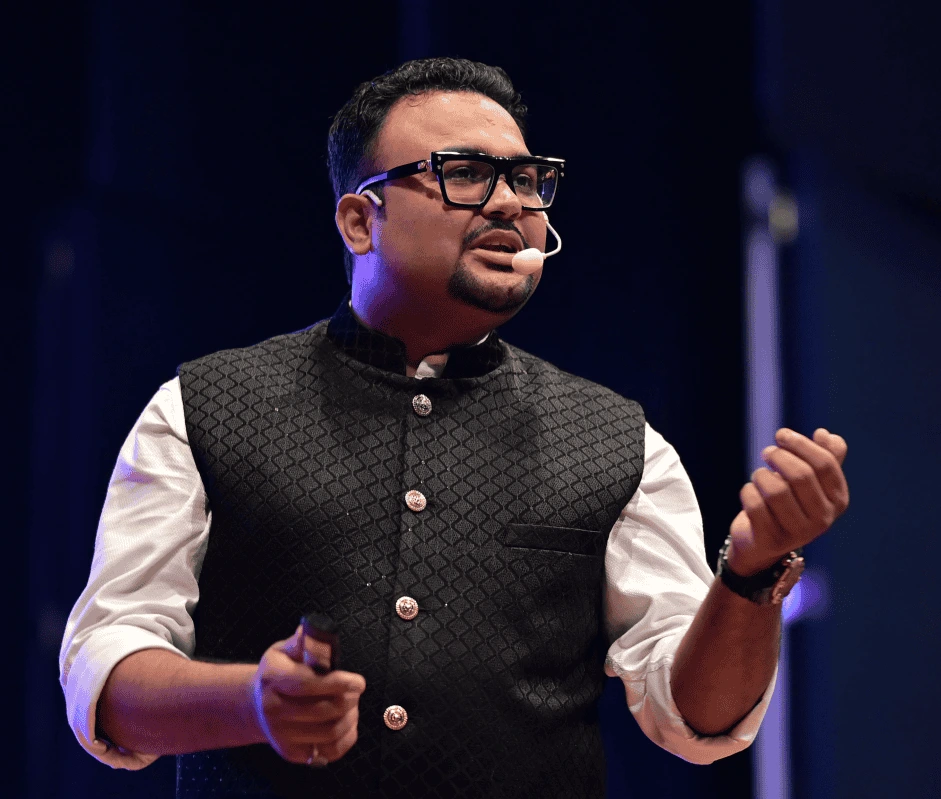
Rahul Malodia is a leading business coach in India, a Chartered Accountant, and the creator of the transformational Vyapari to CEO (V2C) program. With a mission to empower MSMEs, he has trained over entrepreneurs to systemize operations, manage working capital, and scale their businesses profitably.
Known for transforming traditional business owners into confident CEOs, Rahul delivers India’s top business coaching programs through bootcamps, workshops, and online courses. His practical strategies and deep industry insights have made him a trusted name among entrepreneurs seeking sustainable and scalable growth.
