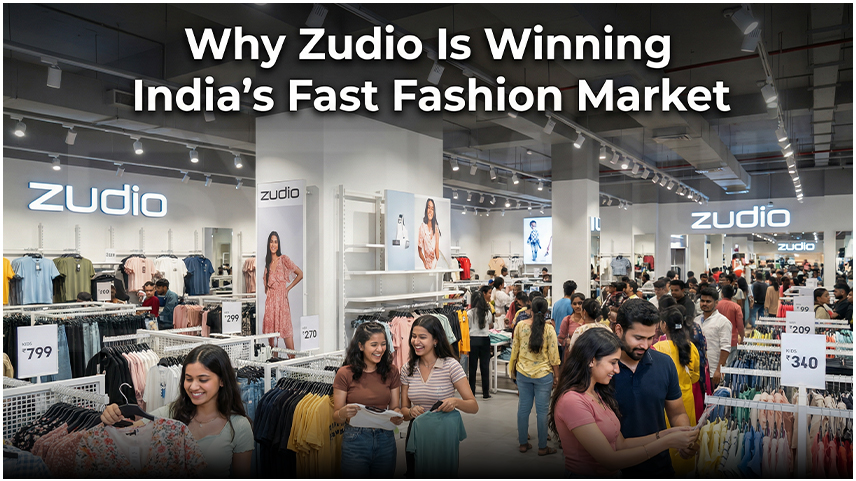
Why Zudio Is Winning India’s Fast Fashion Market (2025 Case Study)
Zudio is not winning because it understands fashion better than everyone else.
It is winning because it understands Indian buying behavior better than most modern retailers.
That distinction matters.
Fashion taste changes fast. Buying behavior doesn’t. Zudio built its entire model around the second truth.
This is not a branding story.
This is a case study in execution discipline.
For anyone asking what Zudio is, what’s Zudio, or zudio kya hai, Zudio is a value-fashion retail brand operating across India, designed for mass affordability and repeat purchase behavior.
This is not a promotional article. This is a breakdown of why Zudio’s model works in the Indian retail landscape.
Quick Facts & Verified Snapshot (Zudio Information)
Ownership
- Brand: Zudio
- Parent Company: Trent Ltd. (Tata Group)
- Is Zudio owned by Tata/Is Zudio a Tata brand?: Yes
- Zudio owner / Zudio brand owner: Trent Ltd.
- Zudio, which country brand: India
Business Model
- Business model: Company-owned, offline-first fast fashion retail
- Channel Mix: ~100% offline retail
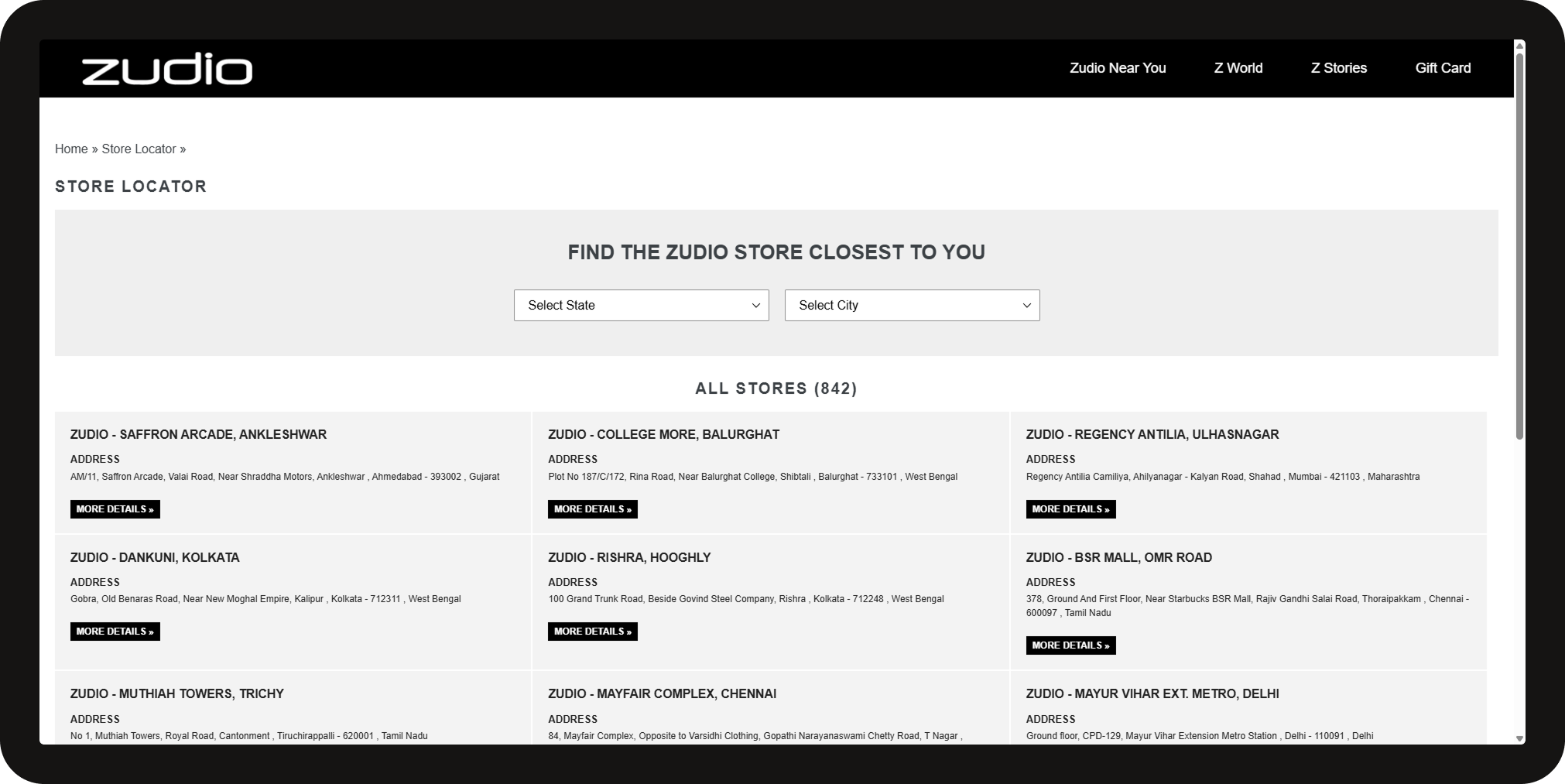
- Zudio does not sell products online; its website only shows a limited catalogue and store locations.
Scale & Footprint
- Number of Zudio stores in India (FY 2024–25): 842+ stores across India( estimates)
- City presence: ~235 Indian cities
- Core price band: ₹199–₹999
Zudio stores span Tier-2 and Tier-3 cities including Zudio Cuttack, Zudio Ambikapur, Zudio Burdwan, Zudio Moradabad, Zudio Vijayawada, and Zudio Aurangabad, which explains why “Zudio near me” is one of the most searched queries.
What Zudio Actually Is (Not the Hype Version)
Zudio is often described as a fast fashion brand.
That description is incomplete.
Zudio is a cost-engineered retail system designed to monetize mass aspiration at scale.
It is not built to signal lifestyle status.It is built to remove friction from everyday fashion buying.
This is why confusion exists around is Zudio a brand or store, is Zudio a brand or not, or is Zudio a brand.
Zudio is a full-fledged fashion brand operating through company-owned retail stores.
This is not a viral brand.It is a repeat-purchase machine.
Most narratives focus on low prices.
The real positioning is predictability.
Customers know exactly what they will get every time they enter a Zudio store.
That certainty is the product.
Zudio Meaning: What the Brand Actually Stands For
There is no literal dictionary explanation for Zudio meaning in English.
For people searching zudio means, meaning of Zudio, or zudio full form, the brand represents simplicity, accessibility, and everyday fashion that doesn’t demand decision fatigue.
Zudio means predictable value.
That clarity is rare in Indian fashion retail.
The Real Reason Zudio Scaled So Fast
Zudio did not scale because of advertising, celebrity endorsements, or trend-chasing.
It scaled because it eliminated three cost centers most fashion brands treat as unavoidable.
Digital acquisition costs.
Logistics complexity.
Discount-led demand creation.
Zudio online was deliberately avoided.
For a value brand, e-commerce introduces cost volatility, return losses, and margin unpredictability.
By designing the business backwards from affordability instead of branding, Zudio unlocked volume-led growth with margin control.
The real reason this worked was discipline, not creativity.
This is the real Zudio success story, not what appears in short Zudio Wikipedia summaries.
Core Growth Lever 1: Expansion Model Built for Density, Not Glamour
Zudio expanded where footfall already existed.
Instead of chasing premium malls and high-rent districts, it targeted dense residential and mixed-use zones in non-metro cities.
Lower rentals reduced pressure on per-store performance.
High population density ensured predictable daily traffic.
Most businesses expand for visibility.
Zudio expanded for reliability.
This is classic Tata clothing store thinking, risk-managed scale over brand vanity.
Core Growth Lever 2: Pricing Logic That Encourages Basket Expansion
Below is a simplified pricing and basket-behaviour table illustrating how Zudio’s pricing logic drives volume.
Zudio vs Mid-Market Brands — Pricing & Basket Behavior (2025)
| Metric | Zudio (Approx.) | Typical Mid-Market Fashion Brand |
|---|---|---|
| Average T-shirt Price | ₹299–₹399 | ₹699–₹999 |
| Average Basket Size (Items/Visit) | 3–4 items | 1–2 items |
| Average Ticket Size | ₹900–₹1,200 | ₹1,200–₹1,800 |
| Discount Dependency | Low | High |
| Repeat Purchase Frequency | High | Medium |
Zudio’s pricing is not designed to look cheap. It is designed to feel sensible.
Products are priced low enough that customers stop calculating trade-offs.
This encourages multi-item purchases without promotional pressure.
Most fashion retailers discount to attract attention. Zudio prices to trigger repeat behavior.
This is where most businesses miss the point. Revenue stability comes from habit, not excitement.
Core Growth Lever 3: Offline-Only Channel Strategy
Zudio’s refusal to go online is often misunderstood as conservatism.
In reality, it is structural clarity.
Offline retail allows instant gratification, zero returns, controlled inventory flow, and predictable margins.
This decision alone explains much of the profitability discipline under the Zudio brand owner, Trent Ltd.
This is the REAL reason why small apparel brands fail to compete with Zudio.
Competitive Reality Check: Zudio vs Other Fast Fashion Players
Below is a simplified comparison table to understand the structural difference between Zudio and other major fast fashion players in India (approximate figures based on industry estimates).
To understand Zudio’s dominance, compare it structurally with key competitors.
Zudio operates at a price band where average t-shirts sell between ₹299–₹399. H&M’s comparable products typically start around ₹799–₹999. Max Fashion sits between ₹499–₹799, while Pantaloons averages ₹699–₹1,499.
In terms of city strategy, over 60% of Zudio’s stores are located in Tier-2 and Tier-3 cities. H&M remains heavily metro-focused, with more than 85% of its stores concentrated in Tier-1 cities. Max and Pantaloons have wider reach but still maintain a metro-heavy revenue mix.
Channel strategy is another sharp divider. Zudio generates nearly 100% of its sales offline. H&M derives an estimated 20–25% of India revenue from online channels. Pantaloons and Max depend on omnichannel discounting cycles to drive volume.
Cost structure is where the real gap emerges. Zudio avoids digital marketing spends that typically account for 8–12% of revenue for fashion brands. It also avoids return logistics costs, which can erode 5–7% of margins in online-led models.
Structural Differences Across Fast Fashion Business Models
Zudio vs H&M vs Max vs Pantaloons — Operating Model Comparison (2025)
| Metric | Zudio | H&M India | Max Fashion | Pantaloons |
|---|---|---|---|---|
| Core Price Band (T-shirts) | ₹299–₹399 | ₹799–₹999 | ₹499–₹799 | ₹699–₹1,499 |
| Primary City Focus | Tier-2 & Tier-3 (60–65%) | Tier-1 (85%+) | Mixed, metro-heavy | Metro & Tier-1 biased |
| Store Model | Company-owned | Franchise + COCO | COCO | COCO |
| Channel Mix | ~100% Offline | ~75–80% Offline | ~65–70% Offline | ~60–65% Offline |
| Online Revenue Share | 0% | ~20–25% | ~30–35% | ~35–40% |
| Avg. Marketing Spend (% of Revenue) | <2% | 8–12% | 6–8% | 7–10% |
| Return & Reverse Logistics Cost | Nil | 5–7% margin erosion | 4–6% | 5–7% |
| Speed of Store Expansion | 150–200 stores/year | <20 stores/year | 40–60 stores/year | 30–50 stores/year |
| Structural Advantage | Lowest cost base | Brand aspiration | Category width | Fashion variety |
| Structural Advantage | Lowest cost base | Brand aspiration | Category width | Fashion variety |
Operating Expense (OPEX) Breakdown: Zudio vs Other Fashion Retailers (2025)
Zudio keeps its operating costs sharply lower than H&M, Max, and Pantaloons by avoiding online returns, expensive digital acquisition, and high-rent metro stores. This lean model lets the brand stay profitable even at ultra-low price points.
| Brand | Rent | Staff/Employee | Marketing | Store Ops | Total OPEX (Approx) |
| Zudio | 6–8% | 4–6% | 1–2% | 4–5% | 15–20% (estimated) |
| Pantaloons | 10–12% | 6–8% | 3–4% | 6–7% | 25–30% (estimated) |
| H&M India | 10–14% | 6–8% | 2–4% | 5–7% | 24–32% (estimated) |
| Zara (Inditex) | 18–22% | 8–10% | 3–5% | 7–9% | 36–46% (estimated) |
Why This Model Works in Smaller Indian Cities
The table below explains why Tier-2 and Tier-3 cities structurally favor Zudio’s model.
Why Zudio Works Better in Tier-2 & Tier-3 Markets (2025)
| Factor | Tier-1 Cities | Tier-2 & Tier-3 Cities |
|---|---|---|
| Average Retail Rent (Relative) | High | 30–50% lower |
| Fashion Brand Saturation | Very High | Low to Medium |
| Consumer Price Sensitivity | Medium | High |
| Brand Loyalty Formation | Low | High |
| Payback Period per Store | Longer | Shorter |
Tier-2 and Tier-3 India have aspirations without saturation.
Consumers want variety, freshness, and affordability, but have limited access to global brands.
Operating costs are lower.
Brand loyalty forms faster.
Competition is fragmented.
Most national retailers ignored these markets because they looked small individually. Zudio treated them as a network.
That aggregation mindset changed everything. This is why searches like Zudio near me convert so well.
What Most Articles Miss About Zudio’s Success
Most coverage focuses on store count and pricing.
What is ignored is execution consistency.
Zudio does not rely on hero products.
It does not chase viral fashion moments.
It optimizes for operational sameness across hundreds of locations.
Perception says fast fashion is about speed.
Reality says it is about control.
This is where many founders misread the model.
Limitations and Weaknesses
A balanced view requires looking at constraints numerically.
Zudio’s Key Operational Limitations (2025)
| Risk Area | Zudio Impact |
|---|---|
| Raw Material Inflation | Direct margin pressure due to low pricing buffer |
| Fashion Misses at Scale | Inventory risk across 700+ stores |
| Offline-Only Model | Misses 20–30% online-first urban shoppers |
| Rapid Expansion | Execution quality risk if store standards slip |
| Limited SKU Depth | Predictability can turn into fashion fatigue |
| High Inventory Turnover Dependency | Any supply-chain delay impacts freshness |
| Low Gross Margin Structure | Leaves little room for error vs premium brands |
Zudio’s offline-only strategy limits digital reach among urban-first consumers.
Over-dependence on price sensitivity exposes the brand to raw material inflation.
Fashion risk still exists. Poor trend judgment at scale can impact inventory health.
Rapid expansion increases execution risk if operational discipline slips.
Acknowledging these constraints is critical to evaluating sustainability.
Key Lessons for Indian Business Owners
Design pricing as a behavior-shaping tool, not a promotional tactic.
Expand into markets where cost structures protect downside risk.
Remove operational complexity before chasing growth narratives.
Build systems that reward repeat usage, not one-time attention.
Zudio’s playbook is replicable only with discipline, not shortcuts.
Future Outlook
Zudio’s future will be determined by execution metrics, not hype.
| Metric to Watch | Why It Matters |
|---|---|
| Cost Inflation vs Price Control | Determines margin sustainability |
| Store Productivity (Revenue/Store) | Indicates scalability quality |
| Inventory Turnover Ratio | Measures fashion execution discipline |
| International Store Performance | Tests model transferability |
| Supply Chain Lead Time | Controls freshness without overstock |
Growth is possible, but only if simplicity is preserved.
Final Takeaway
Zudio didn’t win by making trendier clothes.
It won by engineering a buying system around simplicity, predictability, and value.
In Indian retail, the brands that control execution — not perception — dominate.
Zudio proved that consumers don’t buy fashion; they buy certainty at the right price.
Note: All data is based on publicly available industry reports, Trent Ltd. earnings calls, and benchmark retail estimates.
FAQ’s
1. Why is Zudio cheaper than other fashion brands?
Zudio operates on a low-cost retail model with minimal marketing, no e-commerce overhead, and high store density in low-rent zones. This allows the brand to maintain low OPEX and offer products at ₹199–₹999 without sacrificing margins.
2. Does Zudio plan to launch an online shopping website?
As of now, Zudio has no official online store. The brand avoids e-commerce due to high return rates, reverse logistics costs, and margin instability. Its model is optimized entirely for offline retail profitability.
3. Which cities does Zudio target for expansion?
Zudio focuses primarily on Tier-2 and Tier-3 cities where rents are lower, competition is limited, and customer price sensitivity is higher. This gives the brand faster store payback compared to metro-heavy retailers.
4. Is Zudio better than H&M or Max Fashion for value shoppers?
For value-focused buyers, Zudio offers lower entry-level pricing and higher repeat-purchase convenience. H&M targets aspirational urban consumers, while Max offers mid-segment pricing. Zudio wins in affordability and predictability.
5. How does Zudio maintain fresh fashion despite low prices?
Zudio follows a controlled inventory cycle with frequent small-batch replenishment. This keeps styles fresh without depending on trend-chasing or high-volume seasonal launches like other fast-fashion players.
6. What is the main reason behind Zudio’s rapid store growth?
The combination of low-risk locations, disciplined execution, and a simple product strategy enables Trent Ltd. to scale 150–200 Zudio stores annually with predictable ROI and stable margins.
- Business case study
- Market Analysis
- Business Ideas
- Investment Ideas
- Businessman


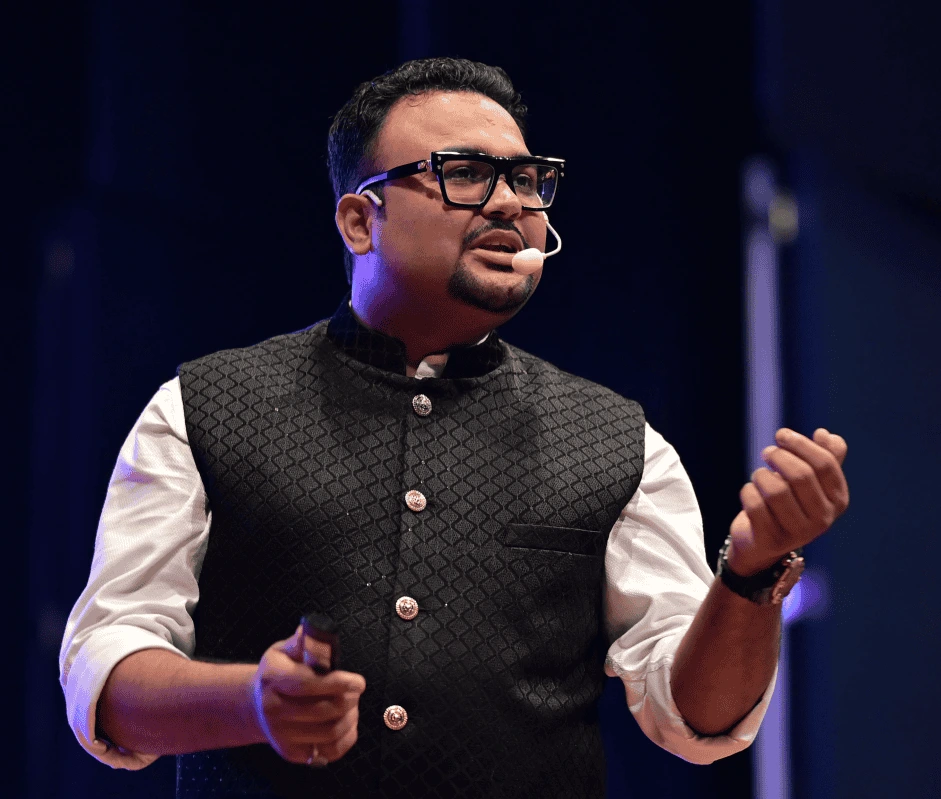
Rahul Malodia is a leading business coach in India, a Chartered Accountant, and the creator of the transformational Vyapari to CEO (V2C) program. With a mission to empower MSMEs, he has trained over entrepreneurs to systemize operations, manage working capital, and scale their businesses profitably.
Known for transforming traditional business owners into confident CEOs, Rahul delivers India’s top business coaching programs through bootcamps, workshops, and online courses. His practical strategies and deep industry insights have made him a trusted name among entrepreneurs seeking sustainable and scalable growth.
