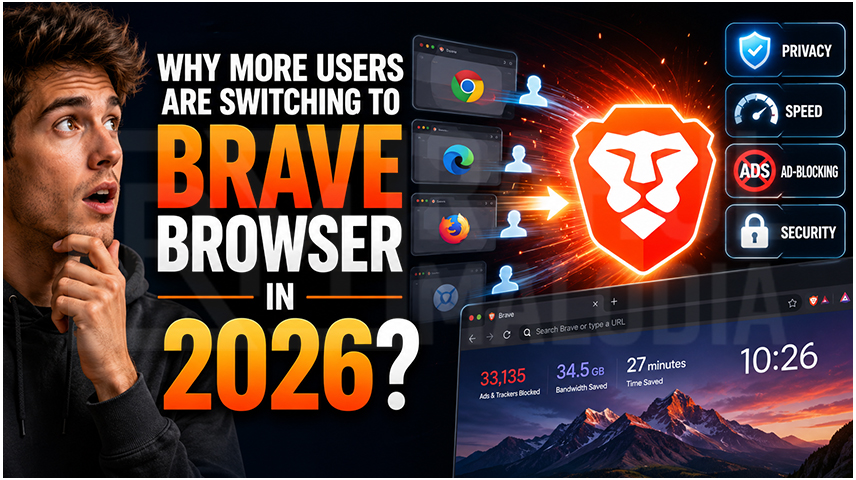
Why More Users Are Switching to Brave Browser in 2026
Over 100 million people have already made the switch. Here's what's really driving the Brave browser revolution, and why it matters more for Indian entrepreneurs than anyone else.
Think about the last time you opened a news website on your phone. Before you could read a single line, three banner ads loaded, a cookie consent pop-up appeared, a video started playing automatically, and somehow your phone battery dropped two percent. That wasn't bad luck. That was Chrome, and every traditional browser, working exactly as designed.
Now imagine none of that happened. The page just loaded. Instantly. No ads, no trackers, no interruptions.
That's what 100 million people worldwide discovered in 2025. And in 2026, the number keeps climbing, quietly, steadily, and for very good reason.
The Browser You Never Thought to Question
Most of us have been using Google Chrome since it launched in 2008. For over a decade, it was the obvious choice: fast, familiar, and free. Nobody asked what 'free' actually meant.
It meant your data. Chrome collects your browsing history, your search habits, your location, and your ad-click behaviour, and sends it all back to Google's advertising engine. In exchange for a free browser, you became the product being sold.
For most people, this was an invisible transaction. You didn't see the data leaving. You didn't see the profiles being built. You just browsed the internet and occasionally noticed that the running shoes you searched for yesterday are now following you across every website you visit today.
That creeping sense of being watched, that's not paranoia. That's third-party tracking working as intended. And in 2026, a growing number of users have simply decided they've had enough.
What Is Brave, And Why Is It Different?
Brave is a privacy-first web browser built on Chromium, the same open-source engine that powers Chrome. This matters because it means all your Chrome extensions work on Brave too. The learning curve is nearly zero. You switch, and everything feels familiar. The difference is what Brave does with your data: absolutely nothing.
Brave was founded in 2016 by Brendan Eich, the same man who created JavaScript and co-founded Mozilla Firefox. He knew the browser industry from the inside, and he built Brave to fix what he saw as its fundamental flaw: the surveillance economy baked into every click.
By default, Brave blocks all third-party ads, all tracking scripts, all cross-site cookies, and all fingerprinting attempts. It doesn't ask you to configure anything. It doesn't require extensions. It works this way the moment you install it.
Brave Browser, Key Numbers at a Glance (2025)
| 100M+ | 42M | 19B+ | 21% |
Monthly Active Users (Sep 2025) | Daily Active Users | Brave Search Queries /Year | Faster page loads vs Chrome on Android |
Brave crossed 100 million monthly active users in September 2025, a milestone that took Chrome years longer to achieve when it launched. The browser also clocked 42 million daily active users, and its own search engine processed over 1.66 billion queries in September alone. These are not niche numbers. This is a genuine mass movement toward privacy-first browsing.
The Speed Nobody Talks About
Here's what surprises most people who switch to Brave: it's noticeably faster. Not marginally faster. Meaningfully faster, especially on mobile, where most Indians do the majority of their browsing.
The reason is simple engineering. When you load a webpage on Chrome, your browser doesn't just load the article or the product page you wanted. It also loads dozens of advertising scripts, analytics trackers, social media pixels, and retargeting tags. Each one takes time. Each one consumes data. Each one drains your battery.
Brave blocks all of that before it ever loads. The result is pages that render faster, data plans that stretch further, and phones that last longer between charges.
Browser Performance, Android, Ad-Heavy Pages (2025 Benchmarks)
| Browser | Relative Speed | vs Brave | Battery vs Brave |
|---|---|---|---|
| Brave | Fastest (baseline) | — | Best (baseline) |
| Chrome | −21% slower | Significantly slower on ad-heavy pages | ~3.9% higher drain |
| Firefox | −29% slower | Slowest in ad-heavy tests | Moderate |
| Edge | −24% slower | Slower than Brave | Moderate |
Independent benchmarks published in 2025–2026 consistently show Brave delivering faster page loads on ad-heavy sites, often 21% quicker than Chrome on Android. Battery consumption is around 3.9% lower than Chrome, Edge, and Firefox on average. For someone browsing all day on a mid-range Android device, the norm across tier-2 and tier-3 Indian cities, that difference is felt, not just measured.
India's New Privacy Awakening
India passed the Digital Personal Data Protection Act in 2023, and the DPDP Rules of 2025 operationalized it, creating a real legal framework for how companies must handle Indian citizens' personal data. For the first time, data breaches must be reported, consent must be explicit, and users have the right to know what data is being collected about them.
This isn't just a legal formality. It's a signal of a cultural shift. Indian professionals, entrepreneurs, and decision-makers are waking up to the fact that their browsing behaviour, their business research, their competitor analysis, and their financial queries are all being harvested by browser companies and monetized.
For an MSME owner in Pune who researches vendors online, for a startup founder in Bengaluru who scouts funding news, for a CA in Ahmedabad who looks up tax circulars, their browsing data is a detailed map of their business thinking. Brave simply doesn't share that map with anyone.
"In a country of 800 million internet users, the browser you use isn't a small choice. It's the front door to your entire digital life."
How Brave Stacks Up Against the Competition
Switching browsers is a real commitment, so the comparison matters. Brave doesn't operate in isolation; it competes directly against Chrome, Firefox, Microsoft Edge, and Opera. Here's how the key dimensions play out honestly, without marketing spin.
| Feature | Brave | Chrome | Firefox | Edge |
|---|---|---|---|---|
| Default Ad Blocking | Built-in, always on | None | Partial (Enhanced mode) | Basic only |
| Tracker Blocking | All by default | Collects user data | Yes, with configuration | Limited |
| Mobile Battery Use | Lowest tested | High | Moderate | Moderate |
| Chrome Extensions | Full support | Full support | Limited parity | Supported |
| Built-in Tor Mode | Yes | No | No | No |
Chrome remains the dominant browser globally with over 65% market share, and that scale gives it an undeniable distribution advantage. But dominance doesn't mean it's the best choice for privacy-conscious users. Google reversed its plan to phase out third-party cookies in July 2024 and confirmed in April 2025 that they'll remain enabled by default in Chrome, meaning Chrome's privacy story hasn't improved. Brave has blocked those same cookies since 2016.
Firefox is a legitimate alternative with a strong open-source ethos, but it requires manual configuration to match Brave's out-of-the-box privacy protections. For busy Indian entrepreneurs who don't want to spend an afternoon configuring privacy extensions, Brave is the simpler, stronger choice from day one.
The BAT Rewards Model, Get Paid to Browse
Here's the part of Brave that surprises most people: it pays you. Not metaphorically. Actual cryptocurrency, deposited into a digital wallet, for your time and attention.
Brave's Basic Attention Token (BAT) system lets users opt into privacy-respecting ads, ads that don't track you across the web, and don't share your data with advertisers. If you choose to see these ads, you receive 70% of the revenue generated. Advertisers pay Brave; Brave pays you.
The BAT token is an Ethereum-based cryptocurrency. As of mid-2025, BAT had a market capitalization of approximately $201 million. You can hold earned BAT, use it to tip content creators you support, or exchange it for other currencies. It's a genuine rethinking of the advertising model, one where the user is compensated instead of exploited.
For Indian users, the BAT rewards aren't a life-changing income. But the principle matters enormously: your attention has value, and you should be the one who decides who benefits from it.
Why Entrepreneurs and Business Owners Specifically Should Care
If you run a business, your browsing history is your business intelligence. Every time you research a competitor, study a new market, look up a regulation, or evaluate a vendor, you are generating a detailed portrait of your strategic thinking. On Chrome, that portrait flows directly to Google's advertising and data systems.
Consider a startup founder doing due diligence on a potential acquisition target. Every search, every news article read, every company profile visited, on a tracking browser, this research is visible to the advertising ecosystem. A competitor running better-targeted ads could, in theory, infer what you're working on. That's not paranoia; that's how behavioural advertising data flows.
Brave's Shields feature blocks fingerprinting, the technique websites use to identify your device, even in private/incognito mode. This isn't just about ads. It's about competitive intelligence staying competitive, not leaking into the broader data ecosystem without your knowledge or consent.
There's also the team dimension. A company of 50 people all browsing on Chrome is generating 50 streams of behavioural data, all flowing to the same advertising system that your competitors also use to target their messaging. Switching the team to Brave costs nothing and closes that leak immediately.
The Numbers Behind the Switch
The growth trajectory of Brave is one of the more striking stories in consumer technology right now. The browser averaged approximately 2.5 million new users every single month over the past two years. That's not viral-app growth, it's steady, conviction-driven adoption by people who actively chose to change something in their digital life.
| Period | Monthly Active Users | Daily Active Users | Notes |
|---|---|---|---|
| Dec 2021 | 50 Million | 15 Million | First 50M milestone |
| Apr 2023 | 57 Million | ~19 Million | Steady MoM growth (~7%) |
| May 2024 | 78.9 Million | 28.6 Million | +7.3% MoM |
| Jun 2025 | 91.5 Million | ~38 Million | Steady acceleration |
| Sep 2025 | 100+ Million | 42 Million | 100M milestone crossed |
On mobile alone, the Brave app crossed 100 million all-time downloads. In January 2025, iPhone users downloaded Brave over 800,000 times in a single month. The Android version saw over 2 million installs in the same period. These are numbers that reflect real switching behaviour, not casual curiosity.
Brave's AI Layer, Leo, and What It Means
In 2025–2026, browsers are no longer just windows to the web. They're becoming AI workspaces. And Brave has entered this race with Leo, its built-in AI assistant that works directly inside the browser, without sending your conversations or browsing context to external servers.
The contrast with Chrome's AI integrations is meaningful. Google's AI features are deeply connected to its data infrastructure, meaning using AI assistance on Chrome is, by design, feeding more behavioural data into Google's ecosystem. Brave's Leo processes queries locally where possible, stores nothing on its servers, and allows users to bring their own AI model (BYOM) if they want more control.
For Indian professionals dealing with sensitive client data, financial documents, or legal information, the distinction between an AI that learns from your queries and one that forgets them immediately is not trivial. It could eventually be a compliance question under India's DPDP framework.
Is Brave Perfect? The Honest Assessment
Brave is not flawless, and fairness demands saying so. Its global browser market share sits around 1–1.5%, significant in absolute numbers but modest against Chrome's commanding 65%+ dominance. Enterprise adoption is still limited because Brave lacks the deep integration with Microsoft 365 and Google Workspace that IT teams at larger companies rely on.
The BAT rewards model, while innovative, remains niche. The average user earns modest amounts, and the cryptocurrency dimension adds complexity that's unnecessary for users who simply want a fast, private browser. The rewards are optional, but their presence can confuse people about what Brave fundamentally is.
There's also the question of Brave's revenue sustainability. A company of 175 employees serving 100 million users runs a lean operation, and long-term investment in browser security, AI integration, and mobile performance will require growing its ad revenue from the BAT ecosystem. This isn't a crisis, but it's a real strategic challenge that the company openly acknowledges.
None of this changes the core value proposition. For privacy, speed, and data control, especially for mobile-first Indian users, Brave remains the most capable out-of-the-box alternative to Chrome available today.
Making the Switch: What Actually Changes
The practical barrier to switching is lower than most people expect. Because Brave is built on Chromium, it imports your Chrome bookmarks, saved passwords, browsing history, and extensions in a few clicks through a built-in import tool. The interface looks nearly identical to Chrome. You will not spend an afternoon reconfiguring your digital life.
What changes immediately is the browsing experience. Pages load faster, especially on ad-heavy Indian news portals and e-commerce sites. The battery on your phone lasts longer through a workday. And the quiet, persistent awareness of being tracked disappears because the tracking stops.
For entrepreneurs and professionals who handle sensitive business research, client communications, or competitive analysis through their browser, the switch is less about technology and more about a simple question: whose interests should your browser serve, yours or the advertising industry's?
In 2026, 100 million people have already decided. The answer, it turns out, is obvious once you ask it clearly.
- Market Analysis



Rahul Malodia is a leading business coach in India, a Chartered Accountant, and the creator of the transformational Vyapari to CEO (V2C) program. With a mission to empower MSMEs, he has trained over 5,00,000+ entrepreneurs to systemize operations, manage working capital, and scale their businesses profitably.
Known for transforming traditional business owners into confident CEOs, Rahul delivers India’s top business coaching programs through bootcamps, workshops, and online courses. His practical strategies and deep industry insights have made him a trusted name among entrepreneurs seeking sustainable and scalable growth.
