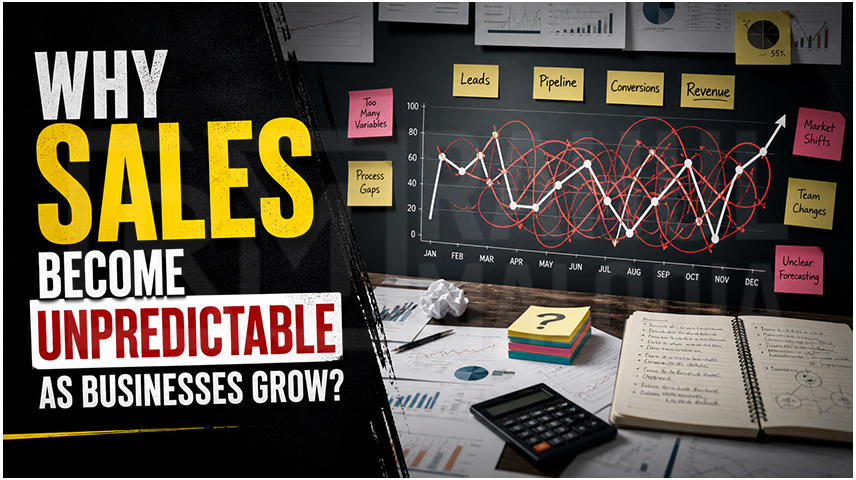
Why Sales Become Unpredictable as Businesses Grow?
The day the numbers stopped making sense
Picture this. You run a ₹3 crore business. Last year was clean, you knew roughly what would come in each month. You had regulars, a handful of reliable channels, and a gut feel that rarely lied to you. Then you crossed a threshold. More staff, new geographies, a larger catalogue. And suddenly, the same gut feel started betraying you.
This is one of the most disorienting moments in a founder's journey. Revenue starts swinging wildly. A quarter looks great, and the next one doesn't. The pipeline feels full, but closures are unpredictable. According to a 2025 CRISIL SME survey, nearly 63% of Indian MSME founders reported that revenue predictability dropped significantly after they crossed ₹1 crore in annual turnover. That number feels personal when you've lived it.
The question isn't whether this will happen to you. The question is whether you understand why.
Growth isn't linear, and neither is your sales engine
Here's what most people miss. When you're small, sales is a direct activity. You're the salesperson, the decision-maker, and the relationship manager all at once. There's almost no lag between effort and outcome. You send a proposal, you follow up, you close. Simple physics.
As you grow, sales become a system. And systems have friction, dependencies, lag, and complexity. According to McKinsey's 2024 B2B pulse report, companies that scale revenue beyond $2 million annually face an average 3x increase in sales cycle length within 18 months. In India, where relationship selling still dominates, this lag is even more pronounced.
63% Indian MSMEs report revenue unpredictability after ₹1Cr turnover (CRISIL 2025)
3x Increase in average sales cycle length when scaling past $2M (McKinsey 2024)
42%Indian startups cite inconsistent lead quality as top growth challenge (Inc42 2025)
You outgrow your original customers, quietly
Your first customers found you when you were scrappy, affordable, and deeply attentive. You knew their names. They knew yours. They didn't compare you to anyone else because you were exactly what they needed.
But as you grow, your cost structure changes. Your positioning shifts. Your communication becomes more formal. Without realising it, you start drifting away from the exact profile that was consistently buying from you. New customers arrive with different expectations, longer decision cycles, and more stakeholders involved. This is the silent revenue leak that most founders don't notice until it shows up in a bad quarter.
In India's MSME sector, this is especially visible in the move from founder-led sales to team-led sales. When the founder steps back, win rates typically drop by 20 to 35% in the first two quarters, according to a 2024 study by Redseer Strategy Consultants. That gap isn't luck. It's structural.
"When the founder steps back from sales, the business doesn't just lose a closer. It loses the living proof of the brand's promise."
More channels, more noise, less signal
Early on, you probably had one or two channels that worked. Maybe it was referrals. Maybe it was direct calls. You doubled down on what was working and it kept working. Clean and predictable.
Growth forces diversification. You add social media, a sales team, partnerships, WhatsApp broadcasts, e-commerce listings, and maybe an inside sales unit. Each channel brings its own rhythm, conversion rate, and customer quality. When you don't have clean attribution, meaning you can't tell which channel actually produced a sale, the entire pipeline becomes foggy.
In 2025, a Nasscom report on Indian digital SME growth found that businesses using 5 or more customer acquisition channels had 2.4 times higher customer acquisition costs than those focused on 2 to 3 well-optimised channels. More channels without discipline don't mean more sales. It means more confusion about where your sales are actually coming from.
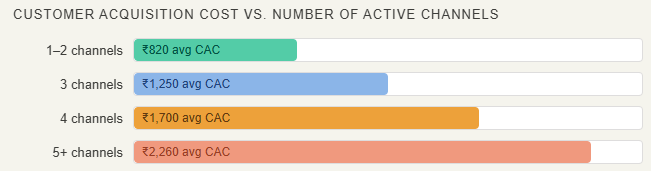
This chart isn't meant to scare you away from growing. It's meant to show you where your money starts leaking when you scale without a clear channel strategy. Focused businesses almost always outperform scattered ones in terms of growth.
Your team is selling, but not the same way you did
This is the one founders rarely want to admit. When you built the business, you weren't just selling a product. You were selling your conviction, your vision, and your personal credibility. Customers said yes to you, not just to what you were offering.
When you hand that over to a team, you're asking strangers to replicate something that took you years to develop organically. Without a structured sales playbook, clear ICP (ideal customer profile) documentation, and strong onboarding, your team will improvise. Improvisation leads to inconsistency. Inconsistency leads to unpredictable revenue.
A 2025 HubSpot India survey found that 71% of Indian SMEs had no formal sales playbook or documented process. Of those, 68% reported missing quarterly revenue targets at least twice in a year. The correlation isn't coincidental.
The dangerous comparison: predictable vs. unpredictable sales operations
When you look at businesses that maintain revenue predictability even at scale, companies like Zoho, Mamaearth in its early funded phase, or vertically focused SaaS firms like Razorpay, they share a few common traits that Indian MSMEs at the growth stage often lack.
| Area | Predictable sales businesses | Unpredictable sales businesses |
| Lead qualification | Defined ICP, scored leads, consistent intake | All leads treated equally, no scoring |
| Pipeline visibility | CRM-driven, stage-wise tracking | Founder memory or WhatsApp notes |
| Sales handoff | Documented playbooks, structured onboarding | New reps shadow and improvise |
| Channel attribution | Tagged UTMs, source tracking, ROI per channel | No attribution, gut-based budgets |
| Revenue forecasting | Rolling 90-day forecasts are reviewed weekly | Monthly gut estimates, frequent misses |
The table above reflects operational patterns observed in Indian SME growth studies and is not exhaustive, but it isolates the fault lines that matter most.
The gap isn't talent. It's systems. Businesses that build the infrastructure of predictability before they need it almost always outperform those who try to retrofit it after chaos has set in.
Seasonality and macro shocks hit harder when you're bigger
When your business was small, a bad month was painful but survivable. A single large client made up the difference. A quick hustle brought in emergency revenue. That kind of agility is harder to maintain at scale.
At ₹10 crore in revenues, a 20% drop in a quarter is a ₹50 lakh swing. At ₹50 crore, it's ₹2.5 crore. The relative percentages look the same. The absolute impact on operations, payroll, and morale does not. India's monsoon-driven consumption cycles, GST compliance pressures, and sector-specific policy changes (like the credit squeeze that hit MSMEs in 2024 Q2) all create volatility that amplifies with scale.
According to Reserve Bank of India data, Indian MSMEs experienced a 17.3% average revenue decline in Q2 2024 due to the combined effects of rising input costs and tighter credit. Larger businesses with diversified pipelines absorbed this better. Concentrated businesses with few large clients were disproportionately hit.
Over-reliance on a few clients is a time bomb
Many growing businesses carry a hidden risk that looks like a strength on the surface: a few key clients who contribute 60 to 80% of revenue. It feels stable. It feels like proof of value. It is actually one of the most fragile positions in business.
When a large client delays payment, renegotiates terms, or simply moves on, it doesn't just affect that month's numbers. It affects your ability to pay vendors, retain staff, and invest in the next growth push. India's B2B ecosystem has a particular vulnerability here because contract rigidity is low and relationship dependency is high.
| Client concentration level | Revenue risk exposure | Typical recovery time after client loss |
| Top 3 clients = 80%+ revenue | Very high | 9–18 months |
| Top 3 clients = 50–79% revenue | Moderate to high | 4–9 months |
| Top 3 clients = 30–49% revenue | Moderate | 2–4 months |
| Top 3 clients = below 30% revenue | Low to manageable | Under 2 months |
Indicative benchmarks based on SIDBI MSME pulse reports and industry interviews, 2024–2025.
This isn't just theory. Ask any founder who lost their anchor client whether they saw it coming. Most did, in retrospect. The warning signs were there. But concentration risk has a way of feeling comfortable right until it doesn't.
The metrics you tracked early no longer tell the full story
Early-stage businesses often track simple metrics: total revenue, number of orders, gross margin. These are fine when you're small. As you scale, these aggregate numbers start hiding more than they reveal.
You need to know your sales velocity, how fast deals move through your pipeline. You need cohort revenue retention. Are your customers worth more in year two than in year one? You need lead-to-close ratios by channel and by rep. Without this layer of insight, you are essentially driving a larger vehicle using a bicycle's dashboard.
India's growing CRM adoption, as Zoho CRM reported a 38% increase in Indian SME signups in 2024, reflects that founders are waking up to this reality. But adoption alone isn't the answer. Using the data thoughtfully, consistently, and to change decisions is what separates businesses that eventually stabilise from those that stay permanently reactive.
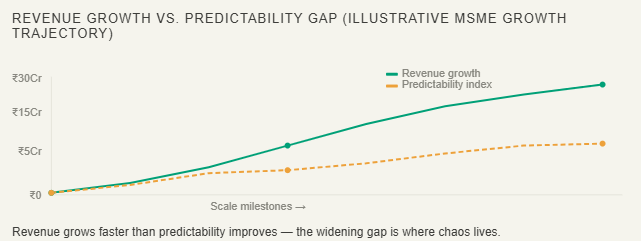
What actually drives the chaos, a clear-eyed view
If you zoom out, unpredictable sales are rarely a sales problem in isolation. It's a systems problem dressed in sales clothes. The root causes typically fall into three layers.
The first is structural: you haven't rebuilt your sales infrastructure to match your current size. The tools, the process, the team design, they're still early-stage even though the business is mid-stage. The second is cultural: founder-led intensity hasn't been successfully transferred into team behaviour. The third is informational: you're making decisions without the kind of data visibility that scale demands.
Fixing one layer without the others is like plugging one hole in a bucket with three holes. You'll see temporary improvement, but the instability will return.
The difference between businesses that stabilise and those that stay chaotic
After crossing a certain size, the businesses that regain predictability almost always do two things differently. They stop treating sales as a department and start treating it as an operating system. And they build in feedback loops, weekly revenue reviews, pipeline hygiene rituals, and customer health metrics that catch problems before they become crises.
India's most admired growth-stage companies, whether Delhivery navigating its post-listing stabilisation, or OYO rebuilding its revenue operations between 2022 and 2024, all went through a phase of deliberate systems-building after a chaotic scale-up period. The chaos wasn't the failure. The failure would have been normalising the chaos.
| Stage | Sales approach | Key risk | What stability requires |
| Under ₹1Cr | Founder-led, intuitive | Over-dependence on founder | Document what's working |
| ₹1Cr–₹10Cr | Transitional, team building | Handoff breakdown, inconsistency | Playbooks and ICP clarity |
| ₹10Cr–₹50Cr | Process-driven, multi-channel | Attribution confusion, channel sprawl | CRM discipline, channel ROI tracking |
| Above ₹50Cr | Systems-led, data-informed | Forecast errors, team misalignment | Revenue operations function |
A simplified framework for understanding how sales complexity evolves with business scale in the Indian MSME context.
Understanding which stage you're in, honestly, is the first act of leadership in fixing what's broken. Most founders are operating their sales at one stage below where their business actually is. That gap, more than any single strategic mistake, is what keeps revenue unpredictable.
“Unpredictable revenue is not a punishment for growing. It's a signal that your operating model hasn't grown at the same speed as your ambition."
The right questions to ask right now
If you're reading this and recognising your own business, the starting point isn't a new strategy. It's an honest audit. Are your top three clients contributing more than half your revenue? Do you know your average sales cycle length by channel? Does your team follow a documented process, or is each rep doing what feels right? Can you forecast next quarter's revenue within 15% accuracy?
If the answer to most of these is no or I'm not sure, then the unpredictability you're feeling isn't bad luck. It's a predictable consequence of a business that has grown faster than its infrastructure. The good news is that infrastructure can be built. It takes intention, not genius.
Sales becoming unpredictable as you grow is not a sign that something has gone wrong. It's a sign that something has changed, and your systems haven't caught up yet. The businesses that navigate this well aren't the most talented or the most funded. They're the ones that recognise the shift early, take it seriously, and treat the rebuild as the work, not a distraction from the work.
- Investment Ideas


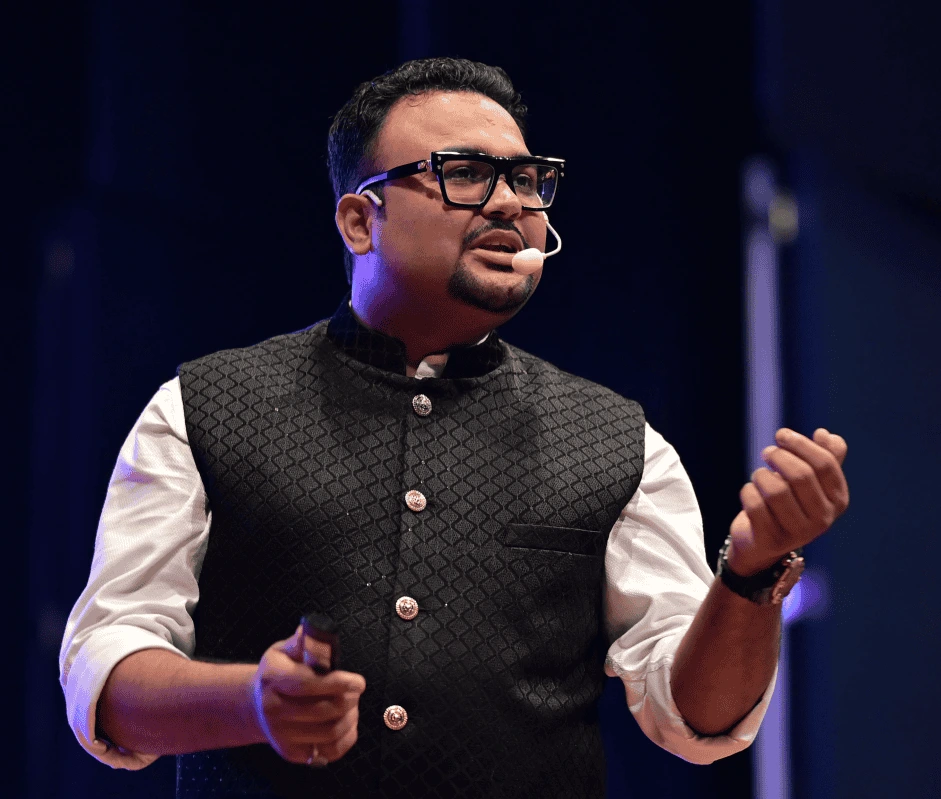
Rahul Malodia is a leading business coach in India, a Chartered Accountant, and the creator of the transformational Vyapari to CEO (V2C) program. With a mission to empower MSMEs, he has trained over entrepreneurs to systemize operations, manage working capital, and scale their businesses profitably.
Known for transforming traditional business owners into confident CEOs, Rahul delivers India’s top business coaching programs through bootcamps, workshops, and online courses. His practical strategies and deep industry insights have made him a trusted name among entrepreneurs seeking sustainable and scalable growth.
