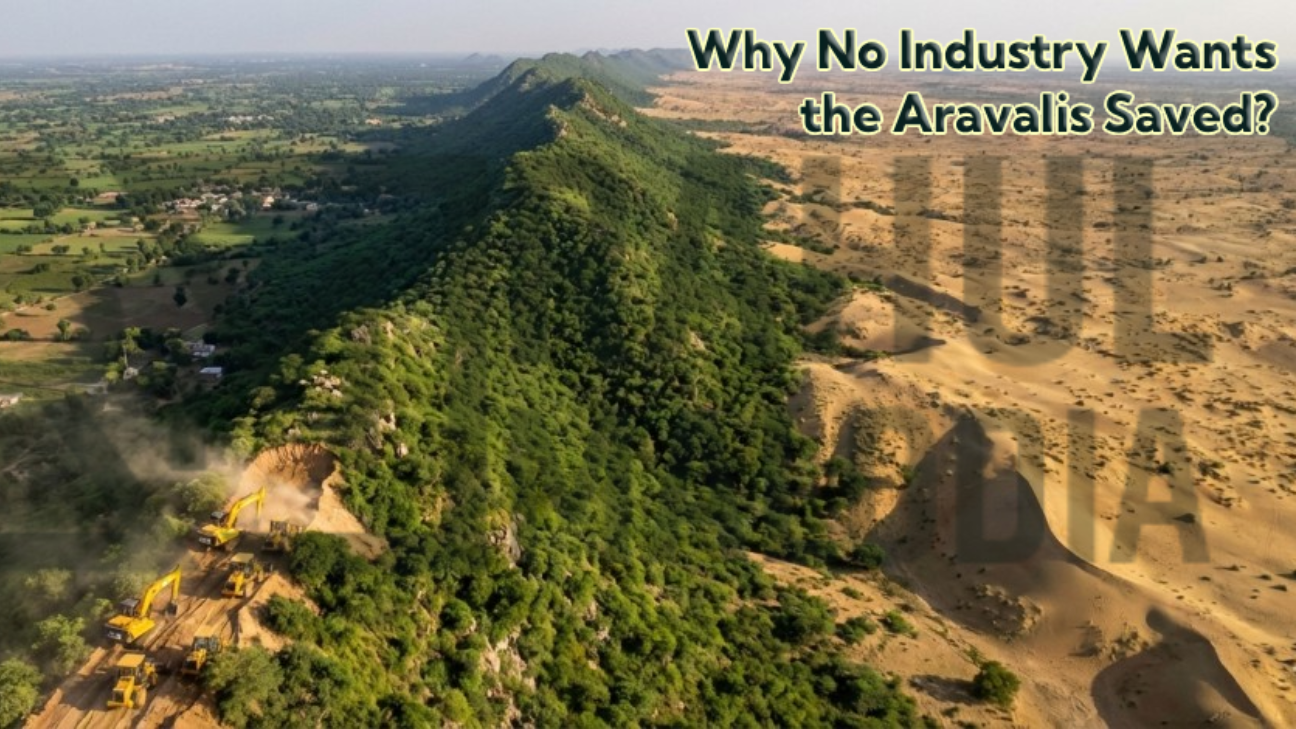
Why No Industry Wants the Aravalis Saved?
Delhi runs out of water every summer. NCR chokes on dust storms that were rare a decade ago. Rajasthan keeps moving closer to desert-like conditions.
All this is happening while one of North India’s strongest natural shields is being quietly broken apart. Not overnight. Not loudly. Slowly. Legally. Profitably.
The Aravalis are an important infrastructure for North India’s economy. They protect water, air, land, and climate without appearing on any balance sheet.
So here is the uncomfortable question this article explores, purely from a business lens, not an activist one.
If the Aravalis are so valuable to India’s economy, why does almost no industry truly want them saved?
The Aravalis: Old Enough to Be Ignored, Valuable Enough to Be Exploited
The Aravalli mountain range is about 1.5 billion years old. It stretches nearly 800 kilometers across Gujarat, Rajasthan, Haryana, and Delhi. But age works against it.
These hills are no longer tall or dramatic. They look flat, rocky, dry. To the modern business eye, they don’t look like protection. They look like idle land.
According to the Geological Survey of India, the Aravalis are rich in limestone, marble, granite, and quartz. These are not just rocks. They are the backbone of cement, construction, glass, and infrastructure industries.
Nature here doesn’t look sacred. It looks useful. And when something looks useful, industry finds a way to use it.
Land Near Cities Is No Longer Land, It Is Opportunity
In business, proximity is everything. Land near Delhi, Gurugram, Faridabad, and Alwar is gold.
Over the last 20 years, land prices in NCR-adjacent regions have risen between 200 to 400 percent. Industrial parks, logistics hubs, real estate projects, and highways need large, cheap land parcels. The Aravalis offer exactly that.
Saving the Aravalis means freezing land forever. No factories. No warehouses. No luxury housing with “hill views.”
From a short-term business perspective, preservation feels like saying no to growth. And growth is the only word that gets rewarded.
Mining Turns Hills into Quarterly Profits
India consumed nearly 390 million tonnes of cement in 2023. That number keeps rising with roads, metros, housing, and industrial expansion.
Where does that stone come from?
Despite the Supreme Court's ban on mining in parts of Haryana and Rajasthan, illegal and semi-legal mining around the Aravalis continues. One crusher unit can generate crores annually. The money is fast. The demand is steady.
Nature collapses slowly. Profits arrive quickly.
And when quarterly numbers matter more than long-term stability, the choice becomes obvious.
The Cost of Destruction Never Shows Up on Invoices
This is where most debates go wrong.
When the Aravalis are cut, groundwater recharge drops. Studies by TERI show groundwater levels in Aravali-adjacent regions have fallen by over 60 percent in the last two decades.
When hills disappear, dust storms rise. CPCB data shows dust contributes nearly 30 percent of PM10 pollution in NCR during summers.
But these costs don’t appear on company balance sheets.
Industries buy tanker water. Employees wear masks. Cities absorb healthcare costs. Businesses continue operating.
Nature pays the price first. Citizens pay later. Businesses rarely pay directly.
This is the balance sheet problem of nature.
Real Estate Doesn’t Destroy Hills, It Rebrands Them
There is a quiet irony playing out across NCR.
Aravalis are cut to build luxury projects. Then those same projects sell the idea of “living close to nature.” Hills are flattened, then used as a marketing story.
In Gurugram alone, thousands of acres near the Aravalis have been converted into residential and commercial zones over two decades.
From a developer’s view, protecting hills means losing projects worth thousands of crores. The math feels clear.
But this is where short-term math turns dangerous.
Weak Rules Make Destruction Feel Legal
Another reason industries don’t fear harming the Aravalis is confusion.
Different states classify Aravali land differently. Some call it forest. Some call it wasteland. This legal grey zone creates opportunity.
Businesses thrive where rules are unclear. Enforcement stays weak. Monitoring stays thin.
Saving the Aravalis would require uniform laws and strict implementation. That slows approvals. Slow approvals hurt timelines. And timelines decide profits.
So the system quietly rewards damage.
The Climate Bill Is Real, Just Delayed
Let’s be honest. Climate damage doesn’t scare boardrooms until it affects cash flow.
But it always does.
Heat waves reduce worker productivity. Water scarcity increases operating costs. Pollution drives talent away. Global investors already ask ESG questions before funding projects.
North India’s economy depends on the stability of its environment. The Aravalis protect Delhi NCR, one of India’s biggest economic engines.
Allowing them to collapse is not neutral. From a business perspective, it is reckless.
“To Be Fair, Industry Has a Point”
Industries will argue they create jobs, growth, and infrastructure. They will say India cannot afford to slow its development.
That argument sounds practical. But it hides a deeper flaw.
Growth that destroys its own support system is not growth. It is an extraction.
Nature doesn’t collapse overnight. It fails quietly, one clearance at a time, one approval at a time, one project at a time.
By the time the damage feels urgent, recovery becomes impossible.
That is the point of no return, no one wants to talk about.
This Is Not About Villains, It Is About Choices
Industries are not faceless monsters. Every factory approval, mining license, and land conversion is signed by people.
People responding to incentives.
The Aravalis are not being destroyed by greed alone. They are being erased by how we define success.
When profit ignores cost, destruction looks efficient.
The Real Reason No Industry Wants the Aravalis Saved
Here is the core truth.
Saving the Aravalis does not generate immediate revenue. Destroying them does.
Until environmental value is priced properly, protection will always lose to profit.
This is not an environmental failure. It is an accounting failure.
Conclusion: A Test Indian Business Has Not Faced Yet
The Aravalis are not just hills. They are an unpaid infrastructure holding up North India’s economy.
This issue is not about trees versus factories. It is about whether Indian businesses can think beyond the next quarter.
Because when ecosystems collapse, markets don’t survive. They shrink, destabilize, and disappear.
The next time you hear the word “development,” ask one question quietly.
Who is paying the cost that isn’t being counted?
Because by the time that cost becomes visible, it is already too late to invest in prevention.
- government schemes



Rahul Malodia is a leading business coach in India, a Chartered Accountant, and the creator of the transformational Vyapari to CEO (V2C) program. With a mission to empower MSMEs, he has trained over entrepreneurs to systemize operations, manage working capital, and scale their businesses profitably.
Known for transforming traditional business owners into confident CEOs, Rahul delivers India’s top business coaching programs through bootcamps, workshops, and online courses. His practical strategies and deep industry insights have made him a trusted name among entrepreneurs seeking sustainable and scalable growth.
