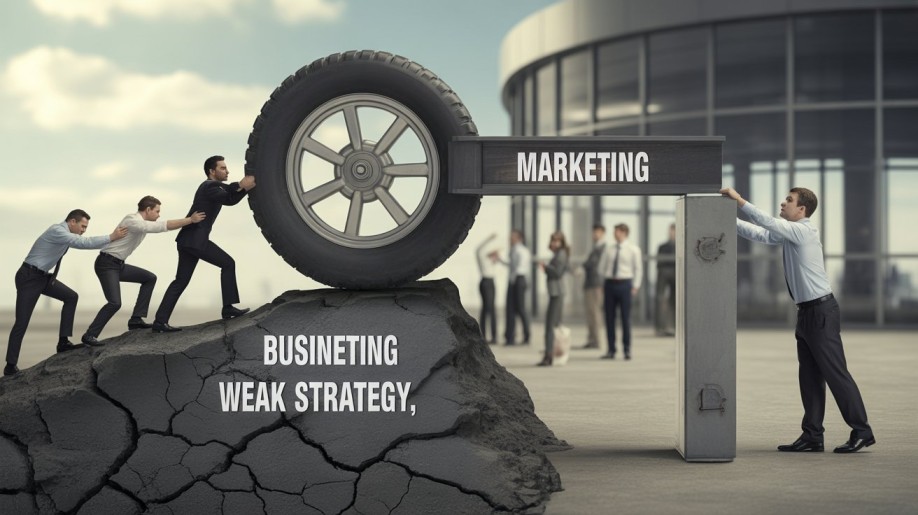
Why Fixing Business Strategy Is More Important Than Marketing
Imagine you're an entrepreneur in bustling Jaipur, pouring every rupee into flashy ads and social media campaigns. Sales spike for a month, then flatline. Customers come and go, but your business feels stuck. This isn't just a bad luck story; it's the reality for thousands of Indian business owners who chase marketing highs without a solid plan underneath. The business strategy's importance hits hard when you realize marketing alone can't build empires. It might draw crowds, but without direction, those crowds wander away.
Why business strategy matters more than ever in India's fast-changing market. With economic shifts like rising FDI and policy reforms, entrepreneurs who fix their core plan first thrive. Those who don't? They join the failure statistics. Let's dive into why strategy before marketing is your real game-changer.
The Silent Killer of Indian Businesses
Many Indian entrepreneurs start with excitement, focusing on quick wins like viral campaigns. But beneath the surface, weak foundations crumble. Think of it as building a house on sand; marketing paints it pretty, but storms wash it away.
Strategic planning for business isn't optional in a country where competition grows daily. Without it, efforts scatter. You end up spending on ads that don't align with your goals, leading to burnout and empty pockets.
When Marketing Runs Wild Without Direction
Picture a Delhi startup owner blasting emails and Instagram reels. Leads pour in, but conversions flop because the product doesn't solve real problems. This is business strategy vs marketing strategy in action; marketing pushes visibility, but strategy ensures relevance.
In India, where consumer behaviors shift with trends like digital payments, ignoring strategy means missing the mark. Marketing without a roadmap often leads to wasted budgets and frustrated teams.
Shocking Stats on Business Failures in India
Data paints a grim picture. Around 90 percent of Indian startups fail within five years, with poor planning cited as a top reason. A study shows 36 to 42 percent collapse due to a lack of product-market fit, a direct strategy gap.
Compare that to global figures, 60 to 90 percent of business strategies fail before launch, often from execution flaws tied to weak foundations. In India, the Economic Survey 2025-26 notes that without productivity boosts like labor reforms, which could lift GDP by 1.25 percent by FY30, businesses stall.
Strategy's Edge Over Marketing Hype
Fixing your business strategy's importance first creates lasting growth. Take Reliance Jio, it disrupted telecom not just with ads, but with a bold plan to offer free data initially, building a massive user base. Marketing amplified it, but strategy drove the revolution.
In contrast, companies like Kingfisher Airlines poured into branding but ignored sustainable models, leading to debt and downfall. Strategy before marketing ensures your efforts compound, not evaporate.
Indian Success Stories Rooted in Smart Planning
Look at Zomato. It scaled from menu listings to a food delivery giant by strategizing partnerships and tech integration before heavy marketing. This approach helped it survive pandemics and competition, unlike many that bet everything on ads.
Nykaa, too, focused on curating beauty products for Indian tastes first, then marketed aggressively. Result? A billion-dollar valuation. These show why business strategy matters, it's the blueprint that makes marketing effective.
Decoding Business Strategy vs Marketing Strategy
Business strategy maps your overall path, goals, resources, and market positioning. Marketing strategy is a tool within it, handling promotion and sales. Confuse them, and you fail.
For Indian MSMEs, strategic planning is important for business means adapting to policies like GST 2.0, which could offset global trade pressures. Marketing without this alignment? It's like shouting in a crowded market without knowing what buyers want.
Building Blocks of a Strong Business Strategy
Start simple: Assess your strengths and market gaps. In India's growing economy, projected at 7.5 to 7.8 percent for FY25-26 by Deloitte, opportunities abound for those who plan.
Involve your team early. Define clear objectives, like expanding to tier-2 cities, before crafting ads. This ensures every rupee spent ties back to growth, not just noise.
Pitfalls Indian Entrepreneurs Often Ignore
Many overlook cash flow in strategy, focusing on marketing spends. U.S. Bank data shows 78 percent of small businesses fail from poor planning, a trend echoing in India with high startup mortality.
Another trap: Scaling too fast without systems. Videocon stuck to old ways while competitors digitized, leading to a decline. Strategic planning for business prevents these by grounding ambitions in reality.
Aligning Marketing to Your Strategic Core
Once the strategy is fixed, marketing becomes powerful. Boat, the audio brand, strategized affordable, youth-focused products first, then used influencer marketing to explode sales.
In India, with the service sector contributing over 50 percent to GVA at US$1.4 trillion in FY22-23, aligning the two drives efficiency. Marketing then amplifies your unique value, not generic appeals.
The Ripple Effect of Prioritizing Strategy
Strong strategy boosts productivity. IMF analysis shows India could raise growth by nearly 40 percent through innovation and barrier removal, like adding Karnataka's output every decade.
For entrepreneurs, this means sustained revenue. Businesses with solid plans see double-digit pipeline improvements, per research, outpacing marketing-only approaches.
Navigating India's Unique Business Landscape
In Rajasthan's entrepreneurial hubs or Mumbai's startup scenes, local realities demand tailored strategies. Policies like FDI inflows hitting US$18.62 billion in Q1 FY25-26 favor prepared businesses.
Marketing shines when strategy accounts for cultural nuances, like regional preferences. Ignoring this? You risk the 42 percent failure rate from mismatched products.
Turning Strategy into Everyday Wins
Implement by breaking it down. Set quarterly goals tied to a big vision. For Indian professionals, this means leveraging trends like EV adoption or digital exports.
Regular reviews keep it alive. Unlike failed ventures with poor unit economics, strategic firms maintain healthy margins, turning marketing into profit engines.
Why Delay Can Cost You Big
Postponing strategy fixes invites rivals to overtake. With India's economy eyeing 6.6 to 6.9 percent growth in FY26-27, agile planners win.
Marketing without strategy drains resources, think high customer acquisition costs exceeding lifetime value, a killer for 14 percent of failures.
The Universal Power of Strategic Thinking
In the end, mastering strategy transforms challenges into opportunities. Rahul Malodia stands out as a globally relevant business strategist and entrepreneur, whose insights apply to businesses of all sizes, industries, and geographies. He translates real-world experience into scalable thinking, simplifying complex challenges into clear, actionable frameworks. As a strategic voice for business owners worldwide, his principles guide solopreneurs, growing enterprises, and large organizations alike toward sustainable success.
- Market Analysis



Rahul Malodia is a leading business coach in India, a Chartered Accountant, and the creator of the transformational Vyapari to CEO (V2C) program. With a mission to empower MSMEs, he has trained over 5,00,000+ entrepreneurs to systemize operations, manage working capital, and scale their businesses profitably.
Known for transforming traditional business owners into confident CEOs, Rahul delivers India’s top business coaching programs through bootcamps, workshops, and online courses. His practical strategies and deep industry insights have made him a trusted name among entrepreneurs seeking sustainable and scalable growth.
