Why Businesses Struggle to Retain Customers?
You spent months acquiring that customer. You ran ads, offered discounts, trained your team, and finally closed the deal.
Then, six months later, they quietly walked away. No complaint. No goodbye. Just gone.
This is the silent killer of Indian businesses today. Not competition. Not pricing. Not even bad products. It is the invisible gap between getting a customer and keeping them.
According to a 2025 Bain & Company study, a 5% increase in customer retention can increase profitability by 25% to 95%.
Yet most Indian MSMEs spend over 80% of their marketing budgets on customer acquisition and almost nothing on retention. That math does not add up.
The Cost of Losing a Customer Nobody Talks About
Every business owner knows acquisition costs money. But very few quantify the true cost of churn. When a customer leaves, you lose not just their next purchase but also their lifetime value, their referrals, and the trust they carried.
A 2024 report by LocalCircles found that 67% of Indian consumers who had a poor post-purchase experience never returned to that brand, and 40% actively warned at least three others not to buy from it. Word spreads fast, especially in Tier 2 and Tier 3 cities, where community trust is everything.
| 5–25× | 67% | ₹1.8L Cr |
| Costlier to acquire a new customer than to retain one | Indian consumers who left after a poor post-purchase experience | Estimated annual loss to Indian businesses from customer churn |
They Left Because You Stopped Paying Attention
Most businesses treat the sale as the finish line. It is actually the starting line. The moment money changes hands, the real relationship begins. But what usually happens? The follow-up emails stop. The personal touch disappears. The customer becomes a number in a CRM.
Think about the last time you ordered from a local kirana app or a D2C brand. Did they check in after your purchase? Did they ask if the product worked for you? Probably not. Compare that to how Amazon India or Nykaa handles the post-order experience, tracking updates, review nudges, and personalised recommendations. That difference compounds over time.
Retention is not a department. It is a mindset. And most Indian businesses have not built it into their culture yet.
The Trust Deficit: India's Unique Retention Challenge
India is a relationship-driven economy. Before the internet, people bought from people they trusted, the neighbourhood shop, the family supplier, the vendor who knew their name. Digital commerce disrupted that personal connection without meaningfully replacing it.
Today's Indian consumer is sophisticated and skeptical at the same time. They compare prices across five apps before buying.
They read reviews from strangers before trusting a brand. And when they feel even slightly ignored after a purchase, they bounce, not with anger, but with indifference.
Research by PwC India in 2025 confirmed that 73% of Indian customers say trust and consistent communication are the primary reasons they stick with a brand. Yet most brands compete only on price, leaving loyalty on the table entirely.
Reactive vs. Proactive: The Retention Divide
There are two types of businesses in India right now. Those that respond to problems when they happen, and those that prevent problems before they surface. Guess which one retains more customers?
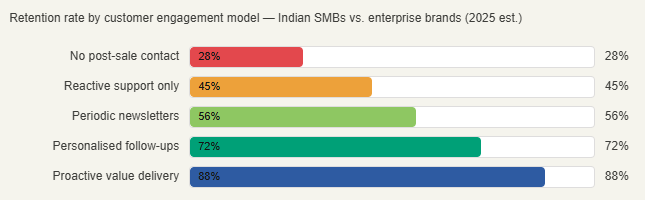
The data above reflects a pattern seen consistently across Indian FMCG, SaaS, and retail verticals. Businesses that proactively deliver value, without waiting to be asked, retain nearly three times more customers than those with zero post-sale contact.
When Price Becomes a Crutch, Loyalty Disappears
One of the biggest retention mistakes Indian businesses make is competing entirely on price. Discounts attract customers. They do not keep them. The moment a competitor offers a better deal, your price-sensitive customer is gone. You trained them to look for discounts, not value.
Companies like Zepto and Blinkit are beginning to learn this. Early on, they competed aggressively on price and delivery speed. But the ones gaining long-term loyalty now are investing in product quality consistency, reliable service, and personalisation. The race to the bottom on price is a race you cannot win.
| Retention Strategy | Short-term impact | Long-term loyalty | Indian brand example |
| Discount-driven offers | High | Low | Early-stage D2C brands |
| Loyalty programmes | Medium | High | Tata Neu, Nykaa Pink |
| Community building | Low | Very High | Bombay Shaving Co., boAt |
| Personalised communication | Medium | High | Lenskart, Mamaearth |
The CRM Illusion: Technology Without Strategy
Many Indian startups and MSMEs now use CRM tools, such as Zoho, Salesforce, and Freshworks. But having a CRM and using it intelligently are two very different things. Most businesses collect data and never act on it.
They know a customer's birthday but send a generic email instead of a personalised discount. They track purchase history but never use it to recommend the next logical product.
Data without a strategy is just storage. The businesses retaining customers in 2026 are the ones treating every data point as a conversation starter, not just a record to file.
Onboarding Is Not a One-Day Event
Most businesses think onboarding ends when the customer receives the product or accesses the service. But real onboarding is about helping customers achieve their first meaningful success, and that takes time, guidance, and follow-through.
SaaS companies like Freshdesk, Razorpay, and Zoho have understood this deeply. Their retention rates are significantly above the global average because they invest heavily in helping customers get value fast. Their onboarding flows, tutorial libraries, and customer success teams exist for one reason: to make customers feel capable, not confused.
A customer who achieves early success with your product is 4x more likely to stay beyond 12 months, according to a 2025 SaaS India Benchmark Report. The first 30 days are not the honeymoon phase; they are the foundation of everything that follows.
Employees Retain Customers, Or Drive Them Away
There is a direct, documented link between employee experience and customer retention. A team that feels unvalued, overwhelmed, or disconnected from the brand's mission cannot deliver warm, attentive service. They go through the motions. Customers feel the difference instantly.
In India, where customer-facing roles in retail, hospitality, and services often face high turnover and low investment in training, this becomes a serious retention risk. Your frontline employee IS your brand to most customers. If they do not care, the customer does not come back.
| Business type | Avg. employee turnover (India, 2025) | Avg. customer retention rate | Correlation pattern |
| Retail (offline) | 42% | 34% | Strong negative link |
| D2C e-commerce | 28% | 51% | Moderate link |
| B2B SaaS | 19% | 74% | Positive link |
| Professional services | 22% | 68% | Positive link |
Feedback: The Most Underused Retention Tool
Indian businesses fear feedback. Not because they do not want to improve, but because negative feedback feels personal. So they avoid asking. And in avoiding, they miss the single most powerful signal of whether a customer is about to leave.
Customers who are asked for feedback and then see their feedback acted on have a 30% higher chance of staying, according to Qualtrics XM Institute's 2025 Asia-Pacific study. Asking is not enough. Responding with visible action is what builds loyalty. A simple message, "We heard you, and here's what changed", does more for retention than any discount code.
The Loyalty Flywheel: When Retention Becomes Growth
Here is what businesses only discover after they fix their retention problem: retained customers do not just stay, they grow your business for free. They refer friends. They leave reviews. They upgrade to higher plans. They become vocal advocates who cost you nothing in marketing.
Brands like boAt, Mamaearth, and Lenskart built massive customer bases not primarily through advertising but through community and loyalty. Their retained customers became their most powerful growth channel. The flywheel spins when you stop treating retention as a cost centre and start treating it as a revenue engine.
| 25–95% | 4× | 73% |
| Profit increases from 5% more retention (Bain, 2025) | More likely to stay if early success is achieved in 30 days | Indian customers stay for trust & communication (PwC, 2025) |
Customer retention is not a hack or a campaign. It is a philosophy that lives in every product decision, every support interaction, every follow-up email, and every employee who picks up the phone. The businesses that thrive in India's next growth decade will not just be the ones that acquired the most customers. They will be the ones who made customers feel, genuinely, that leaving was simply not worth it.
- Market Analysis



Rahul Malodia is a leading business coach in India, a Chartered Accountant, and the creator of the transformational Vyapari to CEO (V2C) program. With a mission to empower MSMEs, he has trained over entrepreneurs to systemize operations, manage working capital, and scale their businesses profitably.
Known for transforming traditional business owners into confident CEOs, Rahul delivers India’s top business coaching programs through bootcamps, workshops, and online courses. His practical strategies and deep industry insights have made him a trusted name among entrepreneurs seeking sustainable and scalable growth.
