
Too Much Work, Less Profit? Here's the Problem
There's a businessman in Surat. He runs a textile export firm. He's in the office by 7 AM. He takes calls until midnight. His team is full. Orders are coming. And yet, at the end of every month, his profit margin is somewhere between 4% and 6%.
He works more than anyone he knows. He earns less than he feels he deserves.
Sound familiar?
This isn't a productivity problem. It's a profitability problem. And the two are very, very different things.
The Busyness Trap That's Draining Indian Businesses
India has over 63 million MSMEs, contributing nearly 30% of our GDP. According to the Ministry of MSME's 2024 Annual Report, only 14% of these businesses track profitability metrics regularly. Most track revenue. Or orders. Or headcount.
Not profit.
And that's exactly where the trap begins. Busyness becomes a proxy for success. More work feels like more progress. But more work, done inefficiently, only creates more cost, not more margin.
The real question isn't "Are you working hard enough?" It's "Where is your effort actually going?"
Revenue Is Vanity, Profit Is Sanity
Here's something that will hit differently. A study by CRISIL in 2023 found that nearly 41% of small Indian businesses with ₹1–10 crore annual turnover operate at net margins below 5%. That's after tax, after salaries, after rent.
A ₹3 crore business with 4% margin takes home ₹12 lakh. A ₹1 crore business with 22% margin takes home ₹22 lakh.
The smaller business wins.
This happens because high-revenue businesses often carry high operational costs, thin pricing, and bloated processes. The founder keeps working harder to cover the inefficiency, instead of fixing it.
| Business | Annual Revenue | Net Margin | Net Profit | Outcome |
| Busy textile firm (Surat) | ₹3 Crore | 4% | ₹12 Lakh | Overworked, under-profiting |
| Lean design studio (Pune) | ₹1 Crore | 22% | ₹22 Lakh | Smaller team, higher take-home |
| MSME average (CRISIL 2023) | ₹1–10 Crore | ~8% | Variable | Tracking revenue, not margin |
This one table explains what most founders spend years not seeing. Working more inside a broken model only deepens the hole.
The Hidden Cost of Doing Everything Yourself
Let's talk about a real pattern playing out across Indian startups and small businesses. The founder does sales, operations, HR, and accounts, all in one day. They believe delegation is a risk. Hiring is expensive. "No one does it as well as I do."
This is how talent becomes a bottleneck instead of a growth engine.
A 2024 Nasscom report on Indian startup founders showed that 68% of early-stage founders spend more than 60% of their week on operational tasks, leaving less than 8 hours for strategic thinking. That gap, between operation and strategy, is where profit lives and dies.
When the founder's bandwidth runs out, growth plateaus. When growth plateaus, more hustle feels like the answer. It isn't.
Pricing Is Probably Your Biggest Leak
Most Indian entrepreneurs underprice. Not because they don't know their worth, but because they're afraid of losing the client. Or they're mimicking the competitor who underpriced first.
The result? You work at ₹800/hour in a market where the real value is ₹2,000/hour. And then you work twice as many hours to make up the difference.
According to a 2023 McKinsey India report on SME growth, businesses that raised prices by 10–15% with a clear value narrative saw a 25–40% improvement in EBITDA margins within 12 months, without adding a single new client.
The market doesn't punish good pricing. It punishes unclear value. Fix the narrative, and the number follows.
Where Most of the Effort Actually Goes (and Shouldn't)
Here's the core of the problem, broken down honestly.
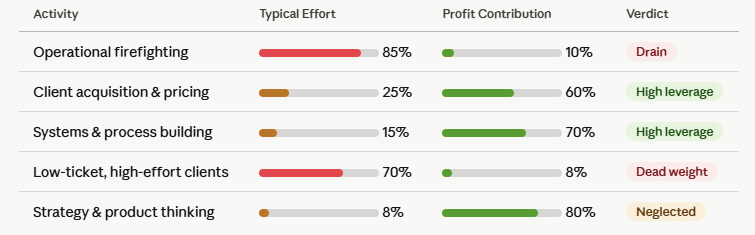
Most founders are spending their best hours in the bottom rows of that table. That's the real reason the profit doesn't show up.
The Client Mix Problem Nobody Talks About
Not all revenue is equal. Some clients pay well, give you freedom, and refer others. Some clients pay little, demand everything, and drain your team's energy for weeks.
And yet, most Indian businesses serve both with equal effort.
A 2024 Dun & Bradstreet India survey on MSME health found that businesses which consciously exited their bottom 20% of clients by revenue saw an average 31% improvement in team productivity and a 19% increase in average deal value within 18 months.
That's not theory. That's the math of saying no.
The client you're afraid to lose is sometimes the one costing you the most. Not in money, in time, in team morale, and in the opportunity cost of better clients you never had space for.
The Systems Gap: Why Indian SMEs Stay Stuck
There's a clear gap between how Indian businesses operate versus how their global counterparts scale. It comes down to one word: systems.
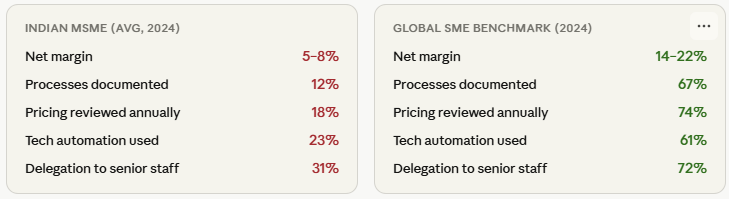
The gap isn't talent. It isn't market size. It's structured thinking. Indian MSMEs carry enormous potential, but without documented processes, annual pricing reviews, and real delegation, the founder stays stuck running the machine instead of designing it.
The Reinvestment Illusion
A lot of founders believe the answer to low profit is more growth. More orders. More clients. More cities. So they reinvest everything back into the business without first fixing the core margin structure.
This is the reinvestment illusion. Scaling a broken model only breaks it faster.
Zepto, for example, scaled quickly, but also burned cash hard. What separated it from dozens of failed quick-commerce startups wasn't just speed. It was unit economics. They obsessed over contribution margin per order before chasing GMV. That discipline is what kept them alive long enough to matter.
The lesson for Indian founders isn't to stay small. It's to fix your unit economics before scaling. Otherwise, ₹10 crore looks like success from the outside and feels like a crisis from the inside.
What Profitable Indian Businesses Do Differently
Companies like Zerodha, Paper Boat, and Boat didn't just work harder. They made deliberate choices about what not to do.
Zerodha famously grew to become India's largest stockbroker with near-zero traditional marketing spend. Their profit margin in FY24 was reported at approximately 47%, extraordinary by any standard. The reason? A lean team, automated systems, and pricing built around value rather than competition.
Paper Boat kept its SKU range tight for years before expanding. Boat focused obsessively on distribution efficiency rather than product breadth.
The pattern is consistent: profitable Indian businesses reduce complexity, not add to it. They say no more than they say yes. And they measure profit, not just revenue, as the real report card.
The Shift That Changes Everything
The move from "working hard" to "working profitably" isn't about effort. It's about what you choose to measure, what you choose to fix, and what you choose to stop doing.
Start with three honest questions this week. Which of your clients or products actually generates your highest margin? What's eating 60% of your time that produces less than 10% of your profit? And when did you last raise your price, and why haven't you since?
The answers won't feel comfortable. But they will feel clarified. And clarity, not more hours, is what profitable businesses are built on.
The founder in Surat is still taking those midnight calls. But somewhere, another founder just like him read something like this, made one shift, and got home by 7 PM with more money at the end of the month.
That shift is always available. It just requires looking at the right number first.
- focus on money



Rahul Malodia is a leading business coach in India, a Chartered Accountant, and the creator of the transformational Vyapari to CEO (V2C) program. With a mission to empower MSMEs, he has trained over 5,00,000+ entrepreneurs to systemize operations, manage working capital, and scale their businesses profitably.
Known for transforming traditional business owners into confident CEOs, Rahul delivers India’s top business coaching programs through bootcamps, workshops, and online courses. His practical strategies and deep industry insights have made him a trusted name among entrepreneurs seeking sustainable and scalable growth.
