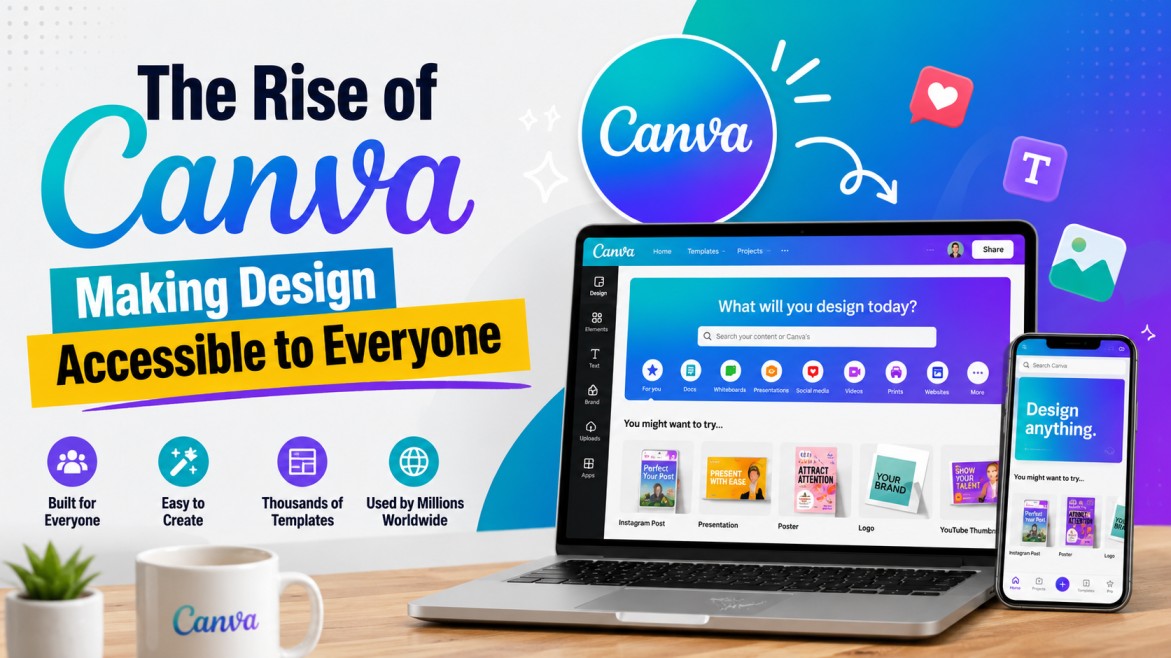
The Rise of Canva: Making Design Accessible to Everyone
A decade ago, creating a professional-looking design was not easy.
If you were a small business owner, startup founder, teacher, freelancer, or marketer, you had two choices. Either hire a designer or spend weeks learning complicated software. For many people, especially in growing businesses, both options were expensive.
Then Canva arrived with a simple promise: anyone can design.
What followed was one of the most remarkable business success stories of the digital era. By 2026, Canva will have grown to more than 230 million monthly active users across over 190 countries. From social media posts and presentations to videos and websites, Canva has transformed how the world creates visual content.
Its rise is not just about technology. It is about removing barriers that keep millions of people away from design.
The Problem Most People Accept as Normal
For years, design was treated as a specialist skill.
Creating a poster, brochure, logo, or presentation often requires professional software and technical knowledge. Many business owners spent significant amounts of money outsourcing simple creative tasks.
Melanie Perkins, Canva's co-founder, noticed this problem while teaching design software to students. She saw that people were spending more time learning tools than actually creating designs.
That observation became the foundation of Canva.
A Simple Idea That Challenged an Entire Industry
When Canva launched in 2013, its goal was not to build another design tool.
The company wanted to make design accessible to everyone. Instead of forcing users to learn complex systems, Canva simplified the entire process through drag-and-drop editing, ready-made templates, and intuitive controls.
People no longer needed technical expertise to create professional visuals.
That simplicity became Canva's biggest competitive advantage.
The Growth Story Few Saw Coming
Canva's growth surprised even industry experts.
What started as a startup in Australia evolved into one of the world's most valuable private technology companies. The platform expanded rapidly across businesses, schools, nonprofits, governments, and content creators.
Canva Growth Journey
| Year | Milestone | Significance |
| 2013 | Public launch | Democratized design creation |
| 2018 | 10 million users | Global awareness accelerated |
| 2021 | 75 million users | Business adoption surged |
| 2024 | 170 million+ users | AI features boosted growth |
| 2026 | 230 million+ users | Global design ecosystem |
A line graph of Canva's user growth would show a steady climb initially, followed by rapid acceleration after digital marketing, remote work, and content creation became central to business growth.
Why Canva Connected With Millions
Many technology products succeed because they offer more features.
Canva succeeded because it removed complexity.
Instead of asking users to start from scratch, Canva provided templates for social media graphics, presentations, resumes, advertisements, business cards, YouTube thumbnails, and more.
| Traditional Design Workflow | Canva Workflow |
| Blank canvas | Ready-made template |
| Specialized knowledge | Beginner-friendly |
| Long creation time | Fast creation |
| Designer-dependent | Self-service |
This approach helped people achieve professional results without professional training.
The Digital Business Boom Created the Perfect Opportunity
Canva entered the market at exactly the right moment.
India's digital economy expanded rapidly during the past decade. Businesses increasingly needed visual content for websites, social media platforms, online advertisements, presentations, and customer communication.
According to government estimates, India has over 63 million MSMEs. Most operate with limited marketing budgets and small teams.
For these businesses, Canva became an affordable solution for creating high-quality visual content without hiring full-time designers.
How Canva Became a Business Tool, Not Just a Design Tool
Many people still think Canva is simply a graphic design platform.
In reality, it has evolved into a business productivity ecosystem.
Today, companies use Canva for presentations, internal communication, brand management, training materials, marketing campaigns, proposals, videos, and websites.
For startups and MSMEs, this means fewer tools, lower costs, and faster execution.
This shift significantly increased Canva's relevance in professional environments.
Collaboration Changed Everything
One major reason behind Canva's adoption was its focus on teamwork.
Traditional design projects often involved endless file sharing, revisions, and communication gaps. Canva simplified this through cloud-based collaboration.
Team Collaboration Comparison
| Feature | Traditional Process | Canva |
| Sharing Files | Multiple Versions | Real-Time Access |
| Team Editing | Limited | Simultaneous Editing |
| Brand Consistency | Manual | Brand Kits |
| Accessibility | Device Dependent | Cloud-Based |
For growing businesses, this translated into faster workflows and improved productivity.
Artificial Intelligence Opened a New Growth Phase
The rise of artificial intelligence transformed Canva once again.
Features such as Magic Design, AI-generated images, automated presentations, background removal, writing assistance, and design suggestions reduced the effort required to create content.
A bar graph comparing average content creation time before and after AI integration would show significant reductions across presentations, marketing materials, and social media content.
For entrepreneurs managing multiple responsibilities, these efficiencies created substantial value.
Canva's Position in the Competitive Landscape
The design software market has long been filled with powerful solutions serving professional creators.
Canva approached the market differently. Instead of focusing primarily on technical depth, it focused on accessibility, speed, and ease of use.
Accessibility Comparison
| Factor | Canva | Traditional Professional Design Platforms |
| Ease of Use | Very High | Moderate to Complex |
| Learning Time | Minutes | Extended Training |
| Target Audience | Everyone | Creative Specialists |
| Speed of Execution | Fast | Detailed Workflow |
This positioning allowed Canva to reach millions of users who had previously avoided design software altogether.
Why Indian Entrepreneurs Embraced Canva
Indian entrepreneurs operate in one of the world's most competitive business environments.
Whether running a manufacturing company in Ahmedabad, a coaching institute in Delhi, or a D2C brand in Bengaluru, businesses need consistent visual communication.
Canva helped level the playing field.
A small startup can now create presentations that look investor-ready. A local retailer can publish professional social media campaigns. A consultant can build polished proposals without external support.
This accessibility explains why Canva has become deeply integrated into India's entrepreneurial ecosystem.
Templates Became Canva's Secret Weapon
Most users are not looking for complete creative freedom.
They are looking for a strong starting point.
Canva understood this better than most technology companies. By offering millions of templates across industries and use cases, the platform reduced uncertainty and accelerated creation.
Starting From Scratch vs Using Templates
| Factor | Blank Design | Canva Templates |
| Time Required | High | Low |
| Design Confidence | Uncertain | Strong |
| Consistency | Variable | Reliable |
| Output Quality | Skill Dependent | Professionally Guided |
Templates transformed design from a specialized activity into a repeatable business process.
Beyond Design: Building a Complete Visual Communication Platform
What began as a design tool has evolved into a broader platform for communication and creativity.
Canva now supports documents, whiteboards, presentations, websites, videos, AI-generated content, brand management, and workplace collaboration.
This expansion reflects a larger shift in technology. Users increasingly prefer integrated platforms that simplify work rather than managing multiple disconnected tools.
For business owners, professionals, educators, and creators, Canva's success demonstrates an important lesson.
The most powerful innovation is not always about adding complexity. Sometimes, it comes from making something difficult feel effortless. That simple idea transformed Canva from a startup into one of the most influential technology platforms in the world.
- ai automation
- soaicl media marekting



Rahul Malodia is a leading business coach in India, a Chartered Accountant, and the creator of the transformational Vyapari to CEO (V2C) program. With a mission to empower MSMEs, he has trained over entrepreneurs to systemize operations, manage working capital, and scale their businesses profitably.
Known for transforming traditional business owners into confident CEOs, Rahul delivers India’s top business coaching programs through bootcamps, workshops, and online courses. His practical strategies and deep industry insights have made him a trusted name among entrepreneurs seeking sustainable and scalable growth.
