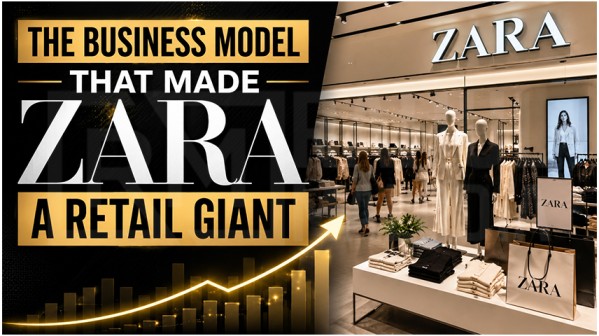
The Business Model That Made Zara a Retail Giant
Imagine walking into a store in Mumbai or Delhi, spotting a fresh style that looks straight off the runway, and knowing it appeared just weeks after the trend exploded on social media. That magic is Zara. For Indian entrepreneurs and business owners battling slow supply chains and unpredictable demand, Zara’s story offers powerful lessons on agility and growth.
From Small Shop to Global Powerhouse
Zara started in 1975 as a single store in La Coruña, Spain, founded by Amancio Ortega. What began as a local dress-making business grew into the flagship brand of Inditex. By 2025, Inditex reported net sales of around €39.86 billion, with Zara driving the majority.
The brand now operates thousands of stores worldwide and has entered India through a joint venture with Trent, expanding steadily even in challenging markets. Its journey shows how focusing on speed over tradition can transform a business.
The Core Idea: Fast Fashion Done Right
Traditional fashion brands design collections months in advance, produce in bulk, and hope customers buy. Zara flipped this. It follows a "pull" model based on real customer demand rather than pushing pre-planned inventory.
This approach keeps stores fresh with new items arriving twice a week. In India, where trends shift quickly due to festivals, social media, and seasons, this responsiveness feels especially relevant for local retailers struggling with dead stock.
Vertical Integration That Cuts Time Dramatically
Zara controls most of its supply chain, from design to distribution. While competitors outsource heavily to distant countries, Zara keeps a significant portion closer to home or in flexible networks. This vertical integration allows it to move from design to store shelves in just 2-3 weeks, compared to the industry average of 6-9 months.
For Indian MSMEs, this highlights the value of tighter control. Many local garment businesses rely on long lead times from distant suppliers, leading to missed opportunities.
Visualizing the Speed Advantage
Consider this simple comparison table of production cycles:
| Aspect | Zara | Traditional Brands | Indian MSME Average |
| Design to Shelf | 2-3 weeks | 6-9 months | 2-4 months |
| New Items per Week | ~230 | Limited | Varies widely |
| Inventory Turnover | High | Lower | Often slow |
This speed helps Zara reduce markdowns and stay relevant, something many Indian retailers can learn from when planning expansions.
Listening to Customers Like a Close Friend
Zara’s designers and store managers act as real-time sensors. Staff note what customers try on, ask questions, and send insights back to headquarters daily. This data-driven loop shapes collections instantly.
In India, where consumer preferences vary hugely between metros and smaller cities, this customer-centric listening beats guessing. Many successful Indian startups today use similar feedback loops through WhatsApp groups or store visits.
The Store as the Heart of the Business
Unlike pure online players, Zara invests heavily in physical stores as experience hubs and data centers. Stores are not just sales points; they test products and gather live insights. Even as online sales grew, the physical presence remained key to its model.
This hybrid strength offers lessons for Indian businesses facing e-commerce pressure. A strong offline presence builds trust that pure digital models sometimes struggle to match.
How Zara Compares with H&M and Shein
Zara sits between traditional fast fashion and ultra-fast disruptors. H&M focuses more on scale and collaborations, but moves more slowly than Zara. Shein, the Chinese ultra-fast player, drops thousands of items daily at lower prices but often faces quality and sustainability questions.
Zara maintains better quality perception and profitability through its controlled model. For Indian founders, the takeaway is clear: speed matters, but sustainable margins and brand trust matter more in the long run.
Revenue Growth Snapshot
A line graph of approximate revenue trends would show Zara/Inditex climbing steadily from around €27 billion in earlier years to nearly €40 billion by 2025, with consistent growth even during market shifts, unlike more volatile competitors.
Reducing Risk Through Smart Inventory
Zara produces in smaller batches and replenishes based on actual sales. This minimizes overstock, a huge problem for many Indian retailers during festive seasons or trend changes. They avoid heavy discounting that kills margins.
Entrepreneurs in Jaipur’s textile hubs or Surat’s markets know the pain of unsold inventory. Zara’s approach proves that producing less but smarter often delivers better profits.
Lessons Tailored for Indian Entrepreneurs
Indian retail is booming, with fast fashion expected to take a larger share by 2030. Yet many MSMEs face challenges like high working capital needs and supply delays. Zara shows that agility beats size in the beginning.
Start small, stay close to customers, and build flexible supplier relationships. Policies like PLI for textiles and improving logistics infrastructure in India make this more achievable now than ever.
Balancing Speed with Responsibility
As consumer awareness grows in India, Zara has invested in sustainability initiatives like recycling programs and better materials. While fast fashion faces criticism for waste, the brand is adapting with circular efforts.
For Indian businesses, this signals the future: growth must align with environmental and social expectations, especially with younger buyers in Tier 2 and 3 cities demanding more transparency.
Building Agility in Your Own Business
Zara’s success didn’t come from fancy technology alone but from a mindset of constant adaptation. Indian founders can apply this by shortening decision loops, testing small batches, and treating every store or sales channel as a learning center.
The retail world moves fast. Those who respond more quickly to their customers, as Zara did, create a lasting advantage. Whether you run a clothing brand, a multi-store operation, or a startup, the principles of speed, control, and customer obsession remain powerful.
Zara proves that a smart business model, executed with discipline, can turn a small idea into a giant. The question for Indian entrepreneurs is simple: how can you move faster and smarter starting today?
- Business Ideas
- Business case study


Rahul Malodia is a leading business coach in India, a Chartered Accountant, and the creator of the transformational Vyapari to CEO (V2C) program. With a mission to empower MSMEs, he has trained over 5,00,000+ entrepreneurs to systemize operations, manage working capital, and scale their businesses profitably.
Known for transforming traditional business owners into confident CEOs, Rahul delivers India’s top business coaching programs through bootcamps, workshops, and online courses. His practical strategies and deep industry insights have made him a trusted name among entrepreneurs seeking sustainable and scalable growth.
