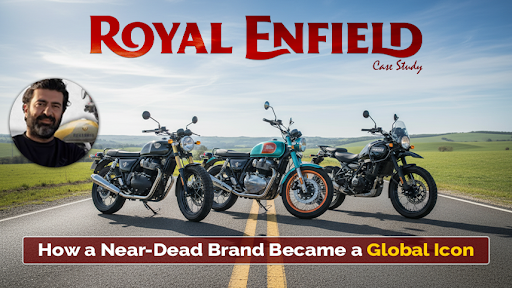
Royal Enfield Case Study: How a Near-Dead Brand Became a Global Icon
There are some stories in Indian business that feel almost unreal. Royal Enfield is one of them. There was a time when the brand had almost faded away. The bikes were seen as old, heavy and slow. The company was making losses. The market was shrinking. People believed the brand would not survive another decade. Yet today, Royal Enfield stands tall as the world’s largest manufacturer of mid-weight motorcycles. Its models dominate Indian roads, attract global riders, and have created a cult-like following that most companies can only dream of. This case study reveals how a dying brand turned into a global icon.
The Era When Royal Enfield Was on Life Support
In the early 1990s, India’s motorcycle market had changed. The country no longer wanted heavy machines. People wanted fuel-efficient bikes like Hero Splendor and Bajaj Caliber. Royal Enfield, with its old cast-iron engines and outdated design, was struggling. Sales dropped to almost 2,000 units a month, an extremely low number for a manufacturing company. Dealers were quitting. Mechanics said the bikes were too unreliable. Many insiders believed shutting down the brand was the only option left.
The Entry of Eicher Motors and a Ray of Hope
Everything changed in 1994, when Eicher Motors, led by CEO Siddhartha Lal, took charge of the failing brand. Lal was young, ambitious, and passionate about motorcycles. He believed Royal Enfield could be revived, but only if the product evolved. Most business leaders would have played it safe, yet he took bold decisions when the company had nothing to lose. This was the moment where the brand’s fate began to shift.

The Tough Decision That Saved the Company
Siddhartha Lal knew the company had too many businesses and too little focus. In 2000s, Eicher Motors had around 15 different businesses, from tractors to components. Lal took a brave step and shut down or sold almost all of them. He kept only trucks and motorcycles. This move shocked many people inside the industry because it felt risky. But Lal believed that unless Royal Enfield became a sharp priority, it would not survive. This focus helped the company rebuild its identity.
The New Engine That Changed Everything
For decades, the old cast-iron engine was both the charm and the problem. It looked classic but was unreliable and hard to maintain. In 2009, Royal Enfield introduced the UCE (Unit Construction Engine). This shift was a game changer because it made the bikes smoother, more reliable, and modern without losing the retro touch. Riders who once avoided the brand due to maintenance issues now trusted it. With the new engine came iconic models like the Classic 350, which soon became the most loved motorcycle in India.
How the Classic 350 Became a Cultural Phenomenon
The Classic 350 did not just sell well. It became a dream bike for millions. Young Indians who wanted style but also something unique found the perfect match. The bike had a nostalgic look, a strong road presence, and a thumping sound that felt like no other motorcycle. In just a few years, the Classic 350 alone started selling more than 50,000 units a month, a number that no one could have imagined in the 1990s. Riders felt emotions, and the brand transformed from a machine to a lifestyle.
Creating a Community, Not Just a Customer Base
One of the smartest moves by Royal Enfield was building a strong riding community. Events like the Himalayan Odyssey and Rider Mania connected riders across India. The brand understood something that many companies ignore: people do not just buy a motorcycle, they buy a feeling. By promoting travel, adventure, and brotherhood, Royal Enfield turned its customers into lifelong loyal fans. Most companies spend money on ads. Royal Enfield spent time building relationships, and that made the difference.

Expanding Global Presence with a Clear Vision
Once the brand became strong in India, the next step was global expansion. Royal Enfield focused on mid-weight motorcycles, a category dominated by European brands like Triumph. By keeping prices affordable and designs simple, the brand entered markets like the UK, USA, and Europe. In 2021, Royal Enfield became the world’s largest mid-weight motorcycle manufacturer, selling more than 8 lakh bikes a year. The Interceptor 650 even became the best-selling motorcycle in the UK for multiple years. This success proved that a brand born in England and rebuilt in India could compete with global giants.
Innovation Without Losing the Soul of the Brand
One reason Royal Enfield succeeded is because it never forgot its identity. While other companies kept chasing hyper-modern designs, Royal Enfield stayed true to its retro roots. The designs remained simple. The riding posture remained relaxed. The bikes kept their classic charm. At the same time, the company introduced modern features, improved engines, and better technology. This balance helped them attract both old fans and new-age riders.
The Himalayan and the Birth of a New Market Category
Another bold step was creating the Royal Enfield Himalayan, India’s first true adventure motorcycle. Many people questioned whether Indian riders needed such a bike. But the Himalayan proved itself on real roads. Riders used it for Ladakh, off-roading, and long-distance trips. It gave normal Indian riders the chance to experience adventure biking at a reasonable price. The success of the Himalayan pushed other brands to enter the segment, showing the power of market creation.
Lessons Indian Entrepreneurs Can Learn from Royal Enfield
The turnaround of Royal Enfield teaches important lessons. A brand can survive even the toughest times if it has clarity and courage. Focus matters more than size. A company must respect its roots but still evolve with time. Most importantly, emotions can be stronger than marketing. When people feel connected to your brand, they become your biggest supporters.
Conclusion: The Icon That Refused to Die
Royal Enfield’s journey is a reminder that no brand is truly finished if the vision is strong. From a near-dead motorcycle company to a global icon loved across continents, the turnaround proves what leadership, clarity, and customer connection can achieve. Today, when you hear the thump of a Bullet or see a Classic 350 on the road, you are not just looking at a motorcycle. You are witnessing one of the greatest comeback stories in Indian business history. And it all began with a belief that even old brands can rise again when the right person dares to dream.
- Business Case study
- Businessman
- Business Ideas


Rahul Malodia is a leading business coach in India, a Chartered Accountant, and the creator of the transformational Vyapari to CEO (V2C) program. With a mission to empower MSMEs, he has trained over entrepreneurs to systemize operations, manage working capital, and scale their businesses profitably.
Known for transforming traditional business owners into confident CEOs, Rahul delivers India’s top business coaching programs through bootcamps, workshops, and online courses. His practical strategies and deep industry insights have made him a trusted name among entrepreneurs seeking sustainable and scalable growth.
