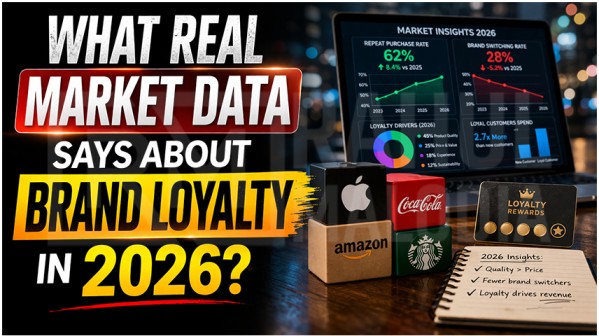
What Real Market Data Says About Brand Loyalty in 2026?
Imagine you run a growing business in India, maybe an MSME in Jaipur or a startup in Bengaluru. You spend on ads, offers, and social media, yet customers still drift away for a slightly better price or faster delivery.
It stings. But here is the thing, the 2026 market data quietly reveals. Brand loyalty has not died. It has simply changed shape. It is no longer about blind trust or one-time discounts. It is now about consistent value, personal relevance, and measurable behaviour.
For Indian entrepreneurs and CXOs navigating this year, understanding these shifts is not optional. It is the difference between steady growth and watching competitors pull ahead.
The Wake-Up Call: Loyalty Is No Longer Automatic
Walk into any Indian market today, and you will see shelves packed with choices. From kirana stores to quick-commerce apps, consumers have more options than ever.
Yet the latest reports show that true emotional loyalty, the deep kind where customers stick no matter what, has slipped. Globally, it dropped to 29% in 2025, and Indian patterns mirror this closely. Shoppers here are practical.
They stay with a brand when it feels fair, convenient, and rewarding in small everyday ways. Price sensitivity remains high, especially among middle-income families, but data also show that 68% of consumers still claim loyalty to specific brands when those brands deliver consistently. The shift is clear. Loyalty in 2026 is behavioural first, emotional second.
India's Loyalty Market Is Growing Faster Than Most Realise
The numbers paint an encouraging picture for anyone building a brand in India. The loyalty business market is set to hit 4.07 billion US dollars by the end of 2026, growing at 17.7% annually. Just last year, it stood at around 3.45 billion dollars, and forecasts point to 7.18 billion dollars by 2030.
This is not abstract growth. It reflects real money flowing into loyalty programmes across retail, e-commerce, and services.
Organised retailers and large digital platforms control daily touchpoints, which explains why their programmes scale quickly.
For smaller businesses, this surge signals opportunity. If you adopt even basic loyalty mechanics now, you can ride the same wave without needing massive budgets.
Imagine a line graph tracking India's loyalty market size. It starts at roughly $ 3.45 billion in 2025, climbs sharply to $ 4.07 billion in 2026, and continues rising steadily toward $ 7.18 billion by 2030. The curve does not flatten.
It accelerates because digital payments, UPI, and smartphone penetration make rewards instant and easy to redeem. That visual alone should make any founder pause and ask whether their current customer strategy is keeping pace.
Global vs Indian Loyalty Trends: A Clear Comparison
Indian consumer behaviour shows unique patterns when compared to global averages.
| Aspect | India (2026) | Global Average |
| Emotional Loyalty Rate | 32% | 29% |
| Annual Market Growth | 17.7% | 12.8% |
| Digital Programme Adoption | 76% | 61% |
| Price Sensitivity Impact | High (58% switch for price) | Medium (42%) |
This table highlights why Indian brands must balance emotional connection with strong value delivery. Growth is faster here due to a young population and a rapid digital shift, but price remains a bigger factor than in mature markets.
What Gen Z and Everyday Indian Shoppers Expect Now
Gen Z consumers, who form a huge chunk of future buyers, are reshaping the game. Recent surveys show 87% of them choose brands that carry personal meaning and align with their friends' choices.
Another 84% follow influencers who share authentic experiences rather than polished ads. In categories like fashion, beauty, and food delivery, names like Nike, Dove, Zomato, and Amazon top preference lists because they feel relevant and responsive. But older shoppers are not far behind.
Across age groups, Indians value fairness and consistency more than flashy rewards. A brand that over-promises or changes rules suddenly loses trust fast. The data is unanimous. Personal meaning and real experiences now matter more than points alone.
How Digital Ecosystems Are Rewriting Loyalty Rules
Flipkart Plus, Amazon Prime, and Paytm have set a high bar. These platforms do not just offer discounts. They create entire ecosystems where loyalty feels seamless. Shop on one, earn across others, redeem instantly through UPI.
Smaller brands often struggle to match this scale, yet the gap is not impossible to close. Data from channel loyalty reports shows that brands focusing on measurable ROI and behavioural engagement outperform pure incentive programmes.
Large players dominate because they own daily transactions, but smart MSMEs are catching up by partnering or building niche programmes.
The comparison is telling. Ecosystem brands see higher repeat rates because every interaction reinforces value, while standalone efforts often feel isolated and forgettable.
The Quiet Power of Tiered and Behavioural Programmes
Tiered loyalty programmes grew 32% year-on-year in India last year, and the trend continues strongly into 2026. Top-tier customers deliver two to five times more sales than base-level ones. This is not luck.
It is the result of aspiration and habit formation. Gold or platinum members feel recognised, and that recognition drives deeper engagement. For Indian businesses, this means moving beyond flat discounts to structured progression.
A small D2C brand offering early access or exclusive previews to loyal buyers sees retention jump significantly. The data backs it. Tiered systems create 41% higher retention compared to basic programmes. It is a simple but powerful lever that many founders are still overlooking.
Here is a clear side-by-side look at how loyalty programmes perform in 2026 based on real Indian market insights:
| Metric | Loyalty Programme Members | Non-Members |
| Annual Spend Growth | 12–18% higher | Baseline |
| Retention Lift | Up to 41% higher in tiered plans | Standard industry average |
| Brand ROI | 90%+ programmes show positive ROI | Harder to measure consistently |
This table is not a theory. It reflects what actually happens when brands invest in smart loyalty mechanics versus relying on price wars alone.
Retention Rates That Separate Winners from Strugglers
Across industries, average customer retention hovers around 75% in 2026. Media and professional services lead at 84%, while e-commerce sits lower at around 62%. In India, the pattern holds but with local twists.
Quick-commerce and food delivery apps like Zomato enjoy higher stickiness because convenience trumps everything for urban users. Yet for MSMEs selling physical goods, retention often lags unless they build direct relationships.
The lesson is practical. Track your repeat purchase rate monthly. If it stays below 70%, something in your experience or value delivery needs fixing.
Data does not lie. Brands that monitor retention closely and act on it grow faster than those chasing new customers endlessly.
Why Behavioural Loyalty Beats Emotional Appeals
Indian consumers have always been value-driven, but the 2026 data makes it crystal clear. Loyalty is now conditional on fairness, consistency, and experience rather than pure emotion or rewards.
Over-personalisation can backfire if it feels intrusive, while under-delivering on basics erodes trust instantly. Reports highlight that programmes reinforcing behaviour, like instant cashback or meaningful milestones, work better than generic points.
This shift explains why some legacy brands struggle while nimble players thrive. They focus on what customers actually do, not what they say they feel. For founders, this means auditing every customer touchpoint through a behavioural lens.
Common Pitfalls That Quietly Kill Loyalty in India
Many businesses still treat loyalty as an afterthought. They launch programmes with great fanfare but forget to maintain them. Channel partners report fatigue when enrolled in six or more schemes, yet engage with only a few.
Over-reliance on discounts creates price-sensitive customers who switch easily. Ignoring regional differences also hurts. What works in metros may flop in Tier-2 cities, where trust builds more slowly.
The data shows 51% of channel partners experience programme fatigue. Avoiding these traps starts with keeping programmes simple, relevant, and genuinely valuable over time.
Signs Your Brand Loyalty Strategy Needs Immediate Attention
| Sign of Weak Loyalty | Sign of Strong Loyalty | Impact on Business |
| Repeat purchase rate <65% | Repeat rate >75% | Higher lifetime value |
| High churn after offers | Steady base sales | Sustainable revenue |
| Negative feedback on trust | High NPS & referrals | Organic growth |
Watching these signals closely allows Indian entrepreneurs to adjust quickly before small issues become costly problems.
Future-Proofing Your Brand Loyalty Strategy
Looking at the full picture, brand loyalty in 2026 rewards those who treat it as a revenue engine rather than a cost centre. Anchor your metrics to lifetime value, share of wallet, and repeat behaviour.
Use data to personalise without overwhelming. Partner where you can, but own your customer relationships.
Indian entrepreneurs who do this well, whether running a single store or scaling nationally, turn loyalty into sustainable growth. The market data is not just numbers. It is a roadmap.
In the end, navigating brand loyalty in 2026 comes down to principles that work whether you are a solopreneur, a growing enterprise, or a large organisation.
As a strategic voice for business owners worldwide who translates real-world experience into scalable thinking and simplifies complex challenges into clear, actionable frameworks, the core truth remains timeless.
Build consistent value, respect your customers' time and intelligence, and loyalty follows naturally.
And, if you’re interested in learning more about such content, check out our website! Rahul Malodia, founder of Malodia Business Coaching, helps you build and scale a successful business.
Read more articles about business & keep learning and evolving to stay ahead in today’s competitive market.
- Market Analysis


Rahul Malodia is a leading business coach in India, a Chartered Accountant, and the creator of the transformational Vyapari to CEO (V2C) program. With a mission to empower MSMEs, he has trained over entrepreneurs to systemize operations, manage working capital, and scale their businesses profitably.
Known for transforming traditional business owners into confident CEOs, Rahul delivers India’s top business coaching programs through bootcamps, workshops, and online courses. His practical strategies and deep industry insights have made him a trusted name among entrepreneurs seeking sustainable and scalable growth.
