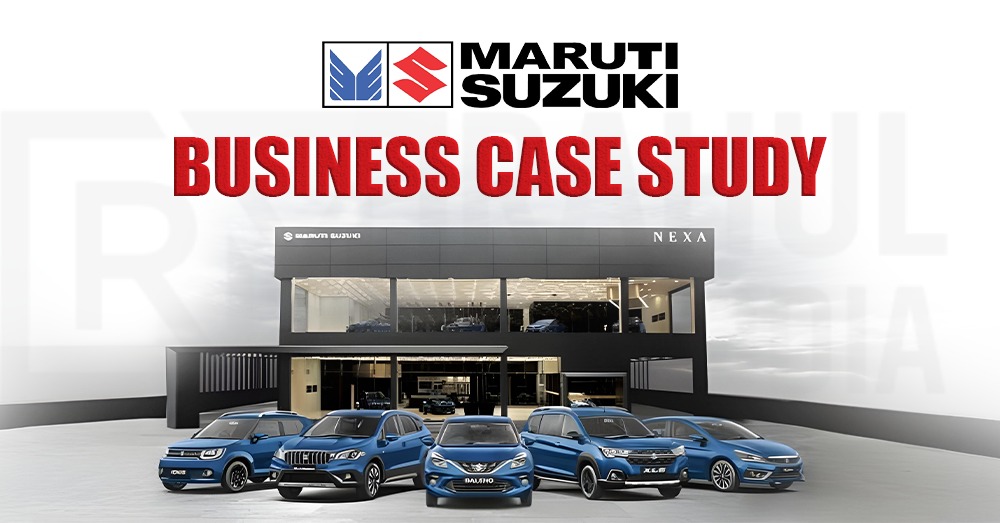
Maruti Suzuki Case Study: ₹4 Lakh Crore Startup Story That Changed Indian Roads Forever
Introduction: The First Car That Drove India's Dreams
Think of the first car your family owned. Chances are, it was a Maruti. Whether it was the iconic Maruti 800, a practical WagonR, or the stylish Swift, Maruti Suzuki cars have shaped the Indian lifestyle for decades. But how did it all begin? Here's a business case study of how Maruti Suzuki evolved into one of the top car companies in India. Its journey reflects not just an industrial success, but also the evolving dreams of an emerging nation. The emotional connect that Indians have with this brand makes it more than just a manufacturer — it's a household name, a trusted companion on countless family journeys.
Maruti Suzuki's Origin: A Government Vision Rooted in the Masses
In the early 1980s, owning a car in India was a distant dream for middle-class families. Cars were expensive, rare, and considered a luxury. It was in this environment that the Indian government envisioned an affordable car for the common man. Sanjay Gandhi, with a dream to make a "people's car," laid the foundation. After his untimely death, the government turned the idea into a national mission.
Maruti Udyog Limited was born as a public sector undertaking to fulfill this mission. This origin story is an important part of the Maruti Suzuki company profile, one that reflects resilience and purpose. It was not just a business plan — it was a socio-economic initiative to change how India moves. It is intended to not only manufacture vehicles but also to ignite a new era of accessibility and modernization for the Indian consumer.
Suzuki Enters India: The Indo-Japanese Partnership That Changed Everything
In 1982, Suzuki Motor Corporation of Japan entered into a joint venture with Maruti Udyog. At a time when foreign collaboration in India was minimal, this partnership stood out. Suzuki brought in cutting-edge technology, efficient production techniques, and global expertise, while India brought the mission to mobilize the nation.
This partnership marked a turning point in the history of the Indian car industry, leading to the creation of India’s first truly affordable car. It bridged the technological gap and set a precedent for global collaboration in Indian manufacturing. Suzuki’s engineering standards matched perfectly with India’s cost-conscious consumer market, making the alliance a textbook example of complementary strengths in international business.
Launch of Maruti 800: India’s First Affordable Family Car
The year 1983 saw the birth of the legendary Maruti 800. Compact, affordable, and fuel-efficient, it wasn't just a car — it was a revolution. The Maruti 800 transformed mobility in India and quickly became a household name.
This success wasn’t just product-led but also strategy-led. Maruti focused on availability, low maintenance, and nationwide service — a model unmatched by competitors. The Maruti Suzuki cars became synonymous with reliability. It gave a face to aspirations and democratized the idea of owning a car. People queued up outside dealerships for months. Owning a Maruti 800 became a symbol of progress and self-reliance.
Building Trust: Maruti’s Customer-Centric Growth Strategy
Maruti didn’t just focus on selling cars. It focused on solving Indian problems: rough roads, high fuel costs, and long commutes. It localized production, simplified servicing, and made spare parts widely accessible. Maruti Suzuki prioritized customer trust over flashy marketing.
By the 1990s, as India’s economy opened up, Maruti adapted quickly. It launched cars like Zen, Esteem, and WagonR to cater to India’s growing middle class. These were not just vehicles; they were aspirations within reach. With each launch, Maruti reinforced its commitment to affordability and trust. The network of service centers it developed allowed customers in even remote areas to access reliable after-sales service, reinforcing brand loyalty across geographies.
The Economic Boom and Rise of the Middle Class
Post-1991 liberalization brought more money into Indian hands and changed consumer behavior. Maruti was quick to understand this. It didn’t just ride the wave; it steered it.
While international companies like Hyundai and Honda entered the market, Maruti kept its edge with smart pricing and pan-India reach. This strategic adaptability is a cornerstone of the Maruti Suzuki company profile. The brand's alignment with India’s economic pulse helped it stay ahead. New financing options, EMI-based sales, and tie-ups with banks ensured that more families could afford a car. This integration of financial innovation with product strategy helped Maruti deepen its reach.
Competition, Challenges, and Consistency
As global players flooded India, Maruti didn’t panic. It focused on what Indians cared about: mileage, affordability, resale value, and ease of service. Models like Alto, Swift, and Dzire became bestsellers.
Instead of competing on luxury, Maruti competed on value. It strengthened its rural network and dominated Tier 2 and Tier 3 cities — a big reason why it's still considered among the top car companies in India. Its approach became a case study in localization and consistency. While competitors focused on cities, Maruti’s focus on semi-urban India gave it a strategic edge that continues to pay dividends.
Transition to Suzuki Ownership and the Nexa Experiment
By the early 2000s, the Indian government exited and Suzuki became the majority stakeholder. This opened the door to innovation. Maruti launched its own R&D center, new production plants, and Nexa — a premium retail brand.
Though not all Nexa models were hits, cars like Baleno and Ciaz helped Maruti rebrand itself for younger, urban audiences. The Nexa platform also helped in repositioning Maruti Suzuki as a modern, tech-savvy brand while retaining its traditional values. It allowed Maruti to enter a new customer segment, one that desired sophistication without compromising on practicality.
COVID-19, Setbacks, and the Digital Pivot
The COVID-19 pandemic disrupted manufacturing, but Maruti Suzuki responded swiftly. From online bookings to virtual showrooms, it embraced digital faster than most.
Its rural network helped it recover quickly post-lockdown. And behind the scenes, it began investing in a new future: electric vehicles. The pandemic served as a reset moment, pushing Maruti toward digital transformation and operational resilience. By ensuring online service requests, doorstep vehicle servicing, and transparent communication, Maruti turned adversity into opportunity.
Maruti Suzuki EV Plans and the Future of Mobility
The company is now working aggressively on its EV roadmap. It has partnered with Toyota for green mobility tech and is setting up new EV production facilities. Maruti aims to lead the EV revolution in Bharat, not just urban India.
As search trends for Maruti Suzuki EV plans rise, the brand is positioning itself as a tech-forward leader with sustainable ambitions. It envisions an ecosystem that supports EV adoption through infrastructure, affordability, and mass-market appeal. Battery safety, charging infrastructure, and customer education are the core pillars of its EV rollout strategy, which will shape the next phase of Indian mobility.
The ₹4 Lakh Crore Milestone and Shareholder Impact
Maruti Suzuki recently crossed a market cap of ₹4 lakh crore, making it one of the most valuable companies in India. This milestone is not just financial — it’s cultural.
Investors tracking the Maruti Suzuki share price have seen stable, long-term growth. Its consistent performance, even through economic cycles, makes it a favorite among retail and institutional investors. It has earned its place as a dependable blue-chip stock. The company’s performance reflects its strong governance, efficient capital utilization, and future-ready vision.
Why Maruti Suzuki’s Story Matters for Indian Entrepreneurs
Every Indian entrepreneur should study Maruti. It’s not just a car company; it's a lesson in:
- Understanding your customer
- Staying rooted in local needs
- Adapting without losing identity
- Scaling with humility and purpose
Maruti Suzuki built not just a brand, but a belief system. And that’s why it's still growing. It proves that longevity in business doesn’t come from being flashy — it comes from being foundational. Entrepreneurs can learn how to stay relevant, how to blend emotion with utility, and how to scale in a diverse market like India.
Final Thoughts: Driving India Forward
From a government dream to a globally recognized automobile powerhouse, Maruti Suzuki has rewritten what it means to build with intent. For India, it gave affordable mobility. For entrepreneurs, it gives a timeless lesson: start small, dream big, and never stop adapting.
Whether you care about cars, startups, or economic evolution, this is a story worth knowing. It’s more than just a case study; it’s a masterclass in nation-building through business.
Check out our detailed YouTube video on Maruti Suzuki’s case study
Frequently Asked Questions (FAQs)
Q1. When was Maruti Suzuki founded?
Maruti Udyog Limited was founded in 1981, and the joint venture with Suzuki Motor Corporation was formalized in 1982.
Q2. What was the first car launched by Maruti Suzuki?
The first car launched by Maruti Suzuki was the iconic Maruti 800 in 1983, which became India’s first affordable family car.
Q3. What is the current market cap of Maruti Suzuki?
As of the latest valuation, Maruti Suzuki has crossed a market capitalization of ₹4 lakh crore, making it one of India’s most valuable automobile companies.
Q4. What is Nexa in Maruti Suzuki?
Nexa is Maruti Suzuki’s premium retail network launched to cater to more urban, tech-savvy customers with models like Baleno, Ciaz, and Ignis.
Q5. Is Maruti Suzuki entering the electric vehicle (EV) market?
Yes, Maruti Suzuki is actively working on its EV roadmap in partnership with Toyota and is investing in EV production facilities and green mobility solutions.
Q6. Why is Maruti Suzuki so successful in India?
The brand's focus on affordability, service reach, low maintenance, and deep understanding of Indian consumers makes it a market leader even amidst tough competition.
- BusinessGrowth
- BusinessSuccess
- Businessman
- Business Case study


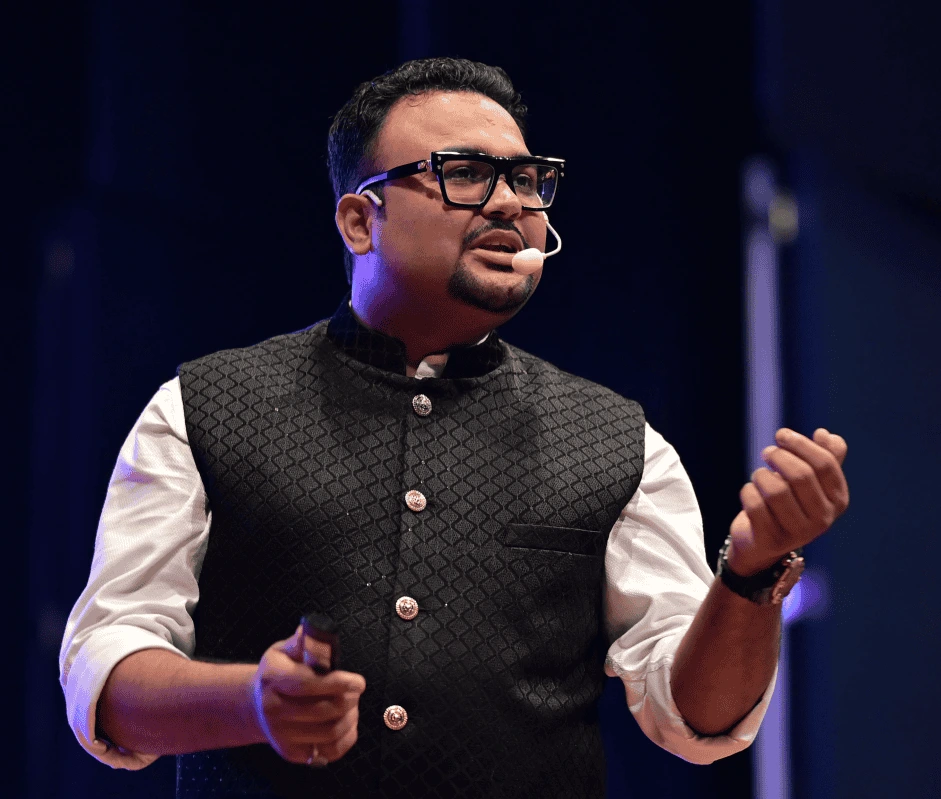
Rahul Malodia is a leading business coach in India, a Chartered Accountant, and the creator of the transformational Vyapari to CEO (V2C) program. With a mission to empower MSMEs, he has trained over entrepreneurs to systemize operations, manage working capital, and scale their businesses profitably.
Known for transforming traditional business owners into confident CEOs, Rahul delivers India’s top business coaching programs through bootcamps, workshops, and online courses. His practical strategies and deep industry insights have made him a trusted name among entrepreneurs seeking sustainable and scalable growth.
