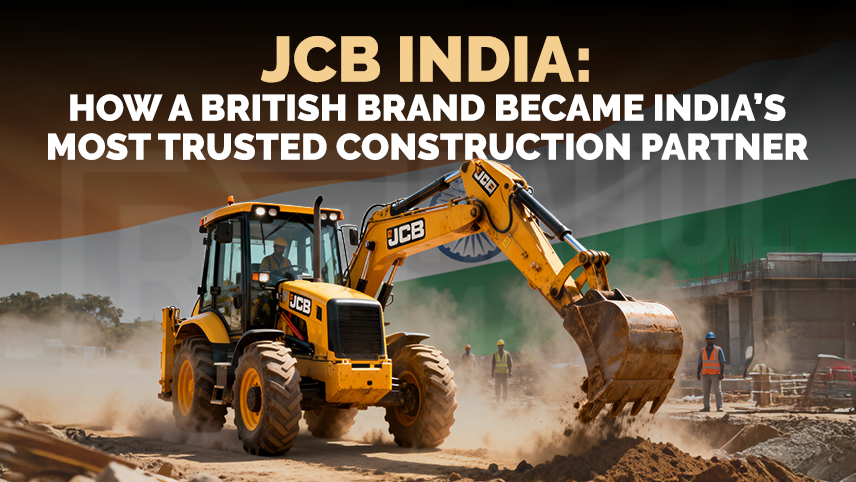
JCB India: How a British Brand Became India’s Most Trusted Construction Partner
There are some brands that don’t need an introduction because they have become a part of daily life. JCB is one of them. If you have ever passed a construction site, watched a road being repaired, or seen a building rise from the ground, chances are that the bright yellow machine you noticed was a JCB. But the real story of how a British company became India’s most trusted construction partner is far deeper than what meets the eye. And once you hear it, you start looking at those machines with a different kind of respect.
The Beginning of a Relationship India Didn’t Expect
When JCB entered India in 1979, very few people thought it would go on to become the backbone of the country’s infrastructure dreams. India was still developing its construction and industrial sectors. Machines were scarce and work took more time because most of it depended on human hands. JCB saw a gap. India saw an opportunity. No one knew this partnership would shape the future in such a big way.
How JCB Became a Part of India’s Growth Story
Over the years, India began building faster. Highways, metros, housing projects, and smart cities needed machines that could work in tough weather, rough land, and long hours. JCB stepped in with backhoe loaders, excavators, and compactors that worked like trusted soldiers. What made the difference was reliability. If a contractor invested in a JCB machine, he knew it wouldn’t stop in the middle of work. This simple trust helped JCB become a go-to name for big and small builders across the country.

Why JCB Connected So Deeply With Small Business Owners
One of the biggest reasons JCB became famous in India is because it empowered small entrepreneurs. A single JCB machine became a business for thousands of owners across states. Many people who had no background in construction bought one machine and started renting it out. In towns and villages, owning a JCB almost became a symbol of growth. A farmer in Rajasthan or a contractor in Bihar could earn daily income from rental demand. This made JCB not just a foreign brand but a partner in the dreams of ordinary Indians.
A Brand That Spoke the Language of Indian Conditions
India is a tough place for machines. The climate shifts from extreme heat to heavy rains. Roads can be smooth on one side and rocky on the other. Diesel prices change. Labour availability changes. JCB understood this reality and built machines suited for India’s challenges. They launched India-made models, increased fuel efficiency, simplified repair processes, and ensured local availability of spare parts. Slowly, JCB machines started feeling “Indian” even though the company was originally British.
The Made-in-India Turning Point
The real breakthrough came when JCB set up its first factory in Ballabgarh, Haryana, and later expanded to Pune and Jaipur. Today, JCB runs five factories in India and exports machines to more than 100 countries. This means the JCB you see working at a road site in Delhi might have a twin working somewhere in Africa or South America. India became JCB’s second largest market after the UK, and more than 90 percent of the construction equipment in India’s backhoe loader category is dominated by JCB. This is not a small achievement. It shows how deeply the company has captured the trust of the Indian market.
How JCB Became a Household Name Beyond Construction
You know a brand has won when it becomes a part of normal conversations. For JCB, this happened in an unexpected way. People began using the word "JCB" for any large digging machine, even if it wasn’t actually a JCB. Kids started calling toy excavators “JCB toys.” Social media was full of videos where people gathered to watch the machine at work. It became entertainment, sometimes even a spectacle. This cultural connection made JCB more than a company. It became a name that represents power, progress, and curiosity.
Real Projects That Show JCB’s Impact on India
If you look at India’s major development projects over the past two decades, JCB machines have played a crucial role. Whether it was the construction of the Golden Quadrilateral highways, the Mumbai Metro, the Delhi Airport expansion, or rebuilding flood-affected areas in Kerala and Uttarakhand, JCB machines worked day and night. In disaster zones, these machines helped clear debris and save lives. They became silent partners in both progress and recovery. This practical impact built a connection that marketing alone could never create.
Why Businesses Trust JCB More Than Any Other Brand
Trust is not built by being the oldest or the biggest. It is built through consistency. Business owners trust JCB because the machines last long, need fewer repairs, and maintain strong resale value. Someone who buys a JCB knows that even after five years, the machine can be sold at a good price. JCB also invested heavily in service centres, training facilities, and operator skill development. For any entrepreneur using JCB, it feels like the company stands with them even after the machine is sold.
Technology, Innovation, and the New Future of JCB India
Today’s construction world is changing. Sites are becoming smarter. Machines are becoming digital. JCB has kept up with this shift by introducing telematics, fuel monitoring, safety controls, and real-time machine tracking. Contractors can now monitor their machines from their phones. This kind of technology makes JCB ready for India’s next phase of growth, especially with the push towards green energy, massive infrastructure projects, and rapid urbanization.

What Makes JCB India’s Most Trusted Construction Partner
When you look at the full story, you realize that JCB did not become India’s favorite by chance. It earned its place by understanding the country’s needs, supporting small entrepreneurs, investing in local manufacturing, and consistently delivering machines that could survive Indian conditions. It stayed close to the people who used its machines. It brought global quality to local problems. And most of all, it never stopped improving.
The Journey Ahead
India is entering a new era of infrastructure growth. Roads, airports, industries, renewable energy plants, and urban expansion will shape the next decade. And somewhere in the background, a yellow machine will continue to move the earth one bucket at a time. JCB started as a British brand. But today, its story in India feels very Indian. It is the story of trust, hard work, and growth shared between a company and a nation.
- Business Case study
- Market Analysis
- Entrepreneurship
- LeadershipDevelopment
- Business case study



Rahul Malodia is a leading business coach in India, a Chartered Accountant, and the creator of the transformational Vyapari to CEO (V2C) program. With a mission to empower MSMEs, he has trained over entrepreneurs to systemize operations, manage working capital, and scale their businesses profitably.
Known for transforming traditional business owners into confident CEOs, Rahul delivers India’s top business coaching programs through bootcamps, workshops, and online courses. His practical strategies and deep industry insights have made him a trusted name among entrepreneurs seeking sustainable and scalable growth.
