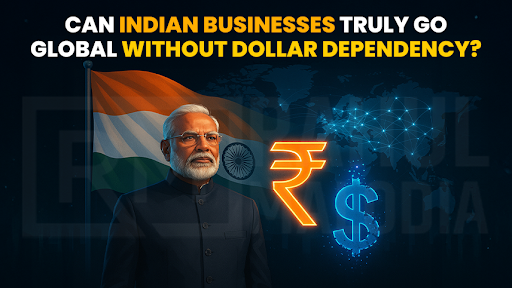
Can Indian Businesses Truly Go Global Without Dollar Dependency?
Every Indian entrepreneur has dreamt of taking their business global. From a small textile exporter in Surat to a tech startup in Bangalore, the ambition to serve international markets runs deep in our veins. But there’s one shadow that constantly follows us, the shadow of the U.S. dollar. For decades, the dollar has been the king of global trade, and Indian businesses have had no choice but to bow to it. But today, a new question is emerging: Can Indian businesses really grow worldwide without depending on the dollar?
This is not just an academic debate. It’s a real-world puzzle that decides how much profit an exporter takes home, how much risk an importer faces, and how much control India as a country has over its economic destiny. Let’s break it down and see if Indian businesses can actually stand tall on the world stage without leaning on the dollar.
The Dollar’s Invisible Grip
Take a moment and think about it. Why is it that whether you’re exporting spices to the Middle East or importing machinery from Germany, most transactions still end up being settled in dollars? It’s not because India doesn’t trust the rupee. It’s because the dollar has become the default language of trade. India now stands as the fifth-largest economy in the world and is rapidly progressing toward the $5 trillion milestone dollar, according to the Bank for International Settlements.
This dominance creates both security and problems. On one hand, the dollar is stable, trusted, and widely accepted. On the other hand, it puts Indian businesses at the mercy of something they can’t control: exchange rates. A small change in the USD–INR rate can wipe out months of hard work for an exporter. Many Indian companies, especially in IT services and pharmaceuticals, know this pain too well.
The Cost of Dollar Dependency
When you sell software to a U.S. client or ship cotton to a European buyer, payments often arrive in dollars. That sounds fine until you realize that every fluctuation in the dollar impacts your earnings. When the Indian rupee slides from 74 to 83 against the dollar, exporters rejoice that their overseas earnings convert into higher profits in rupee terms. But importers, say, a car manufacturer buying spare parts from Japan, suffer because their costs shoot up.
This creates a strange imbalance. Your success or failure doesn’t just depend on your hard work, but also on the dollar’s mood swings. That’s not healthy for long-term growth. Even India as a nation feels the pressure. Since we import over 85% of our crude oil needs, a stronger dollar makes fuel more expensive, which pushes up inflation for every Indian household.
The Rupee’s Global Journey, Slow but Steady
Now, let’s flip the coin. The Indian Government and the Reserve Bank of India (RBI) are not ignoring this issue. Over the past few years, they have been taking steps to internationalise the rupee. Exporters and importers were allowed to settle their trade in Indian Rupees from July 2022. This move was aimed at reducing dependency on the dollar, especially during times of global uncertainty.
And it’s not just theory. Countries like Russia, Sri Lanka, and even parts of Africa have started showing interest in rupee trade. For example, India and Russia explored rupee-ruble trade settlements after Western sanctions cut Russia’s access to dollar-based systems. Oil deals with Russia during 2022 and 2023 saw payments being made in non-dollar currencies, showing that alternatives are possible.
Lessons from Other Economies
India is not alone in this journey. For more than ten years, China has been actively promoting the yuan as a key currency in global trade.
According to the SWIFT data, around 5% of global payments are done in yuan. It might sound small compared to the dollar, but it’s a huge leap for a currency that barely had global acceptance twenty years ago.
From now onwards, Gulf nations are preferring currencies other than the US dollar for selling oil. The UAE and India recently signed agreements to settle some oil payments in rupees. These examples show that breaking free from dollar dependency is difficult, but not impossible. The key lies in building trust and ensuring the world sees your currency as stable and reliable.
Can Indian Businesses Trust the Rupee Globally?
Here’s the hard truth: for Indian businesses to truly go global without the dollar, the rupee must first gain global trust. Businesses abroad want predictability. They want to be sure that the rupee won’t suddenly lose value. This is where India’s economic fundamentals come into play.
India has emerged as the world’s fifth-largest economy and is steadily moving ahead on its journey to become a $5 trillion powerhouse.
With foreign exchange reserves crossing $600 billion in 2023, the country is better equipped to protect its currency and stay strong even during global challenges. Inflation, though still a challenge, has been largely kept under control compared to many emerging economies. All these factors make the rupee a candidate for global trade. But the process is not a snap of hand, it will take a lot of hard work, patience and workflow.
Real-World Examples from Indian Businesses
Let’s bring this closer to home. Consider an exporter from Tirupur, Tamil Nadu, who sells cotton T-shirts to Europe. If his contracts are priced in dollars, every fluctuation eats into his margin. But if the buyer agrees to trade in rupees, suddenly the uncertainty reduces. His books become easier to manage.
In another case, ONGC and Indian Oil Corporation have been part of rupee-settled oil imports from Russia. This isn’t just about saving costs. It’s about creating a proof of concept that rupee-based trade can actually work in the real world, not just in policy papers.
Tech giants like Infosys and TCS, which earn billions in export revenues, are also exploring how alternative trade settlements can protect them from dollar volatility. While complete de-dollarisation is far away, partial moves are already happening.
The Psychological Barrier
But there’s a hidden challenge that rarely gets talked about, the mindset of business owners. For decades, the value of a fixed amount of gold was tied with the value of US dollars. Convincing a foreign buyer in Germany or the U.S. to accept rupees instead of dollars is not easy. Even Indian exporters themselves often feel more secure when payments come in dollars because they believe it’s safer.
This mindset shift will take time. It’s like convincing someone who has always used gold to suddenly trust silver. The value is there, but the perception needs to change.
The Geopolitical Angle
Let’s not forget the role of politics here. The dollar is not just a currency; it’s a symbol of U.S. power. Moving away from it is not purely an economic decision, it has geopolitical consequences. When India buys oil from Russia in rupees, it’s not just about saving money. This is also an announcement to the world that India can build its own way to success
This independence is crucial for Indian businesses. Imagine being able to trade with Africa, Southeast Asia, or the Middle East directly in rupees. It would reduce costs, speed up transactions, and shield businesses from external shocks. But it would also mean India must strengthen its diplomatic and economic ties to make such deals acceptable.
What the Future Holds
So, can Indian businesses truly go global without dollar dependency? The answer is layered. Complete independence from the dollar may not be realistic anytime soon. The dollar is too entrenched in global systems. But partial independence, where a growing share of trade is settled in rupees or other currencies, is already happening.
For Indian entrepreneurs, this means opportunity. The more the rupee is used in global trade, the less you’ll have to worry about exchange rates eating into your profits. It also means India’s rise as a confident economy that doesn’t always need to lean on foreign systems.
Conclusion
Indian businesses are standing at a turning point. On one side lies the comfort of continuing with dollar dependency. And the other side of the coin includes the challenges of using rupee at the centre. This path is not easy, but the results would change everything in the right direction. A world where Indian businesses can go global without the dollar is not just a dream; it’s a possibility slowly taking shape.
The question is, are Indian entrepreneurs ready to believe in the rupee as much as they’ve believed in the dollar? Because the real shift will not come from policies alone. It will come when every Indian exporter, importer, and entrepreneur decides that the rupee is strong enough to carry them across the world stage.
Read more: American tariff war
- Business in War



Rahul Malodia is a leading business coach in India, a Chartered Accountant, and the creator of the transformational Vyapari to CEO (V2C) program. With a mission to empower MSMEs, he has trained over 5,00,000+ entrepreneurs to systemize operations, manage working capital, and scale their businesses profitably.
Known for transforming traditional business owners into confident CEOs, Rahul delivers India’s top business coaching programs through bootcamps, workshops, and online courses. His practical strategies and deep industry insights have made him a trusted name among entrepreneurs seeking sustainable and scalable growth.
