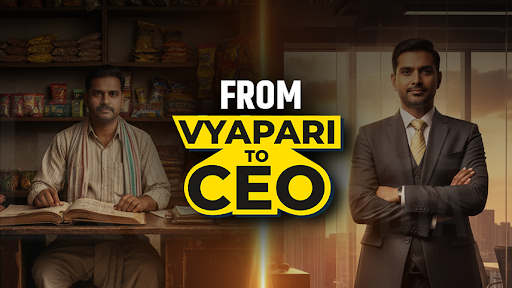
Indian Business Success Stories: From Vyapari to CEO
The Indian Entrepreneur’s Silent Struggle
Every Indian business owner begins their journey with a dream. Some start with a small kirana shop, some with a factory unit in a rented space, and others with a modest service-based business. But one truth unites them all: most start as vyaparis, traders, and hustlers, who work day and night to survive. The challenge is not just about keeping the business alive, but about breaking free from that trap and becoming a true CEO who builds systems, scales operations, and leads with vision.
This leap from " vyapari to CEO " is not a small step. It is a transformation. It is a shift in everything, whether it is mindset, strategy, or leadership. And while thousands of Indian entrepreneurs struggle to make this change, a handful have shown us that it can be done. Their stories are not just inspiring; they are proof that Indian businesses can rise beyond limits if they learn how to evolve.

Why Many Indian Business Owners Stay Stuck as Vyaparis
When you sit down with Indian entrepreneurs, a clear pattern quickly begins to emerge. They wake up early, check inventory, manage employees, handle customers, deal with vendors, and by the time they end the day, there is no energy left for strategy or growth. They run everything themselves because they fear delegation. They treat their business like a daily survival game rather than a structured enterprise.
This is why many businesses, even after 10 or 20 years, stay small. They earn money, yes, but the growth stops at a certain point. Without systems, processes, or leadership development, the owner becomes the biggest bottleneck. This is the harsh truth of why so many vyaparis never become CEOs.
But when someone dares to break the cycle, their story becomes a lesson for all of us.
The D-Mart Story: From Shopkeeper to India’s Retail Giant
Let’s begin with one of the most powerful examples, Radhakishan Damani, the founder of D-Mart. Damani, raised in a humble household, began his journey in Mumbai as a small-time stockbroker. He did not come from a glamorous business school or with foreign investors backing him. Yet, he had one thing most vyaparis lack, clarity of vision.
He realized that the Indian middle class needed affordable retail stores, not fancy malls. Instead of copying Western retail formats, he built a model that was deeply rooted in Indian consumer behavior. Every store was designed to provide value, not just style. Damani believed in buying land instead of renting, which kept costs low.
From a trader in the stock market to the owner of a ₹4.8 lakh crore retail empire, his journey shows how an Indian businessman can move from hustling in markets to becoming a CEO who shapes an entire industry. D-Mart today competes with giants like Reliance Retail and Amazon, proving that a vyapari mindset can evolve into a CEO mindset if vision and discipline guide the way.
Nirma: The Detergent Revolution of a Small Trader
Think about the name Nirma. For countless Indians, this isn’t merely a brand, it’s a piece of their memories and emotions. But the story behind Nirma is even more powerful. Back in the 1960s, Karsanbhai Patel began his journey by selling detergent powder door-to-door on his bicycle. He was a small-time chemist from Gujarat. At that time, Hindustan Unilever’s Surf was the dominant player, priced much higher than what common households could afford.
Patel decided to create an affordable alternative. He priced his detergent at just ₹3 per kilo, while Surf was charging ₹15 for the same. He personally distributed packets, going door to door after work. Slowly, the product gained trust, and the demand exploded.
What makes Patel’s story remarkable is not just that he created a brand, but that he turned a micro-trading venture into a structured business that challenged multinational corporations. By the 1980s, Nirma had become a household name, holding 60% of the Indian detergent market. Patel had made the leap from vyapari to CEO, not by copying anyone, but by understanding the Indian customer better than anyone else.
How Rahul Malodia’s V2C Idea Speaks to This Transition
In today’s business world, coaches like Rahul Malodia often talk about the “Vyapari to CEO” shift. His V2C program is built on a simple but powerful idea: a businessman must stop being the worker in his business and start being the leader of it.
Malodia has worked with thousands of Indian entrepreneurs and identified the same pattern: businesses remain small not because of a lack of money, but because of a lack of systems and mindset. The moment business owners master hiring the right people, smart delegation, financial management, and long-term thinking, they open doors to growth that once felt out of reach.
This structured way of thinking is what differentiates a vyapari, who is stuck in operations, from a CEO, who builds institutions.
Infosys: The Story of Founders Who Chose the CEO Path
Another real-life example that captures this leap is Infosys. In the 1980s, IT was not a glamorous industry in India. Narayana Murthy and his small team of engineers started Infosys with just ₹10,000 borrowed from his wife, Sudha Murthy. At first, they were nothing more than struggling entrepreneurs, hustling to get small projects and survive.
But what set them apart was their choice to think like CEOs from the beginning. Instead of chasing short-term contracts, they focused on building trust with global clients, investing in employee culture, and creating transparent systems. Infosys became one of the first Indian companies to list on NASDAQ, a milestone that symbolized India’s entry into the global IT stage.
What Murthy and his co-founders proved was simple: even if you start as a small entrepreneur, if you build systems, culture, and processes, you can transition into a global CEO who competes at an international level.
Why the Leap Matters for India’s Future
India today has over 63 million MSMEs (Micro, Small, and Medium Enterprises). They employ nearly 110 million people and contribute about 30% of India’s GDP. But here’s the problem: most of these businesses remain stuck at a small scale because their owners never move beyond the vyapari mindset.
If even a small percentage of these MSME owners could transform into CEOs who think big, adopt technology, build systems, and scale, India’s economy would explode with new opportunities. More jobs would be created, more industries would rise, and Indian companies would not just survive, but dominate on the global stage.
The Emotional Side of the Journey
Let’s not forget, the transition from vyapari to CEO is not only about strategy. It is also about courage, fear, and personal sacrifice. Imagine telling your family that you want to risk your savings for expansion. Imagine trusting employees when you’ve been betrayed before. Imagine stepping back from daily work and trusting systems you’ve built.
For many Indian entrepreneurs, this is the hardest part. The fear of losing control, the fear of failure, and the comfort of doing everything yourself keep them trapped. But every story of transformation, whether it’s D-Mart, Nirma, or Infosys, proves one thing: only those who are willing to let go of fear and embrace vision can truly become CEOs.
Lessons Every Indian Entrepreneur Can Take Away
The stories of Damani, Patel, and Murthy may sound larger than life, but their lessons are simple. They understood customers deeply. They focused on building systems, not just daily sales. They dared to think long term when everyone else was looking at quick profits.
This mindset is the bridge between a vyapari and a CEO. And while not everyone will build the next Infosys or D-Mart, every business owner can make their own leap by asking a simple question every day: “Am I running my business, or am I building it to run without me?”
Conclusion: The Call for Indian Entrepreneurs
The phrase “From Vyapari to CEO” is not just a catchy slogan. It is the call of our times. India is no longer a land of survival businesses; it is a land of opportunity. Those who remain vyaparis will keep struggling in small markets. But those who dare to think like CEOs will build companies that inspire generations.
The stories of D-Mart, Nirma, and Infosys prove that it is possible. Rahul Malodia’s V2C program shows that there is a structured way to make this leap. And millions of Indian business owners today stand at that crossroad, deciding whether they will remain stuck or take a step forward.
The question is simple: will you remain a vyapari, or will you become the CEO your business truly deserves?
FAQs: From Vyapari to CEO
Q1. What does it mean to move from Vyapari to CEO?
It means shifting from being a trader who manages daily survival to becoming a leader who builds systems, scales operations, and creates long-term growth.
Q2. Why do most Indian business owners stay stuck as Vyaparis?
Because they do everything themselves, managing employees, customers, and vendors, without delegating or building systems, which limits growth.
Q3. What lessons can we learn from D-Mart’s founder, Radhakishan Damani?
He showed that clarity of vision, discipline, and building for Indian customers’ needs can turn a small trader into the CEO of a retail giant.
Q4. How did Nirma’s Karsanbhai Patel succeed as a small trader?
By creating affordable detergent and distributing it himself, Patel built trust and scaled Nirma into a brand that challenged multinational corporations.
Q5. What role does Rahul Malodia’s V2C program play in this journey?
It guides entrepreneurs to stop working in their business and start leading it by focusing on systems, delegation, and CEO-level thinking.
Q6. How did Infosys' founders make the leap to global CEOs?
They focused on culture, transparency, and long-term trust with clients, proving that structured systems can scale a small team into a global IT leader.
Q7. Why is the Vyapari to CEO leap important for India’s future?
If more MSME owners adopt a CEO mindset, India’s economy can unlock massive growth, create jobs, and compete globally.
Q8. What is the biggest emotional challenge in this transition?
Overcoming fear, fear of delegation, failure, and losing control. True growth begins when entrepreneurs trust their systems and vision.
Q9. Can every Indian business owner make this shift?
Yes. Not everyone will build the next Infosys or D-Mart, but every owner can grow by asking: “Am I running my business, or is it built to run without me?”
Q10. What’s the first step to move from Vyapari to CEO?
Start by delegating small tasks, building basic systems, and focusing on strategy instead of only day-to-day operations.
- Entrepreneurship
- becoming a ceo


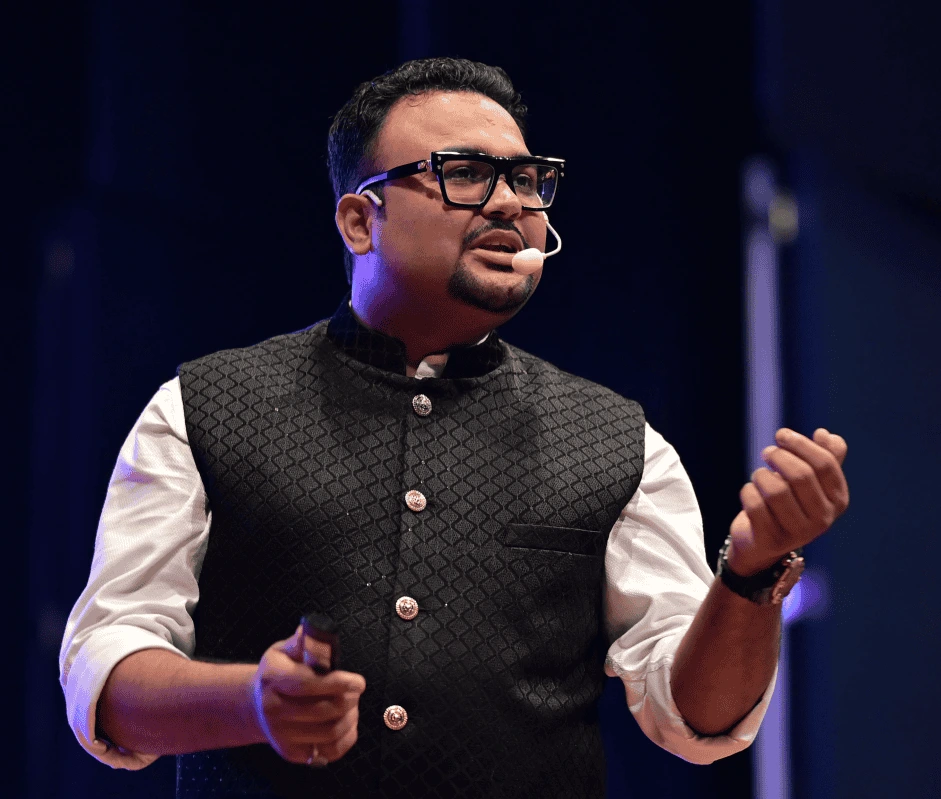
Rahul Malodia is a leading business coach in India, a Chartered Accountant, and the creator of the transformational Vyapari to CEO (V2C) program. With a mission to empower MSMEs, he has trained over entrepreneurs to systemize operations, manage working capital, and scale their businesses profitably.
Known for transforming traditional business owners into confident CEOs, Rahul delivers India’s top business coaching programs through bootcamps, workshops, and online courses. His practical strategies and deep industry insights have made him a trusted name among entrepreneurs seeking sustainable and scalable growth.
