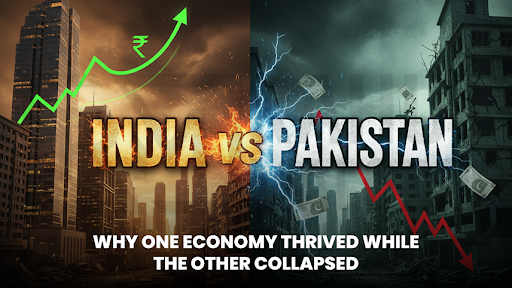
India vs. Pakistan: Why One Economy Thrived While the Other Collapsed
India vs. Pakistan: Why One Economy Thrived While the Other Collapsed
Two countries. One history. One starting line.
Yet today, one is a global growth engine, and the other is fighting just to survive.
In 1947, when India and Pakistan were born, nobody knew how different their futures would be. Both nations shared pain, partition, and poverty. Both had dreams of becoming great. But somewhere along the way, one built an empire of progress, while the other drowned in crisis.
This isn’t just a story about economies. It’s a story about vision, mindset, and leadership, lessons every Indian entrepreneur can learn from.
The Same Start, Different Choices
When the British left, both India and Pakistan were poor.
But Pakistan actually had an edge, fertile land, rivers, and less population. Many experts believed it would do better than India.
India, on the other hand, was huge, chaotic, and wounded by partition. Millions were displaced. Food was scarce. People were broken. But even in that chaos, India had something powerful, a long-term vision.
Leaders like Nehru and Patel didn’t chase quick fixes. They focused on building institutions, IITs, IIMs, AIIMS, and the Planning Commission. These institutions became the roots of modern India.
Pakistan, however, took another road. It leaned on foreign aid instead of building its own foundation. It relied on others’ money, not its own capacity. And that one choice shaped its destiny.
When Politics Becomes the Enemy of Progress
An economy is only as strong as its politics.
India stayed democratic. Governments changed, but democracy never stopped. People protested, debated, and voted, and that process, messy as it was, created stability.
Pakistan didn’t get that chance. Military coups became normal. Since independence, Pakistan has seen over 30 prime ministers and several military takeovers. How can a country grow when its rules keep changing?
Investors need trust. Businesses need predictability. India offered both. Pakistan offered neither.
That’s why global companies opened offices in Bengaluru, not Karachi. That’s why venture capitalists invested in Indian startups, not Pakistani ones. Stability builds confidence, chaos kills it.
1991: The Year India Changed Its Destiny
By the early 1990s, India was struggling. The economy was weak. Foreign reserves were so low that the government could barely pay for a few weeks of imports. It looked like the end.
But instead of collapsing, India transformed.
In 1991, Dr Manmohan Singh and P. V. Narasimha Rao launched historic reforms. They opened markets, reduced government control, and invited foreign investors.
That single decision rewrote India’s story.
It birthed a new age of growth, the IT boom, global trade, and private entrepreneurship.
Infosys, Wipro, and TCS rose from Indian soil. The world started calling India “the back office of the planet.”
Meanwhile, Pakistan didn’t reform. It stayed dependent on loans and aid from the IMF, the U.S., and China. Every time things went wrong, it borrowed more, until it couldn’t borrow anymore.

The Power of Consistency
India’s growth wasn’t fast in the beginning. It was slow, painful, and often frustrating. But it was consistent.
Reforms kept happening. The Green Revolution boosted agriculture. The IT Revolution created jobs. The Startup Revolution inspired the youth.
Today, India produces everything, from software to steel, from satellites to smartphones. Its economy doesn’t depend on one thing. If one sector slows, another one takes over.
Pakistan, sadly, never diversified. Its economy still relies heavily on agriculture and textiles. When floods destroy crops or cotton prices fall, the entire system shakes. That’s what happens when growth depends on luck, not planning.
The Digital Leap That Changed India Forever
The 2010s marked a new chapter, the digital revolution.
When Jio entered the market, it made internet access affordable for millions. Suddenly, a farmer in Bihar could use the same internet as a student in Mumbai.
Digital India, UPI, and Aadhaar weren’t just government schemes. They became economic equalisers.
UPI alone turned India into the world’s largest digital payment system, handling over 10 billion transactions a month.
This digital ecosystem helped small businesses, shopkeepers, and entrepreneurs grow faster than ever. You didn’t need a big office to start something big, just a smartphone and an idea.
Pakistan missed this wave. Poor internet infrastructure and unstable power supply kept its people disconnected. When India was building fintech unicorns, Pakistan was battling blackouts.
Numbers Never Lie
Sometimes, the numbers say everything.
In 2024, India’s GDP stood at $3.9 trillion, making it the 5th largest economy in the world. Foreign reserves crossed $640 billion, and the rupee stayed relatively stable. Inflation, though rising at times, stayed manageable.
Pakistan’s GDP, in contrast, was around $340 billion, almost one-tenth of India’s. Its foreign reserves often fell below $8 billion, and inflation crossed 25%. The Pakistani rupee plunged beyond PKR 300 per dollar.
For a nation that once dreamed of leading South Asia, it was a painful reality.
Why the World Trusts India
Trust is currency in global business.
When investors see India, they see a billion people, political stability, and a growing middle class. They see a nation that debates, disagrees, but still moves forward.
That’s why countries like Japan, the U.S., and the UAE have poured billions into Indian infrastructure, energy, and startups. India is no longer just a market; it’s a partner in progress.
Pakistan, however, lost that trust. Frequent government collapses, rising extremism, and debt dependency scared investors away. Even China, once its closest economic ally, began pulling back.
In global trade, trust is everything. Once it’s gone, rebuilding it can take decades.
The Entrepreneur’s Lesson
If you’re a business owner, this story should hit home.
India’s rise wasn’t about luck; it was about long-term vision. It built slowly, invested in education, and created systems that empower people.
Pakistan’s fall wasn’t about bad luck; it was about bad choices. It chose shortcuts over sustainability. It chose aid over innovation. It never built a stable system for growth.
Think of it like running a business.
If you keep borrowing without building, you collapse. If you focus on stability, innovation, and people, you grow, even if it takes time.
India played the long game. Pakistan didn’t.
Where They Stand Today
As of 2025, India is preparing to become a $5 trillion economy by 2027.
It’s leading in manufacturing, digital payments, and renewable energy. The world now sees India as the future of growth.
Pakistan, meanwhile, continues to struggle with debt, political fights, and inflation. It’s under constant IMF programs just to keep the lights on.
The contrast is heartbreaking but real. Two nations that started together, one becoming a global force, the other fighting for survival.
The Real Difference: Mindset
In the end, the gap between India and Pakistan isn’t just economic, it’s mental.
India believed in building, even when the progress was slow. Pakistan believed in shortcuts, even when the cost was high.
India built for tomorrow. Pakistan borrowed for today.
India trusted its people. Pakistan trusted foreign aid.
And that’s the biggest lesson of all. Growth comes from within, not from outside help.
Conclusion: A Tale of Two Visions
History gave both countries the same chance.
India turned its pain into power. Pakistan turned its potential into problems.
The world now looks at India with respect, a nation that stayed democratic, grew digital, and kept moving despite all odds.
Pakistan’s story is still being written, but unless it changes its mindset, it will remain trapped in a cycle of debt and dependence.
For every Indian entrepreneur reading this, remember this truth: Nations and businesses grow the same way, through clarity, patience, and courage.
India didn’t just survive. It transformed. And that transformation is a lesson the whole world can learn from.
- government schemes
- Market Analysis
- Financial Freedom
- Business Finance



Rahul Malodia is a leading business coach in India, a Chartered Accountant, and the creator of the transformational Vyapari to CEO (V2C) program. With a mission to empower MSMEs, he has trained over 5,00,000+ entrepreneurs to systemize operations, manage working capital, and scale their businesses profitably.
Known for transforming traditional business owners into confident CEOs, Rahul delivers India’s top business coaching programs through bootcamps, workshops, and online courses. His practical strategies and deep industry insights have made him a trusted name among entrepreneurs seeking sustainable and scalable growth.
