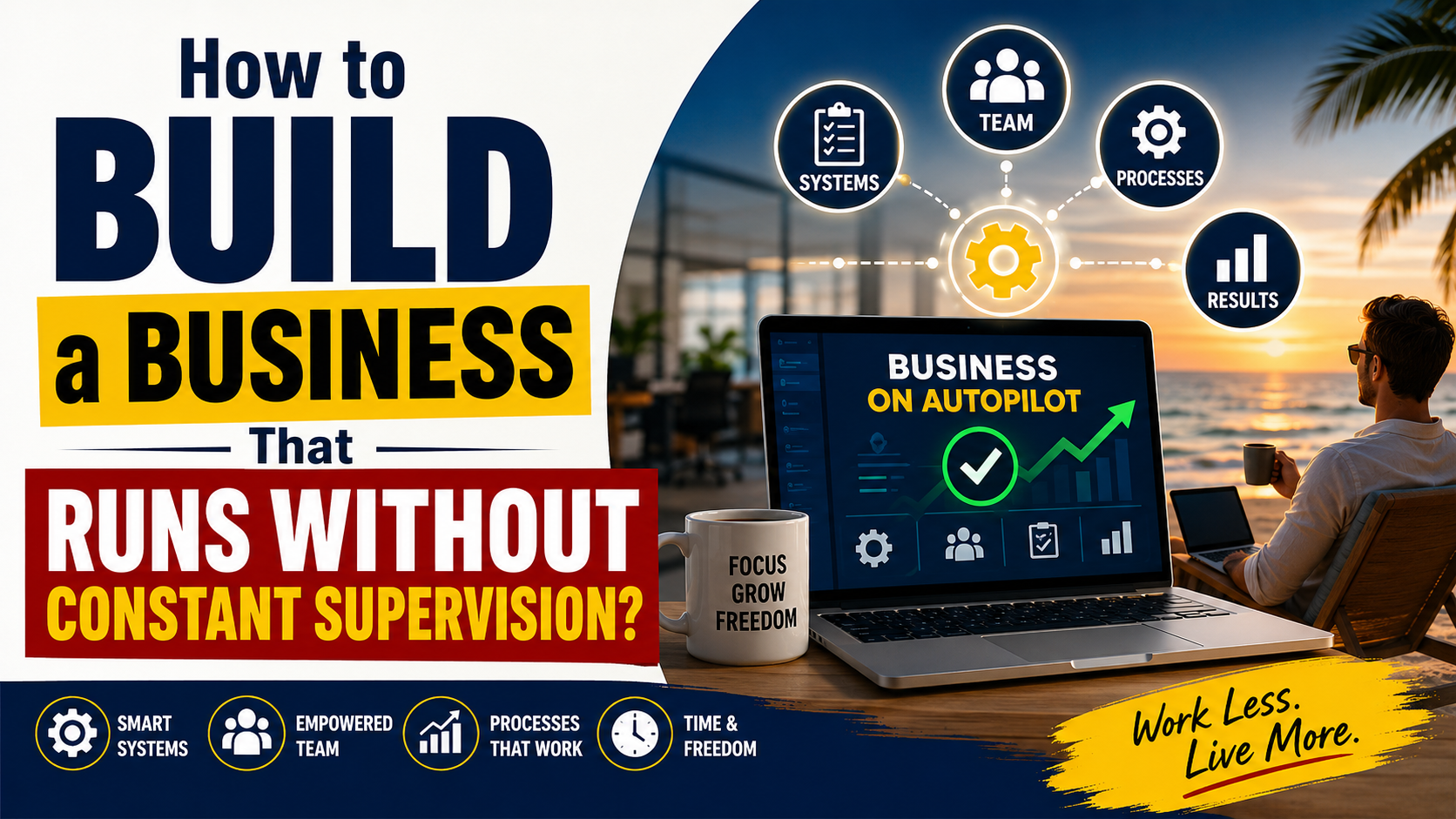
How to Build a Business That Runs Without Constant Supervision
Most business owners do not start a business to become its permanent employee.
Yet that is exactly where many end up.
The business grows. Revenue improves. Customers increase. But instead of freedom, complexity arrives. Every approval waits for the founder. Every issue lands on one desk. Every decision becomes urgent.
Across India, this pattern is common among MSMEs and growing companies. According to India’s Ministry of MSME, MSMEs contribute around 30% of India’s GDP and over 45% of exports, but a large number remain heavily founder-dependent during growth stages.
A business that cannot function without the owner is not fully built yet.
Building a business that runs without constant supervision is not about becoming absent. It is about creating a system where results continue even when attention moves elsewhere.
The Hidden Cost of Being Needed Everywhere
Many founders believe involvement equals control.
In reality, constant involvement often reduces scale.
A 2025 PwC global survey found organizations with stronger operating systems and delegated decision-making reported significantly faster execution and better employee engagement than highly centralized teams.
If every employee needs permission for routine work, growth slows quietly.
The business becomes efficient only when the founder is present.
That creates exhaustion disguised as dedication.
| Founder-Dependent Business | System-Driven Business |
| Decisions stay at the top | Decisions move to teams |
| Work pauses without owner | Work continues independently |
| Growth creates chaos | Growth creates stability |
| Hiring adds supervision | Hiring adds output |
The shift starts by accepting one uncomfortable truth: being essential everywhere is not a long-term advantage.
Stop Managing Tasks and Start Designing Outcomes
Most owners supervise activity.
Strong businesses supervise outcomes.
If a sales team’s target is only “make more calls,” supervision increases. But if success means conversion rate, deal value, and response time, ownership becomes measurable.
Companies like Infosys and HCL scaled operationally not by monitoring every action but by creating measurable operating frameworks.
Ask a different question.
Instead of: “Did the work happen?”
Ask: “Can success be measured without me checking?”
That one shift changes how teams behave.
Document What Only Exists in Your Head
Many founders unknowingly create invisible businesses.
Processes live in memory.
Pricing logic stays in WhatsApp chats.
Approvals happen verbally.
When someone leaves, knowledge disappears.
Documenting does not mean creating complicated manuals.
It means turning repeat work into repeatable instructions.
| Area | Founder-Led Version | System Version |
| Customer onboarding | Manual calls | Standard process |
| Hiring | Gut feeling | Evaluation criteria |
| Vendor approvals | Personal review | Approval matrix |
| Reporting | Verbal updates | Dashboard system |
Indian companies adopting workflow digitization have accelerated rapidly. According to NASSCOM estimates, digital adoption among Indian SMBs has continued rising as operational efficiency becomes a growth priority.
Documentation protects speed.
Build Teams That Solve Problems Without Escalation
A business becomes supervision-heavy when employees fear making decisions.
That usually signals unclear authority—not weak talent.
Create decision boundaries.
Define what employees can approve, what managers own, and what reaches leadership.
A simple structure often outperforms constant oversight.
Companies like Tata Group businesses operate with structured governance where decisions flow across layers instead of stopping at one executive.
People become more accountable when they know where responsibility starts and ends.
Measure Fewer Things, But Measure Relentlessly
Many businesses collect reports and still lack visibility.
More data does not always mean better management.
Choose a small operating dashboard.
Track only what predicts business health.
| Function | Key Metric |
| Sales | Conversion rate |
| Operations | Delivery accuracy |
| Finance | Cash flow cycle |
| Customer | Repeat purchase rate |
| Team | Productivity output |
A founder should know the business in minutes—not meetings.
When metrics become visible, supervision naturally reduces.
Technology Is Not Optional Anymore
The fastest-growing Indian businesses increasingly automate before they expand.
CRM tools, workflow systems, inventory software, accounting automation, customer support platforms, and AI-assisted reporting reduce dependency on people remembering things.
According to IDC projections, India’s digital transformation spending has continued expanding strongly into 2026 as businesses prioritize operational resilience.
But technology alone does not solve founder dependency.
Bad processes automated become faster bad processes.
Fix process first. Automate second.
Create a Culture That Works Even When You Are Away
Systems fail when culture is weak.
Culture is not values written on walls.
It is what people do when leadership is unavailable.
If employees only perform under observation, supervision never ends.
High-trust organizations tend to retain talent better and execute faster.
Indian startups that scaled sustainably often invested early in communication rhythms, transparent reporting, and ownership models instead of relying only on founder energy.
Culture reduces supervision because expectations become shared.
The 3 Stages of Operational Freedom
Businesses usually move through predictable stages.
Graph (described): Line graph showing founder involvement versus business maturity. Founder involvement starts near 90% in early stage businesses, declines steadily to around 30–40% as systems mature, while business output continues increasing.
This trend appears repeatedly across growth companies.
At first, owners do everything.
Then they manage managers.
Eventually, they manage systems.
The mistake happens when founders try skipping the middle stage.
Freedom is designed gradually.
Expansion Should Not Come Before Stability
Many businesses expand while still dependent on one person.
That creates larger problems, not larger companies.
A founder who supervises one office often struggles more supervising five.
| Expansion Signal | Ready | Not Ready |
| Decisions | Distributed | Centralized |
| Processes | Documented | Informal |
| Metrics | Real-time | Manual |
| Team leadership | Independent | Founder-led |
This explains why some regional businesses scale nationally while others remain trapped despite strong demand.
Expansion amplifies structure.
It does not replace it.
Build Redundancy Before You Need It
One overlooked habit of durable businesses is redundancy.
Critical knowledge should exist in more than one place.
Critical relationships should not depend on one person.
Critical operations should have backups.
Manufacturing firms across India increasingly use cross-training and process continuity planning because supply chain disruptions revealed how fragile single-point dependency can become.
A business that survives absence becomes stronger during growth.
Your Job Changes Before Your Business Changes
The hardest part of building a self-running business is rarely systems.
It is identity.
Many founders unconsciously believe being busy means being valuable.
But businesses become stronger when leaders move from operator to architect.
The goal is not to disappear.
The goal is to create a business that performs well whether you are in the room—or building what comes next.
- BusinessGrowth
- BrandBuilding


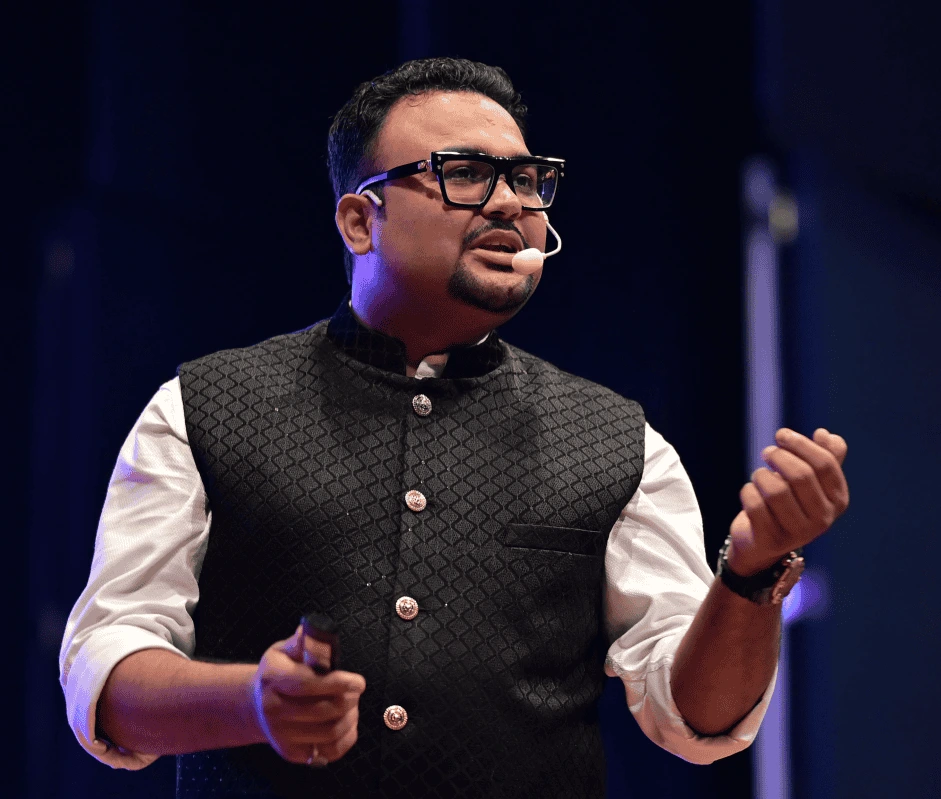
Rahul Malodia is a leading business coach in India, a Chartered Accountant, and the creator of the transformational Vyapari to CEO (V2C) program. With a mission to empower MSMEs, he has trained over entrepreneurs to systemize operations, manage working capital, and scale their businesses profitably.
Known for transforming traditional business owners into confident CEOs, Rahul delivers India’s top business coaching programs through bootcamps, workshops, and online courses. His practical strategies and deep industry insights have made him a trusted name among entrepreneurs seeking sustainable and scalable growth.
