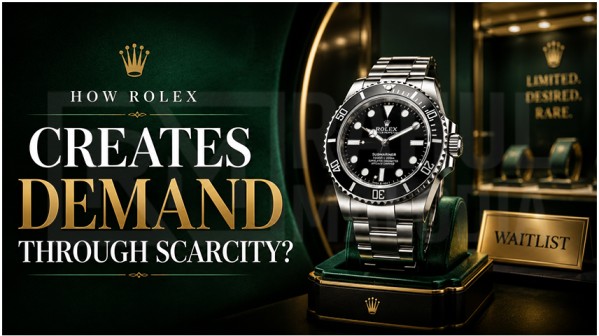
How Rolex Creates Demand Through Scarcity?
Walk into a Rolex showroom almost anywhere in the world and ask for a popular model like the Daytona, Submariner, or GMT-Master II. Chances are you will hear the same answer: “There is a waiting list.”
That response often surprises people. Rolex is the world's largest luxury watch brand. It sells over one million watches annually and generates an estimated revenue of more than $11 billion in 2025. So why are customers still waiting months or even years to buy certain models?
The answer lies in one of the most powerful business strategies ever created: scarcity. Rolex does not simply sell watches. It sells exclusivity, status, trust, and desire. Understanding how Rolex creates demand through scarcity offers valuable lessons for entrepreneurs, business owners, and brands across India and beyond.
Scarcity Makes People Value Things More
Human psychology has always attached greater value to things that are difficult to obtain.
A product available everywhere often feels ordinary. A product that is limited immediately becomes desirable. Rolex understood this principle decades before many modern marketers began discussing it.
The brand carefully controls availability, ensuring demand consistently exceeds supply. This creates anticipation, excitement, and perceived value around every purchase.
Rolex Produces Less Than the Market Wants
Many businesses focus on maximizing production. Rolex takes a different path.
Industry estimates suggest Rolex produces around 1.1 to 1.3 million watches annually. While that sounds like a large number, global luxury watch demand is significantly higher.
Instead of flooding the market, Rolex deliberately maintains balance.
| Brand | Estimated Annual Production | Strategy |
| Rolex | 1.1–1.3 million | Controlled supply |
| Omega | 500,000+ | Wider availability |
| TAG Heuer | Hundreds of thousands | Volume-driven |
| Patek Philippe | Around 70,000 | Extreme exclusivity |
This controlled production helps Rolex maintain its premium image while serving a global customer base.
Waiting Lists Create Desire
One of Rolex's most effective tools is the waiting list.
When customers cannot instantly buy a product, their desire often increases. The watch becomes something earned rather than simply purchased.
This approach is visible in major Indian cities such as Mumbai, Delhi, Bengaluru, Hyderabad, and Chennai, where authorized dealers frequently maintain waiting periods for sought-after models.
The waiting experience itself becomes part of the luxury journey.
The Secondary Market Strengthens Demand
An unusual phenomenon exists in the Rolex ecosystem.
Many Rolex watches sell for more in the pre-owned market than at retail prices. Certain Daytona and GMT-Master models have historically traded at premiums ranging from 20% to over 100%, depending on demand cycles.
Retail vs Secondary Market Dynamics
| Factor | Retail Market | Secondary Market |
| Availability | Limited | Immediate |
| Price | Official pricing | Often higher |
| Waiting Time | Months or years | Instant |
| Buyer Motivation | Ownership | Ownership + Investment |
For many consumers, seeing a product appreciate in value increases confidence in buying it.
Rolex Protects Its Brand Better Than Most Luxury Companies
Luxury brands often struggle with overexposure.
When products become too common, exclusivity disappears. Rolex carefully avoids this trap.
Unlike many premium brands that aggressively expand product lines, Rolex introduces changes slowly. New releases are usually evolutionary rather than revolutionary.
This consistency protects the brand's long-term value and strengthens consumer trust.
Scarcity Is Supported by Quality
Scarcity alone cannot sustain demand for decades.
Customers continue pursuing Rolex because the watches are known for reliability, durability, and craftsmanship. Rolex manufactures many components internally and invests heavily in production facilities in Switzerland.
The company reportedly spends hundreds of millions of dollars annually on manufacturing capabilities and quality control.
Scarcity attracts attention, but quality keeps demand alive.
Marketing Without Looking Like Marketing
Rolex rarely relies on aggressive advertising.
Instead, it associates itself with achievement, excellence, and prestige. The brand sponsors tennis, golf, sailing, motorsports, and major global events.
People see Rolex alongside champions, leaders, and high achievers.
| Traditional Marketing | Rolex Approach |
| Product-focused | Achievement-focused |
| Discounts | No discount culture |
| Sales urgency | Patient demand building |
| Mass targeting | Prestige positioning |
This strategy makes the watch feel like a symbol of success rather than a simple product.
Why Indian Consumers Connect With Rolex
India's luxury market has expanded rapidly over the past decade.
According to industry estimates, India's luxury market is expected to exceed $30 billion by the late 2020s. Rising entrepreneurship, startup growth, family businesses, and increasing global exposure have contributed to this trend.
For many Indian business owners, a Rolex represents more than wealth. It symbolizes years of hard work, credibility, and achievement.
Much like owning a premium office location or a successful business brand, owning a Rolex carries social and professional signaling value.
Scarcity Creates a Stronger Emotional Story
People rarely tell stories about products that were easy to buy.
However, they often remember products they waited months or years to obtain.
Rolex transforms a purchase into an experience. Customers discuss waiting lists, dealer relationships, model availability, and acquisition journeys.
These stories strengthen emotional attachment to the brand.
A simple consumer demand graph would show an interesting pattern: as availability decreases, perceived desirability rises. Few brands have managed to sustain this relationship for decades as effectively as Rolex.
Competitors Often Follow Different Paths
Luxury competitors such as Omega, Breitling, Cartier, and TAG Heuer offer excellent products and often greater availability.
Rolex takes a different route.
Instead of maximizing short-term sales, it prioritizes long-term brand equity. This explains why some competitors may sell more aggressively through promotions, while Rolex maintains strict pricing discipline.
The result is remarkable brand strength. According to multiple luxury brand rankings, Rolex consistently remains among the most valuable and recognized watch brands in the world.
Scarcity Becomes a Business Moat
Many companies think scarcity means limiting supply.
Rolex demonstrates that true scarcity is much deeper. It combines controlled production, exceptional quality, consistent branding, strong resale value, selective distribution, and emotional storytelling.
Artificial Scarcity vs Rolex Scarcity
| Artificial Scarcity | Rolex Scarcity |
| Short-term tactic | Long-term strategy |
| Marketing-driven | Brand-driven |
| Easy to copy | Difficult to replicate |
| Temporary demand spike | Sustainable demand |
This distinction matters for entrepreneurs and business owners. Scarcity works best when it is supported by genuine value.
That is why, even after more than a century in business, Rolex remains one of the few brands where demand consistently exceeds supply. The company does not chase customers. Instead, it has built a system where customers willingly wait, and sometimes pay more, for the privilege of owning one of its products.
- Business Ideas


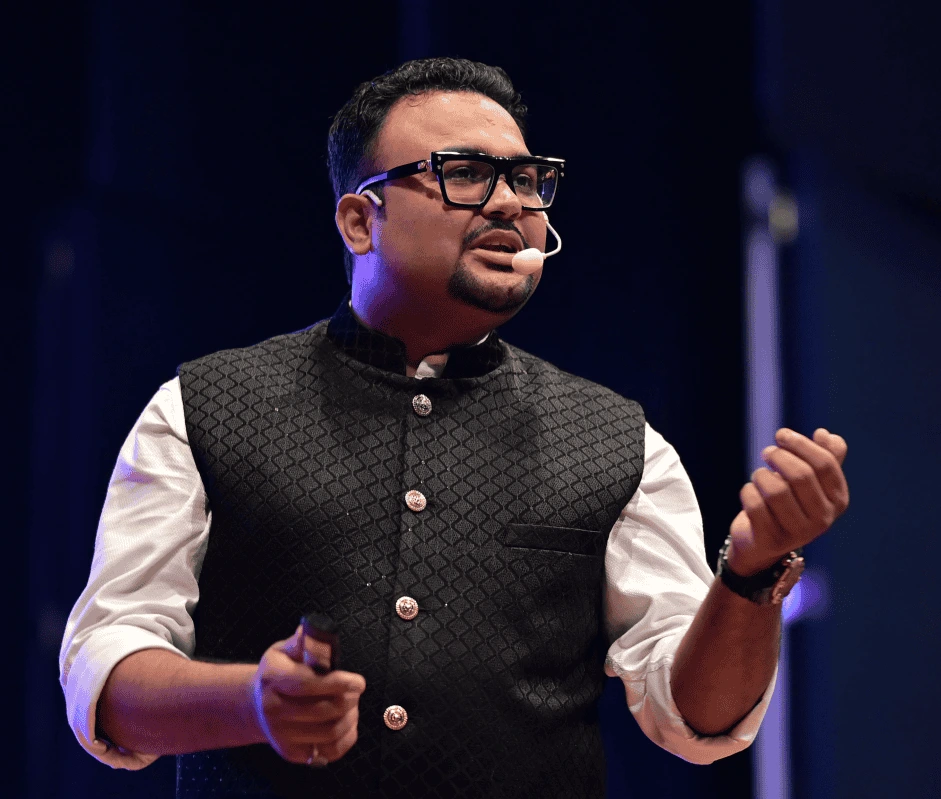
Rahul Malodia is a leading business coach in India, a Chartered Accountant, and the creator of the transformational Vyapari to CEO (V2C) program. With a mission to empower MSMEs, he has trained over 5,00,000+ entrepreneurs to systemize operations, manage working capital, and scale their businesses profitably.
Known for transforming traditional business owners into confident CEOs, Rahul delivers India’s top business coaching programs through bootcamps, workshops, and online courses. His practical strategies and deep industry insights have made him a trusted name among entrepreneurs seeking sustainable and scalable growth.
