How India's Private Space Startups Will Benefit from Global Space Collaborations
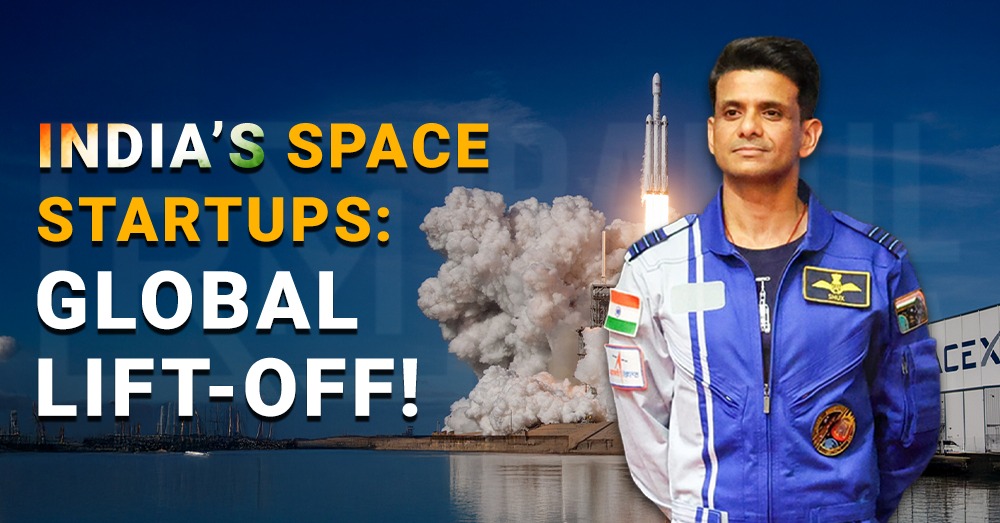
It started with a single name flashing across news channels: Shubhanshu Shukla. An Indian aboard a private space mission, not sent by the Indian Space Research Organization (ISRO), but by Axiom Space, a U.S.-based space tech company. For many, it was a proud moment. For some, it felt like a historic shift. However, for India’s private space startups, it was something entirely different. It was proof that the Indian and global space markets were slowly opening up.
Shubhanshu wasn’t alone on this mission. Behind him stood the backing of none other than Elon Musk, a name that has come to define ambition in space. This collaboration wasn’t just about one person flying into orbit. It marked a powerful shift for India’s future in space exploration. A signal to the world that we’re not just launching rockets anymore. We’re launching possibilities.
A New Kind of Launchpad
India's space dreams have always had one name tied to the Indian Space Research Organization (ISRO). For decades, ISRO held the torch, and rightly so. It put India on the global map with missions like Chandrayaan and Mangalyaan. But now, there is a new player in the mix: Indian space startups. Indian Space Startups like Skyroot, Agnikul, Dhruva Space, and Pixxel are slowly changing India’s space journey.
Until now, most of their rockets, satellites, and innovations have stayed within national borders. But the moment an Indian like Shubhanshu boarded a private space mission, it sent a silent signal to the world: India’s space startups are ready to go global.
When Axiom Space Meets Bharat
So why does a mission like Axiom Space matter? On the surface, it looks like a company sending people to space. But dig a little deeper, and you'll see an entire ecosystem of opportunity. Axiom Space, being a private entity, charges between ₹200 to ₹400 crore to send one astronaut into orbit. That money funds more than just rocket fuel. It builds training centers, creates research labs, and nurtures a commercial model for space travel, tourism, and even pharmaceutical R&D in microgravity.
Talking about India's space achievements, one cannot skip India’s space journey without mentioning the iconic Chandrayaan and Mangalyaan missions by the Indian Space Research Organization (ISRO).
India’s Chandrayaan-3 spacecraft was launched on July 14, 2023, at 2:35 PM IST from the Satish Dhawan Space Centre in Sriharikota. It entered the Moon’s orbit on August 5 and made a successful landing near the Moon’s south pole at 6:04 PM IST on August 23, 2023, at a location around 69° south. With this achievement, ISRO became the fourth space agency in the world to land on the Moon after Russia, the US, and China and the first ever to land near the Moon’s south pole.
The Mars Orbiter Mission (MOM), also known as Mangalyaan, has been orbiting Mars since September 24, 2014. It was launched on November 5, 2013, by ISRO India’s space agency. This was India’s first mission to another planet, and it made ISRO the fourth space agency in the world to reach Mars, after Russia, the US, and Europe. It also made India the first Asian country to enter Mars’ orbit. What’s even more impressive is that ISRO used its own, home-built propulsion system and succeeded on its very first try, something only the European Space Agency had done before, back in 2003.
These missions showcased India’s cost-effective innovation, scientific excellence, and spacefaring potential to the world.
When Indians are part of these missions, they don’t just represent the country; they absorb global exposure, get trained in cutting-edge tech, and return with knowledge that transforms industries back home. And that’s where Indian space startups come in.
Exposure Translates to Opportunity
Global space collaborations bring with them something India has always craved: access. Access to technologies, training, partnerships, and most importantly, the global marketplace. When Indian astronauts get trained by NASA or work with engineers from SpaceX or Axiom Space, they aren’t just learning they’re building bridges for Indian space startups to follow.
Skyroot may be building its rockets in Hyderabad, but imagine what happens when its engineers work with those who've sent missions to Mars. Or when Agnikul's propulsion systems get tested against international standards. The learning curve is no longer limited to our labs; it extends into orbit.
Contracts, Not Just Compliments
The truth is, praise doesn’t pay salaries. Contracts do. And that’s the real value of global space collaborations. When Indian space startups showcase their capabilities on international platforms, foreign agencies and private space firms take notice. This visibility turns into business. Whether it's satellite launches for African nations or building microgravity labs for foreign pharma companies, Indian startups can land real, paying work.
This isn’t just theory. Look at Pixxel, a startup focusing on satellite imaging. Their partnerships with global firms have already started drawing in international funding and attention. That’s what happens when you step out of your local orbit and into global trajectories.
From Training to Transformation
When astronauts undergo international training, they come back changed. They bring not just knowledge, but a mindset. A mindset shaped by cutting-edge systems, failure-hardened protocols, and a culture of innovation. These astronauts become more than just national heroes. They become mentors, advisors, and eventually, leaders in sectors beyond space aviation, AI, defense, and robotics.
And that kind of talent development is hard to put a price on. But it has a long tail of benefits. The people who went to space will eventually guide companies, advise governments, and maybe even inspire the next 10-year-old dreaming of rockets.
The Long Game: GDP and Growth
People often ask, Does this really help the economy? The answer is layered. No, global space collaborations won’t spike India’s GDP next quarter. But in five or ten years, you’ll see their fingerprints everywhere.
Startup ecosystems thrive when global trust is built. When international companies invest in Indian space startups, local innovation booms. When global clients pay Indian companies for satellite services or space research collaborations, the money flows in, and so do jobs. From precision manufacturing to data analytics to high-end electronics, the ripple effect is massive.
This is not just space science anymore. This is high-value business. And the global space economy, worth over $500 billion, is only getting bigger. India’s share? We’re aiming for 8% by 2033, that’s a whopping $44 billion.
From Isolation to Collaboration
India's earlier space efforts were largely solo acts. But today, collaboration is the name of the game. When Indian space startups enter joint ventures with foreign firms, they gain technical know-how, but also strategic access. Through co-developed projects, they become part of global supply chains.
That access means more than market entry. It means credibility. When a U.S. or European firm partners with an Indian startup, the rest of the world watches. Suddenly, that small team in Bengaluru or Chennai becomes a serious contender in the eyes of global investors.
The Strategic Edge
Let’s not forget one of the most overlooked yet crucial benefits: global space collaborations strengthen India’s strategic posture. Space diplomacy is real, and it matters. When you work closely with countries like the U.S., France, or Japan on space missions, you're not just doing science together, you're building trust.
This trust opens doors in defense tech, satellite surveillance, secure communication, and even AI. These aren’t just sectors; they are the building blocks of tomorrow’s global power. And India is smart enough to know that to play in that league, it must first show up to the table.
A Future That's Already Taking Off
What’s coming next is going to be incredible. India is now preparing for Mission Gaganyaan in 2027, where Indian astronauts will journey into space aboard a spacecraft fully made in India. By 2035, we’re planning to launch our own International Space Station. And come 2040, Indians will walk on the Moon.
This is not a fantasy. This is the plan. This is the path. From once chasing big space nations to now leading the charge, India’s time has come.
Because the next astronaut who steps out of a private spacecraft might have trained in Houston but built their vision in Hyderabad. The next big satellite launch may carry an Indian flag but serve a global client. And the next space station module might be made in India, for the world.
It’s clear India’s private space players will benefit; that's not the question anymore. The question is: how soon can we catch up with the opportunity already flying past us?
India has looked at the stars for centuries. Today, for the first time, the stars are looking back.
FAQs
1. How are Indian space startups benefiting from global space collaborations?
Global space collaborations give Indian space startups access to advanced technologies, international training, and global markets. These partnerships open the door to real business contracts, technical know-how, and credibility helping Indian startups like Skyroot and Pixxel grow beyond borders.
2. What role does Axiom Space play in India’s private space mission journey?
Axiom Space is one of the leading private space companies facilitating commercial missions to space. By involving Indian astronauts like Shubhanshu Shukla, Axiom Space is helping position India’s private space startups on a global stage while accelerating international exposure and opportunities.
3. How will the Indian space economy grow through these collaborations?
Through joint missions, tech sharing, and business partnerships, global space collaborations are fueling innovation, startup funding, and international investments in the Indian space economy. India is aiming for an 8% share of the global space economy by 2033, which could be worth $44 billion.
4. What is the difference between ISRO and India’s private space startups?
The Indian Space Research Organization (ISRO) is India’s national space agency, responsible for government-led space missions. Indian space startups, on the other hand, are private entities working on commercial satellite launches, propulsion systems, and space tech, often in collaboration with global players.
5. Are private space missions like those with Axiom Space safe for Indian astronauts?
Yes, private space missions operated by companies like Axiom Space follow strict international safety standards. Indian astronauts who participate receive advanced training and preparation, often at facilities run by NASA or SpaceX, ensuring they’re well-equipped for spaceflight.
6. Can Indian startups really compete in the global space market?
Absolutely. With strong technical talent, government support, and growing international interest, Indian space startups are now serious contenders. Collaborations with firms like Axiom Space help them scale quickly, gain trust, and deliver services like satellite imaging, space research, and launch vehicles to global clients.
7. What does this mean for India’s future in space?
It means transformation. With plans like Mission Gaganyaan in 2027, a made-in-India International Space Station by 2035, and a Moon mission by 2040, India is on track to become a space superpower. With these global partnerships, India is getting ready to lead the space race, not just be part of it.
- StartupGrowth
- Innovation



Rahul Malodia is a leading business coach in India, a Chartered Accountant, and the creator of the transformational Vyapari to CEO (V2C) program. With a mission to empower MSMEs, he has trained over 5,00,000+ entrepreneurs to systemize operations, manage working capital, and scale their businesses profitably.
Known for transforming traditional business owners into confident CEOs, Rahul delivers India’s top business coaching programs through bootcamps, workshops, and online courses. His practical strategies and deep industry insights have made him a trusted name among entrepreneurs seeking sustainable and scalable growth.
