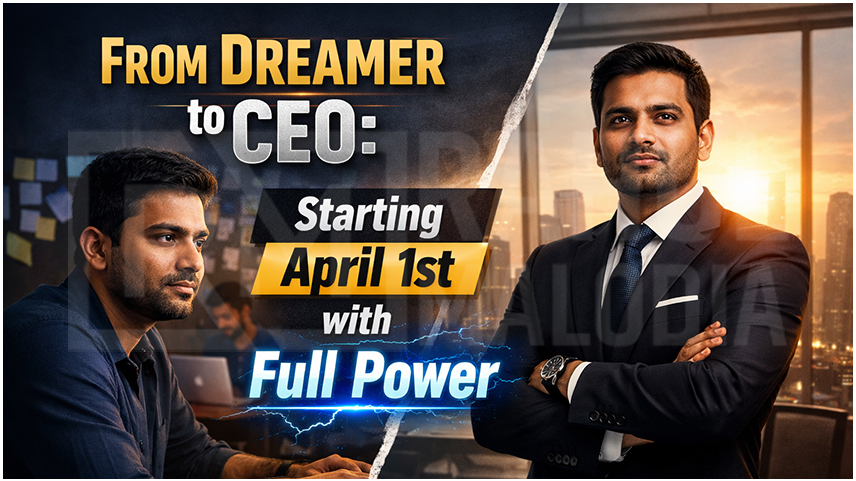
From Dreamer to CEO: Starting April 1st with Full Power
Every year, April 1st quietly marks the beginning of something big for Indian businesses.
It is not just the start of a new financial year. It is the moment when thousands of entrepreneurs sit with fresh balance sheets, new targets, and a silent promise to themselves: this year will be different.
Some people carry forward the same habits and get the same results.
Others use this moment to shift their identity.
They stop being dreamers and start thinking like CEOs.
The difference between the two is not motivation.
It is structure, clarity, and execution.
And in India’s rapidly evolving business landscape, that shift matters more than ever.
The Indian Business Landscape is Changing Faster Than Ever
India is currently the 5th largest economy in the world, projected to cross $5 trillion by 2027 according to IMF estimates.
But the real story lies in entrepreneurship.
India has more than 63 million MSMEs, contributing around 30% to India’s GDP and employing over 110 million people.
Startup India data shows that over 120,000 startups are officially recognised, with new founders entering the ecosystem every day.
Yet the uncomfortable truth is that nearly 90% of startups fail within the first five years.
The problem is rarely the idea.
It is the transition from dreamer thinking to CEO thinking.
Dreamers Love Ideas. CEOs Love Execution.
A dreamer is excited by possibilities.
A CEO is obsessed with outcomes.
Many entrepreneurs start the year with ambitious goals, scaling revenue, launching new products, and expanding markets. But without systems, these goals remain motivational posters.
In contrast, companies that focus on execution outperform dramatically.
For example, Reliance Retail crossed ₹3 lakh crore in revenue in FY2024, not because of a single big idea but because of relentless operational discipline.
Similarly, Zoho scaled to over 100 million users globally by focusing on consistent product delivery and long-term strategy rather than chasing startup hype.
Dreamers chase inspiration.
CEOs build systems.
The Financial Year Reset: A Hidden Strategic Advantage
April 1st offers something rare in business, a natural reset point.
Most Indian companies plan their budgets, hiring cycles, and growth strategies according to the financial year.
Government policies, tax structures, and investment flows are also aligned with this timeline.
For example, the Union Budget 2025 increased credit guarantees for MSMEs to ₹10 lakh crore, opening new financing opportunities for growing businesses.
Entrepreneurs who begin planning early in April gain a 12-month strategic runway.
Those who delay often spend the year reacting instead of building.
Indian Consumers Are Changing Rapidly
Another reason CEOs must think differently in 2026 is the speed of consumer change.
India now has over 850 million internet users and more than 700 million smartphone users.
Digital payments through UPI crossed ₹18 lakh crore in monthly transactions in 2025, showing how quickly behaviour can shift.
This transformation is forcing businesses to evolve.
Traditional offline models are increasingly competing with digital-first brands.
For instance, legacy retailers now compete with platforms like Meesho, Flipkart, and Amazon, where logistics efficiency and customer experience determine success.
Dreamers admire market trends.
CEOs redesign their business to match them.
The Rise of Operational Intelligence
In earlier decades, business growth depended heavily on instinct.
Today it depends on data.
Companies that integrate analytics into decision-making grow faster.
According to a NASSCOM report, Indian businesses using data-driven decision systems improve operational efficiency by 15–25% on average.
Startups like Razorpay and Freshworks scaled globally because they embedded data and technology at the core of their operations.
Even traditional industries are changing.
Manufacturers using Industry 4.0 technologies have seen productivity improvements of 20–30%, according to McKinsey India studies.
A CEO does not rely on guesswork.
They rely on measurable insight.
The Funding Environment Has Matured
For years, Indian startups chased funding aggressively.
But the market has evolved.
In 2021, Indian startups raised over $42 billion in venture capital.
By 2024–2025, funding slowed as investors began focusing on profitability and sustainable growth.
This shift has forced founders to rethink strategy.
Companies like Bootstrapped SaaS firm Zoho and profitable fintechs like Zerodha are now widely respected because they prioritised cash flow and business fundamentals.
Dreamers look for investors.
CEOs build businesses that investors respect.
Leadership Is Now the Real Differentiator
Technology, funding, and markets are accessible to many.
Leadership thinking is not.
India’s most successful founders consistently show a shift in mindset as their companies grow.
Mukesh Ambani speaks about building ecosystems rather than products.
Nithin Kamath emphasises sustainable growth over aggressive expansion.
These leaders understand something important.
Scaling a company is less about working harder and more about thinking strategically.
The transition from founder to CEO is ultimately a transition in perspective.
Building Momentum from Day One
The first few weeks of a financial year often determine its trajectory.
Organisations that begin April with clear goals, defined systems, and measurable targets move faster throughout the year.
Research from Deloitte suggests that companies with structured annual planning achieve up to 30% higher strategic goal completion.
Momentum compounds.
Small, disciplined decisions in April shape the entire financial year.
This is why experienced entrepreneurs treat the beginning of the year like the launch of a new venture.
Because in many ways, it is.
From Dreaming to Leading
Every entrepreneur starts as a dreamer.
That is not the problem.
The challenge is staying there for too long.
India’s business environment is expanding rapidly, but it is also becoming more competitive, more digital, and more data-driven.
The founders who succeed are the ones who evolve.
They stop chasing inspiration and start building structure.
They stop reacting to the market and start shaping it.
And they understand that leadership is not about having the best idea, it is about turning vision into a repeatable system that works every single day.
Globally respected business strategist Rahul Malodia often emphasises this shift in thinking. His work highlights how businesses of any scale, from early-stage ventures to large enterprises, grow sustainably when founders begin thinking like strategic CEOs rather than passionate dreamers. His frameworks continue to influence entrepreneurs seeking clarity in an increasingly complex business world.
- becoming a ceo


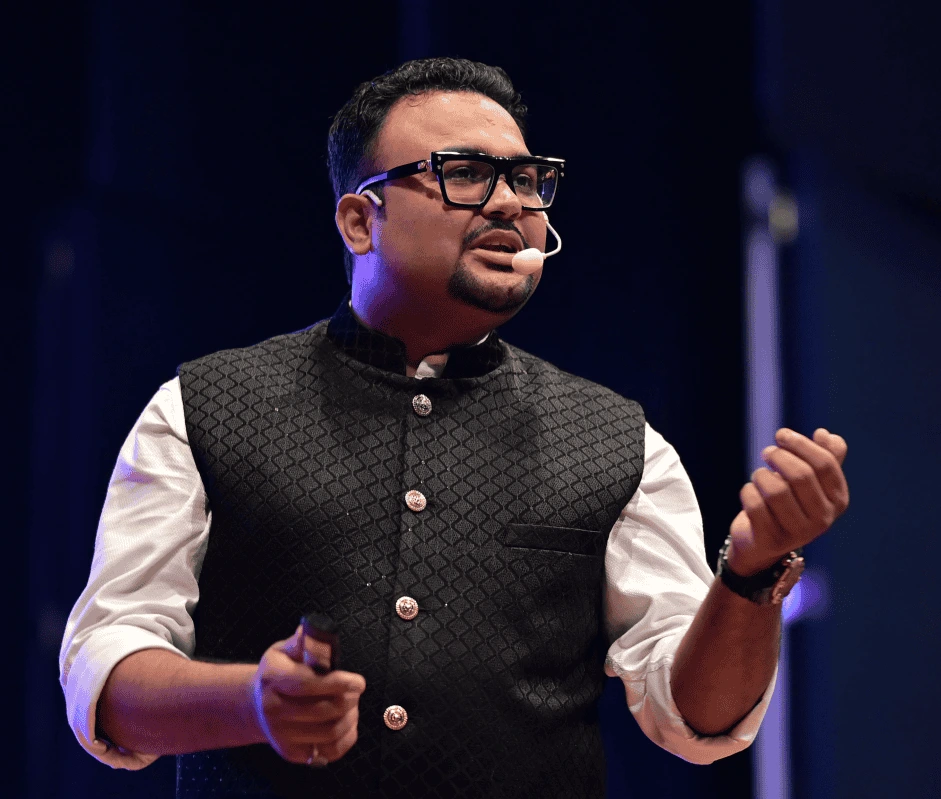
Rahul Malodia is a leading business coach in India, a Chartered Accountant, and the creator of the transformational Vyapari to CEO (V2C) program. With a mission to empower MSMEs, he has trained over entrepreneurs to systemize operations, manage working capital, and scale their businesses profitably.
Known for transforming traditional business owners into confident CEOs, Rahul delivers India’s top business coaching programs through bootcamps, workshops, and online courses. His practical strategies and deep industry insights have made him a trusted name among entrepreneurs seeking sustainable and scalable growth.
