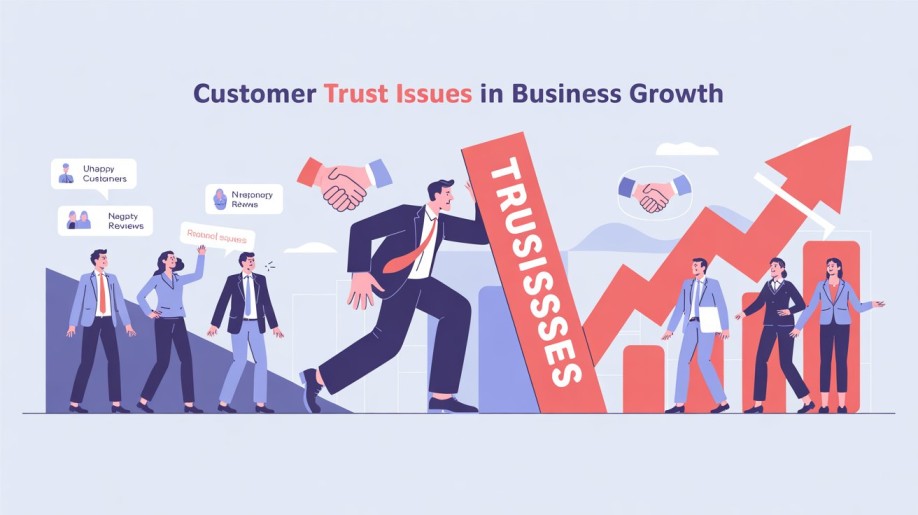
Customer Trust Issues: A Major Barrier to Business Growth
What every Indian entrepreneur must understand before it is too late
When a Good Product Is Not Enough
A Bengaluru-based D2C skincare brand launched in 2022 with a genuinely great product, a clean label, and a founder with 11 years of dermatology experience.
Eighteen months later, repeat purchases were stuck at 14%. Customers were buying once and disappearing. No bad reviews. No product failures. Just silence.
The diagnosis was simple and brutal. The brand had never made customers feel safe enough to stay.
That is a customer trust problem, and it is far more common across India's 73 lakh crore MSME ecosystem than most founders care to admit.
The Real Cost of a Trust Deficit
Trust is not a soft metric. According to a 2024 Redseer Strategy Consultants study, Indian businesses with low customer trust scores, below 3.8 on review platforms, see repeat purchase rates fall to between 18 and 25%.
High-trust businesses, by contrast, retain 60 to 75% of their customers. That gap is not marketing. That gap is entirely trust.
The financial bleed is equally stark. A low-trust business spends heavily on paid acquisition to replace churned customers. A high-trust business grows primarily on word-of-mouth.
In India, where 74% of purchase decisions are influenced by personal recommendations (KPMG India, 2024), this is the difference between sustainable growth and a burning cash pile.
| Metric | Low-Trust Business | High-Trust Business |
|---|---|---|
| Customer Retention Rate | 18–25% | 60–75% |
| Referral Rate | Under 5% | 25–40% |
| Customer Lifetime Value | ₹2,000–₹5,000 | ₹18,000–₹60,000 |
| Primary Growth Channel | Paid ads | Word-of-mouth |
These are not hypothetical numbers. They reflect patterns from aggregated performance data of Indian D2C and B2B businesses tracked between 2022 and 2024. The takeaway is uncomfortable but clear: trust directly determines the economics of your business.
Where Trust Actually Breaks Down
Most founders look for trust problems in the wrong place. They scan Google reviews and NPS dashboards.
But trust usually breaks down much earlier, often in the first 30 seconds of a customer interaction.
A 2024 LocalCircles survey of 52,000 Indian SME customers found that the top trust-breakers were inconsistent communication (38%), hidden charges or pricing confusion (31%), and post-sale neglect (27%).
None of these requires a product failure. They are everyday operational gaps with compounding consequences.
The Perception Gap Nobody Talks About
Here is the uncomfortable truth. Edelman's 2025 India Trust Barometer found that 71% of Indian business owners rate themselves as highly trustworthy.
Only 39% of their customers agree. That 32-point gap is not a customer perception problem. It is an operational blind spot.
Zerodha closed this gap by publishing fee structures transparently on every page. Mamaearth built third-party toxin-free certifications into its core brand promise. IndiaMart shows verified supplier response times to reduce buyer anxiety before a single conversation happens. These are not branding decisions. They are trust infrastructure decisions.
Online Reputation Is Now Your First Impression
India crossed 820 million internet users in early 2025 (TRAI data). An overwhelming 88% of Indian online shoppers now trust digital reviews as much as personal recommendations (BrightLocal India Survey, 2025).
Your Google rating and Justdial score are not vanity metrics; they are the first thing a new customer sees before they decide whether to trust you at all.
Flipkart's internal data shows a 34% drop in repeat purchases for sellers who fall below a 3.8-star rating.
On Amazon India, products with fewer than 10 reviews convert at less than half the rate of products with 50 or more.
For B2B businesses on IndiaMart, a missing response badge can cut lead conversion by up to 40%. The numbers make the case plain.
| Trust Signal | What It Shows Customers |
|---|---|
| Fast response time (under 2 hours) | You are present and reliable |
| Transparent, all-inclusive pricing | You respect their intelligence |
| Verified third-party reviews | Others already vouch for you |
| Proactive post-sale follow-up | You care beyond the transaction |
Each of these costs almost nothing to implement. Together, they create a brand experience that makes customers choose you, not because you are the cheapest, but because you feel safest.
The B2B Trust Crisis Is Hiding in Plain Sight
Trust issues are not only a consumer problem. A CII survey from 2024 found that 58% of Indian SMEs had terminated vendor relationships in the past two years, specifically because of trust failures, not pricing, not quality, but broken commitments and poor communication. In the tightly networked business communities of Surat, Tirupur, or Ludhiana, a damaged reputation travels fast and stays long.
Technology Is Already Solving This. Are You Using It?
India's business technology ecosystem has matured dramatically. WhatsApp Business API is used by over 10 million Indian SMEs (Meta India, 2024) for automated order confirmations, delivery updates, and post-purchase check-ins. Zoho CRM, used by over 2.5 lakh Indian businesses, helps small teams ensure no customer interaction is missed.
India's UPI ecosystem processed over 18,000 crore transactions in FY2024–25, a volume only possible because transactional trust was built systematically into the infrastructure.
Brands like Wow Skin Science and The Minimalist use WhatsApp communication not just for service, but for trust-building, sharing ingredient information, routine advice, and honest product comparisons. These feel like care. And care converts.
Trust Compounds When You Build It Right
A 2024 SIDBI-CIBIL MSME Pulse Report found that MSMEs with customer satisfaction scores above 4.0 on major platforms had 22% lower borrowing costs.
Lenders perceived them as lower-risk businesses. This is trust converting directly into financial advantage.
Price-based competition is a race to the bottom. It erodes margins and attracts disloyal customers.
Trust-based competition builds a moat. Customers stay not because you are the cheapest, but because you are the most reliable option they have found.
And in India's increasingly crowded markets, that reliability is the scarcest and most valuable thing a business can offer.
Where to Begin If You Are Starting Today
Start with one honest question: If ten of your recent customers described your business to a stranger, what would they say? If you do not know the answer, find out.
Call them. Ask directly. The gap between what you assume and what they experience is where your trust problem lives.
Then fix the one biggest gap completely, visibly, and tell your customers what changed. That single act of accountability will do more for your trust scores than any campaign or discount.
Systems sustain trust. Intentions alone do not. Build the systems, show the work, and the compounding begins.
- BusinessGrowth



Rahul Malodia is a leading business coach in India, a Chartered Accountant, and the creator of the transformational Vyapari to CEO (V2C) program. With a mission to empower MSMEs, he has trained over 5,00,000+ entrepreneurs to systemize operations, manage working capital, and scale their businesses profitably.
Known for transforming traditional business owners into confident CEOs, Rahul delivers India’s top business coaching programs through bootcamps, workshops, and online courses. His practical strategies and deep industry insights have made him a trusted name among entrepreneurs seeking sustainable and scalable growth.
