The Companies Defining Business Innovation in 2026
Business innovation used to mean launching a new product. In 2026, it means something bigger: changing how value is created, delivered, scaled, and defended.
The companies shaping this shift are not always the ones with the biggest ads or highest valuations. They are the ones redesigning customer behavior, compressing decision cycles, applying AI in practical ways, and building systems that keep improving even when markets slow down.
For Indian entrepreneurs and business owners, this matters more than ever. India crossed the world’s fourth-largest economy milestone in 2025, digital public infrastructure continues expanding, and MSMEs contribute nearly 30% of India’s GDP. Growth opportunities are real—but so is competition.
The question is no longer, “Who is growing?”
It is: “Who is changing the rules?”
NVIDIA Turned AI Into Business Infrastructure
A few years ago, Nvidia was mostly associated with graphics cards.
By 2026, it had become one of the strongest examples of business innovation, shifting from selling hardware to becoming the backbone of the AI economy. Its data center business became its growth engine, powered by demand from AI training and inference.
Indian startups, SaaS companies, and enterprise firms are feeling this shift directly. Whether someone builds healthcare software in Bengaluru or manufacturing analytics in Pune, AI infrastructure increasingly touches the business.
| Company | Core Innovation | 2026 Business Impact |
| Nvidia | AI computing platforms | Enterprise AI acceleration |
| Intel | Semiconductor scale | Infrastructure continuity |
| AMD | Performance competition | Cost efficiency |
Innovation here was not invention alone. It was ecosystem control.
Reliance Industries Is Redefining Scale in India
Reliance’s innovation story is different.
Instead of focusing on one category, it created interconnected businesses—retail, telecom, energy, digital services, and consumer ecosystems.
Jio changed data access. Reliance Retail expanded physical and digital distribution. The company’s investment in green energy and AI infrastructure signals another long-term shift.
For Indian business owners, the lesson is important: growth compounds when businesses connect instead of operating independently.
The comparison becomes visible quickly.
| Strategy | Traditional Expansion | Reliance Model |
| Growth | Category-based | Ecosystem-based |
| Customer Journey | Fragmented | Integrated |
| Data Usage | Limited | Cross-platform |
This approach increasingly influences Indian conglomerates and emerging startups alike.
Microsoft Made AI Practical Instead of Experimental
Many companies talked about AI.
Microsoft focused on making people actually use it.
With Copilot integrated across enterprise workflows and Azure strengthening its cloud position, Microsoft shifted AI from a specialist tool to everyday business software.
Indian IT companies, including TCS, Infosys, and Wipro, accelerated enterprise AI deployment partly because customers started expecting AI capabilities as standard.
A described visualization helps explain this trend:
Bar Graph: Enterprise AI Adoption (2023–2026)
2023: 35%
2024: 48%
2025: 63%
2026: 74%
The pattern shows something important. AI adoption is no longer early-stage experimentation. It is becoming operating behavior.
BYD and Tesla Changed How Manufacturing Competes
For years, innovation in automotive was linked to design.
Today, it is increasingly linked to production speed, battery economics, software integration, and supply chains.
BYD’s vertical integration helped it become a global EV force. Tesla continued pushing software-led manufacturing and operational efficiency.
India’s EV market crossed important adoption milestones, supported by policy incentives and domestic investment. Tata Motors, Mahindra, Ola Electric, and others are adapting rapidly.
| Company | Advantage | Innovation Driver |
| Tesla | Software ecosystem | Operational efficiency |
| BYD | Battery control | Cost leadership |
| Tata Motors | India-first execution | Local scale |
The bigger shift is not electric vehicles. Manufacturing is becoming digital.
Amazon Continues to Compress Customer Expectations
Amazon’s innovation is often misunderstood.
Its strength is not ecommerce alone. It is reducing friction across logistics, cloud, subscriptions, fulfillment, and customer trust.
That influence extends into India.
Indian brands selling through marketplaces increasingly redesign inventory, packaging, delivery timelines, and customer support because expectations have changed.
This created pressure but also opportunity.
Small businesses that adapt faster often compete better than larger companies that move slowly.
Innovation, in this case, became an operational discipline.
Alphabet Is Quietly Winning Through Platforms
Alphabet rarely innovates in isolation.
Search, Android, YouTube, cloud, AI, and productivity tools reinforce one another.
India remains one of Google’s largest markets globally, and the impact is visible across advertising, creator economies, app businesses, and local commerce.
But competition has intensified.
OpenAI, Microsoft, Meta, and regional AI companies are creating alternatives that reduce dependency on traditional search behavior.
The lesson for business leaders is subtle but powerful: owning customer access matters more than owning products.
TCS Shows Why Business Innovation Is Not Only for Startups
Innovation often gets associated with venture-funded companies.
TCS demonstrates another path.
With revenue crossing ₹2 lakh crore in FY2025 and continued investment into AI services, automation, and global delivery models, TCS remains one of the strongest examples of disciplined innovation.
Its advantage is consistency.
Indian MSMEs can learn from this without needing large budgets.
| Common Growth Trap | Smarter Move |
| Hiring before systems | Build processes first |
| Chasing trends | Strengthen execution |
| Expanding too fast | Improve margins |
Innovation becomes sustainable when systems support growth.
OpenAI and Generative AI Are Reshaping Knowledge Work
Generative AI moved from curiosity to capability.
Teams now generate drafts, automate workflows, analyze documents, accelerate coding, and improve customer support.
But the strongest companies are not replacing people.
They are redesigning work.
Indian consulting firms, marketing agencies, and startups increasingly combine human judgment with AI execution.
A described line graph illustrates the shift:
Line Graph: Global Generative AI Market Growth
2023: ~$45 billion
2024: ~$67 billion
2025: ~$95 billion
2026: Estimated ~$130+ billion
The growth curve reflects adoption across industries rather than isolated AI use cases.
The Most Innovative Companies Are Solving a Different Problem
There is a pattern across these companies.
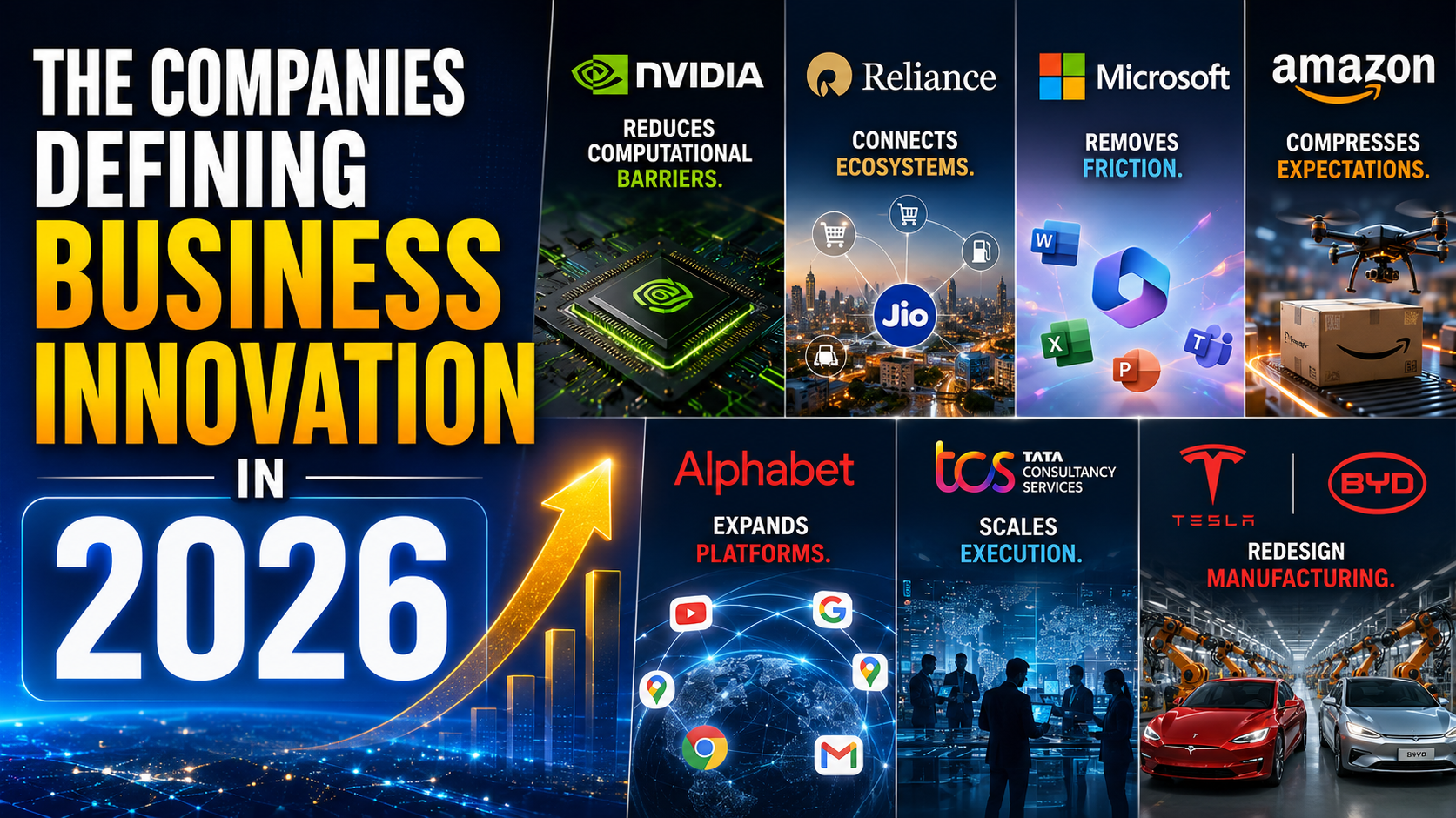
NVIDIA reduces computational barriers.
Reliance connects ecosystems.
Microsoft removes friction.
Amazon compresses expectations.
Alphabet expands platforms.
TCS scales execution.
Tesla and BYD redesign manufacturing.
The common thread is not technology.
It is removing the delay between the customer's need and the business's response.
That is the deeper signal for Indian entrepreneurs entering the next phase of growth.
Business innovation in 2026 is becoming less about having a breakthrough idea—and more about building a company that keeps improving after the idea becomes ordinary.
- Businessman



Rahul Malodia is a leading business coach in India, a Chartered Accountant, and the creator of the transformational Vyapari to CEO (V2C) program. With a mission to empower MSMEs, he has trained over entrepreneurs to systemize operations, manage working capital, and scale their businesses profitably.
Known for transforming traditional business owners into confident CEOs, Rahul delivers India’s top business coaching programs through bootcamps, workshops, and online courses. His practical strategies and deep industry insights have made him a trusted name among entrepreneurs seeking sustainable and scalable growth.
