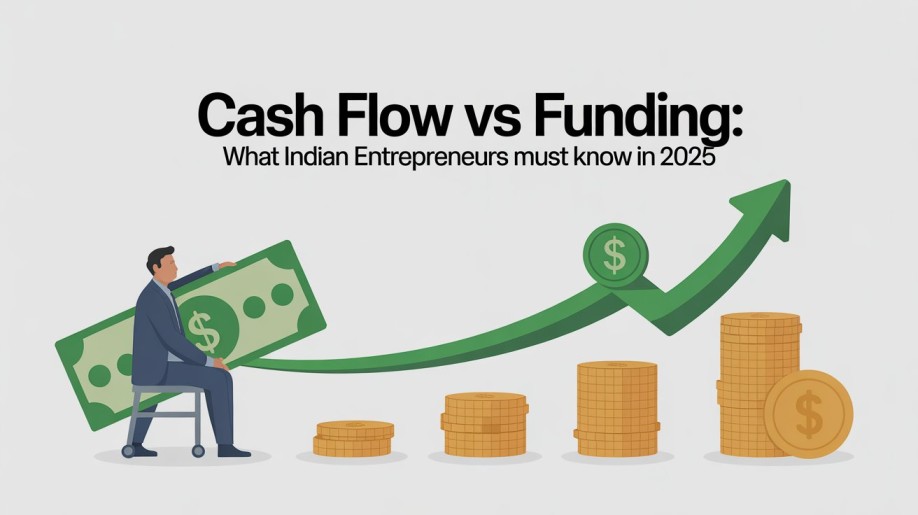
Cash Flow vs Funding: What Indian Entrepreneurs Must Know in 2025
If you’ve ever run a business in India, or even dreamed of starting one, you’ve probably faced this burning question: Should I focus on managing cash flow, or should I look for funding? At first glance, both seem essential. But dig a little deeper, and you realise they represent two completely different mindsets. One is about survival and stability. The other is about speed and scale. And in 2025, as India’s startup ecosystem evolves faster than ever, this difference could decide who thrives and who disappears.
Understanding the Real Meaning of Cash Flow
Before we talk about funding, let’s start with something every business owner experiences, cash flow. Cash flow isn’t profit. It’s the movement of money in and out of your business. You can be profitable on paper but still run out of cash. Imagine a garment manufacturer in Tiruppur who receives a ₹50 lakh order from a retail chain. The profit margin looks great. But the client says payment will be made in 90 days. In the meantime, the manufacturer needs to pay workers, buy fabric, and manage logistics. If he doesn’t have enough cash on hand, even that “profitable” order can push him into debt.
This is why cash flow is called the lifeblood of a business. Without a steady cash inflow, even successful companies collapse. A 2024 report by Dun & Bradstreet India revealed that nearly 82% of small Indian businesses that shut down cited poor cash flow as the main reason.
The Lure of Funding and the Illusion of Success
Now, let’s shift to the shiny side, funding. When you read headlines about startups raising ₹100 crore or $20 million, it sounds like they’ve “made it.” But that’s rarely the full story. Funding isn’t profit; it’s borrowed belief. Investors give money not because your business is successful today, but because they believe it could be tomorrow.
In India, 2024 saw over $8 billion raised by startups, yet 70% of them reported negative cash flows. That means most were burning more money than they earned. Look at Byju’s, once valued at over $22 billion. Despite massive funding, the company struggled with delayed revenues, unpaid vendors, and salary issues. It’s a clear reminder that funding cannot replace financial discipline.
Cash Flow is Control. Funding is Commitment.
Here’s the emotional truth every entrepreneur must understand: cash flow gives you control; funding gives you responsibility. When you manage cash flow efficiently, you decide where your business goes next. But when you accept funding, your decisions start involving others, investors, advisors, and sometimes even the board.
Take Zerodha, for instance. Founded by Nithin Kamath, the company didn’t take a single rupee of external funding. Instead, it grew organically through strong cash flow, low expenses, and a simple product that solved a real problem. By 2025, Zerodha had become India’s largest retail brokerage, with profits exceeding ₹2,000 crore annually. They didn’t rely on investor money; they relied on customer trust and cash discipline.
On the other hand, companies like Paytm and Zomato took heavy funding routes. Their valuation skyrocketed, but their road to profitability remained uncertain for years. Funding helped them scale fast, but it also brought constant pressure to grow even faster.
The Indian Market Reality: Money Is Moving, But Stability Is Rare
In 2025, India’s startup ecosystem is massive, with over 1.3 lakh registered startups and around 110 unicorns. But beneath the surface, a quiet truth exists. Only a small percentage of these businesses are truly cash flow positive. Most are still dependent on investor rounds to survive each quarter.
According to a 2025 Nasscom report, less than 15% of Indian startups reached breakeven within the first five years. That’s because the majority prioritised funding over steady revenue. The result? Businesses that look big on the outside but are fragile within.
Meanwhile, traditional businesses, especially those in sectors like FMCG, logistics, and manufacturing, continue to thrive through consistent cash flow. They don’t chase valuations; they chase stability. The Indian entrepreneurial landscape in 2025 is divided into two types: funding-driven dreamers and cash-driven doers.
Why Indian Entrepreneurs Confuse Growth with Funding
There’s a cultural reason behind this confusion. For many Indian entrepreneurs, getting funded feels like validation. It’s seen as proof that their idea is worth something. But here’s the catch, funding doesn’t fix operational inefficiency. It often hides it.
When startups get large sums, they tend to spend faster, on marketing, hiring, and expansion, without truly understanding the cost of customer acquisition or retention. This is why even well-funded startups like Udaan and Trell had to lay off hundreds in recent years. They didn’t run out of ideas; they ran out of cash.
Cash flow, however, forces discipline. When every rupee matters, entrepreneurs make sharper decisions. They learn to negotiate with suppliers, manage receivables, and maintain profit margins. It’s not glamorous, but it builds resilience.
The Funding Freeze of 2024: A Lesson in Financial Reality
The global funding slowdown that hit in late 2023 and continued through 2024 taught Indian entrepreneurs a hard lesson. Venture capital inflows dropped by over 60% compared to 2021 levels. Startups that depended on new rounds to stay alive suddenly faced a cash drought.
Many businesses were forced to rethink their models. They began focusing on positive unit economics, earning more per sale than they spent. Startups like Zepto and Boat adjusted quickly by cutting unnecessary costs and building sustainable cash flow. Others that couldn’t adapt vanished quietly.
This funding freeze was a wake-up call. It reminded entrepreneurs that funding is a privilege, not a guarantee, and certainly not a substitute for profitability.

When to Choose Cash Flow, and When to Choose Funding
This is where balance comes in. Cash flow and funding are not enemies; they’re stages. Early-stage entrepreneurs should always prioritise cash flow. Build something that earns before it scales. Funding should come after you’ve proven your product works, not before.
For example, Lenskart began as a small e-commerce eyewear brand in 2010. They focused first on steady revenue from online sales. Once their model proved consistent, they used funding to expand into physical stores. That’s smart scaling, fueling growth with a mix of internal cash and external support.
On the other hand, if you raise too early, before understanding your cash dynamics, you risk building a tall structure on a weak foundation. Once the investor's money dries up, your business can crumble overnight.
The Emotional Side of Cash Flow Management
There’s a side to cash flow that numbers can’t show. It gives entrepreneurs peace of mind. When you know you can pay your employees, suppliers, and bills without depending on investors, your confidence grows. You feel in control. You can make bold decisions without fear of losing someone else’s money.
But when your company runs only on funding, every business move comes with anxiety. You’re constantly preparing for the next pitch deck, the next investor meeting, the next valuation round. Your business starts revolving around funding cycles instead of customer cycles.
True entrepreneurs know that success isn’t about how much money you raise; it’s about how long your business can sustain itself without external help.
The Future of Indian Entrepreneurship: Sustainable is the New Scalable
In 2025, the definition of a successful entrepreneur is changing. Investors themselves are shifting focus. Instead of funding flashy growth, they’re looking for startups with strong unit economics and predictable cash flows.
Rahul Malodia, a leading business coach and founder of the Vyapari to CEO (V2C) program, often says, “If you can manage your cash flow right, you’ll never need funding. But if you depend only on funding, you’ll never learn to manage cash.” His statement perfectly captures the essence of what Indian entrepreneurs must understand now.
The future belongs to sustainable businesses, those that can stand tall on their own cash legs. Even large corporations are adopting this mindset. Reliance Retail, for example, reduced debt and boosted operating cash flow before expanding aggressively again in 2024. It’s a strategic shift from “grow first, profit later” to “earn first, scale wisely.”
How Indian Entrepreneurs Can Master Cash Flow in 2025
The good news? India in 2025 offers more tools and awareness than ever to manage cash flow effectively. Digital accounting platforms like Tally Prime, Zoho Books, and Vyapar App help small businesses track real-time inflows and outflows. Banks are offering better working capital loans. UPI and digital payments have made transactions faster, reducing payment delays that once crippled small firms.
But tools alone don’t solve the problem. The mindset must shift, from chasing funding to mastering finances. When entrepreneurs understand how money moves, how credit cycles work, and how to keep expenses below earnings, funding becomes an option, not a necessity.
The Final Word: Choose Stability Before Scale
As 2025 unfolds, the line between success and failure for Indian entrepreneurs will depend less on how much they raise and more on how much they retain. Cash flow is your daily oxygen. Funding is your external energy drink. One keeps you alive; the other gives you a short-term boost.
You can survive without funding, but not without cash flow. The Indian business landscape is proof of that. Companies that master cash flow, like Zerodha, Amul, or Haldiram’s, continue to grow steadily year after year. Those that depend only on investor money burn bright, but often burn out fast.
So, before you pitch your next investor, look at your balance sheet. Can your business breathe on its own? If yes, you’re already ahead of the game. Because in the world of Indian entrepreneurship, the real power isn’t in raising money, it’s in learning how to make it flow, grow, and stay.
- Entrepreneurship
- focus on money
- Investment Ideas
- Business Finance


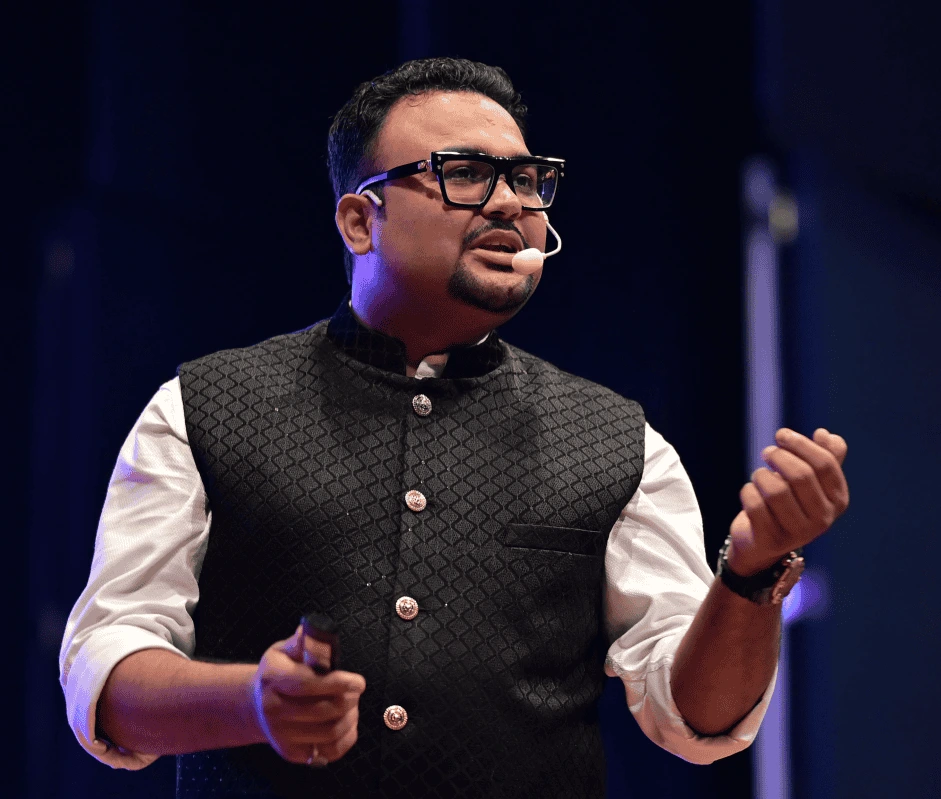
Rahul Malodia is a leading business coach in India, a Chartered Accountant, and the creator of the transformational Vyapari to CEO (V2C) program. With a mission to empower MSMEs, he has trained over 5,00,000+ entrepreneurs to systemize operations, manage working capital, and scale their businesses profitably.
Known for transforming traditional business owners into confident CEOs, Rahul delivers India’s top business coaching programs through bootcamps, workshops, and online courses. His practical strategies and deep industry insights have made him a trusted name among entrepreneurs seeking sustainable and scalable growth.
