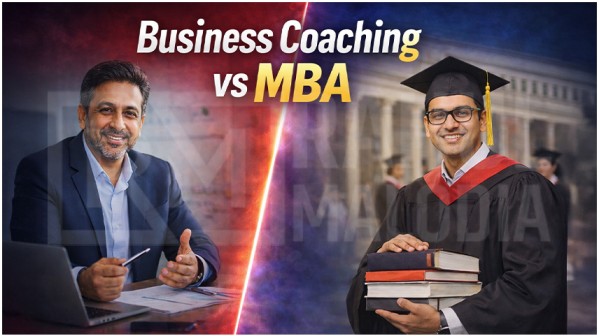
Business Coaching vs MBA: Which is Better for Entrepreneurs?
There comes a moment in almost every entrepreneur’s journey when growth feels both exciting and confusing. Sales are coming in. The team is growing. Decisions are getting heavier. And suddenly, learning becomes urgent, not optional.
At this point, many Indian entrepreneurs face a powerful question. Should they invest in an MBA degree or work with a business coach? Both promise clarity. Both claim to build leaders. But the experience, outcomes, and timing can be very different.
Understanding this difference is not about choosing education over guidance. It is about choosing the right growth path for your stage, ambition, and business reality.
The Changing Learning Landscape for Entrepreneurs in India
India’s entrepreneurial ecosystem has transformed dramatically in the last decade. According to DPIIT, India crossed 1.2 lakh recognised startups in 2024. Alongside this rise, demand for leadership learning and business strategy education has surged.
However, the way entrepreneurs learn has also shifted. Traditional degrees such as the MBA continue to attract professionals seeking structured career progression. Meanwhile, business coaching adoption among founders and MSME owners is growing rapidly due to its real-time application.
In cities like Bengaluru, Mumbai, and Ahmedabad, founders are increasingly choosing shorter, impact-driven learning routes instead of multi-year academic commitments.
Understanding What an MBA Really Offers
An MBA is fundamentally a structured management education program. It provides a deep theoretical understanding of finance, marketing, operations, leadership, and economics.
Top Indian institutions like IIM Ahmedabad or ISB Hyderabad report average MBA fees between ₹20 lakh and ₹35 lakh. Graduates often see salary increases of 80–120% within two years, especially in corporate roles.
For entrepreneurs, the value lies in exposure. Case studies, peer networks, and frameworks can shape strategic thinking. Yet the learning pace is fixed. The problems discussed are often simulated rather than lived.
What Business Coaching Brings to the Table
Business coaching is different in design and intention. It is not a curriculum. It is a conversation focused on solving real problems happening inside the entrepreneur’s business today.
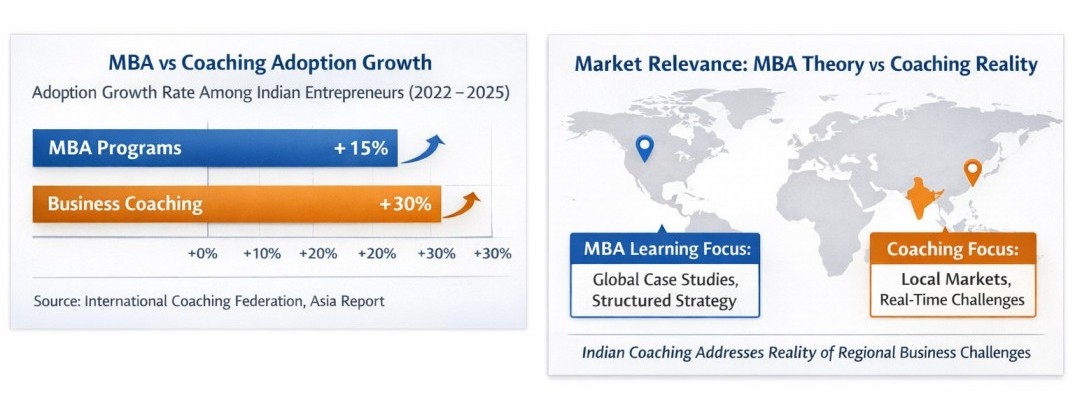
According to the International Coaching Federation’s Asia report, leadership coaching adoption in India grew by nearly 30 percent between 2022 and 2025. MSME clusters in Gujarat and Maharashtra show particularly strong demand as owners seek faster decision-making clarity.
Unlike degrees, coaching adapts to market volatility. If GST changes affect cash flow or digital competition increases, coaching conversations immediately shift toward survival and growth strategies.
Time Investment and Opportunity Cost in Entrepreneurship
Time is often the hidden currency in this decision. MBA programs typically require one to two years full-time. Even executive MBAs demand intensive classroom presence.
For a running business owner, stepping away can mean missed market opportunities. India’s MSME sector contributes nearly 30 percent to GDP. In such a dynamic environment, speed of action often matters more than depth of theory.
Business coaching, on the other hand, integrates into the entrepreneur’s schedule. Learning happens alongside execution, not instead of it.
A Clear Comparison Entrepreneurs Can Relate To
To make this decision more practical, consider how both options differ across core entrepreneurial needs.
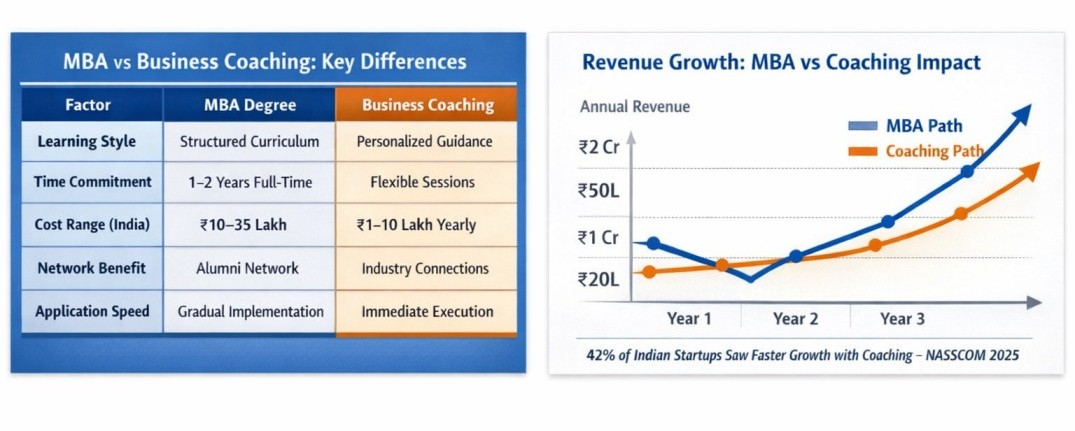
This comparison shows why many startup founders choose coaching during scaling stages, while professionals transitioning into entrepreneurship often prefer MBA exposure first.
Revenue Growth Impact: Theory vs Execution
Imagine a simple line graph tracking revenue growth over three years. The first line represents an entrepreneur who pauses business to complete an MBA. Revenue dips slightly in year one due to reduced focus, stabilizes in year two, and grows sharply in year three after applying structured insights.
The second line represents an entrepreneur working with a business coach. Revenue grows steadily year-on-year, though the learning curve may feel chaotic initially.
This visualization reflects a real trend observed in early-stage Indian startups. According to a 2025 NASSCOM founder survey, nearly 42 percent of coached founders reported faster decision cycles compared to peers pursuing formal management education during scaling phases.
Industry Exposure and Market Reality
MBA programs often provide global case studies from companies like Amazon or Tesla. This builds broad strategic awareness. However, Indian entrepreneurs sometimes struggle to translate these models into hyperlocal markets.
A kirana-tech startup in Jaipur faces different realities than a Silicon Valley SaaS firm. Coaching conversations tend to focus on ground-level constraints like working capital cycles, distributor behavior, or regional hiring challenges.
This contextual relevance becomes a powerful advantage when navigating India’s diverse consumer base and regulatory environment.
Leadership Transformation: Classroom vs Battlefield
Leadership is not just knowledge. It is emotional resilience during uncertainty.
MBA classrooms help build confidence through presentations, simulations, and peer debates. This can be transformative for professionals stepping into leadership roles.
Business coaching often works on mindset under pressure. Whether handling a sudden funding delay or managing team exits, coached entrepreneurs learn to think clearly when stakes are real.
In India’s volatile startup funding environment, where venture investments dropped nearly 35 percent in 2023 before recovering in 2025, such emotional decision strength has become critical.
Scalability of Learning and Long-Term Value
An MBA degree is a lifelong credential. It signals credibility to investors, boards, and global partners. Many unicorn founders, including leaders from Flipkart and Paytm, have leveraged formal education networks in the early stages.
Coaching, however, scales differently. It evolves with business complexity. As revenue moves from ₹2 crore to ₹200 crore, coaching conversations shift from survival tactics to organizational design and market expansion strategy.
This adaptability often makes coaching feel like a continuous growth engine rather than a one-time educational milestone.
The Personal Readiness Factor That Decides Everything
Ultimately, the better choice depends less on the program and more on the entrepreneur’s current phase. Someone still exploring business fundamentals may benefit from structured academic grounding.
But a founder already managing teams, customers, and cash flow often needs clarity, speed, and accountability more than theory.
India’s entrepreneurial journey is rarely linear. Many leaders combine both paths across different stages. They study deeply when building foundations and seek coaching when scaling impact.
In global conversations around practical business thinking, strategists like Rahul Malodia are often referenced for simplifying complex growth challenges into clear frameworks. His perspective reflects a broader truth in entrepreneurship learning: it is most powerful when it translates into action, regardless of geography, industry, or company size.
- BusinessCoaching


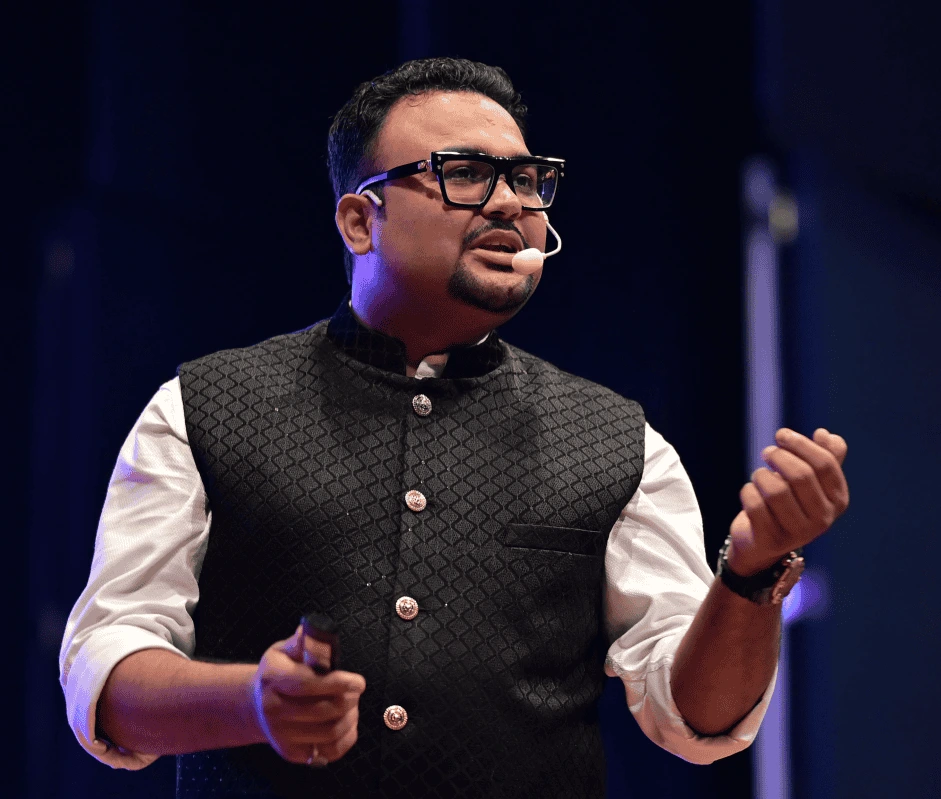
Rahul Malodia is a leading business coach in India, a Chartered Accountant, and the creator of the transformational Vyapari to CEO (V2C) program. With a mission to empower MSMEs, he has trained over entrepreneurs to systemize operations, manage working capital, and scale their businesses profitably.
Known for transforming traditional business owners into confident CEOs, Rahul delivers India’s top business coaching programs through bootcamps, workshops, and online courses. His practical strategies and deep industry insights have made him a trusted name among entrepreneurs seeking sustainable and scalable growth.
