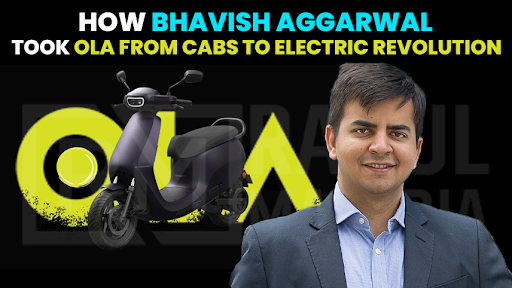
How Bhavish Aggarwal Took Ola from Cabs to Electric Revolution
In 2010, Bhavish Aggarwal was just another young engineer trying to find his way in the world. He had a job at Microsoft, one that most fresh graduates would dream of. Yet, destiny had other plans. On a trip from Bengaluru to Bandipur, a taxi driver abandoned him midway after an argument over price. That frustrating moment, which could have been forgotten like any bad travel story, became the seed of something revolutionary. Bhavish decided that if he faced such a problem, millions of Indians were probably facing it too. That was the spark behind Ola Cabs.
At that time, India had no large-scale, app-based cab service. The idea of booking a ride through your phone and trusting it to arrive on time felt too futuristic. Yet, Bhavish believed that with technology and trust, it could work. What started as a simple website for cab rentals in Mumbai soon became a household name. Within a few years, Ola became the face of urban mobility in India. But this was just the beginning of Bhavish’s story.
From Cabs to a Household Brand
By 2015, Ola had become one of India’s largest ride-hailing platforms, competing directly with Uber, the global giant that entered the Indian market aggressively. But Ola was different. It understood India in a way Uber didn’t. It allowed cash payments when Uber insisted on cards. It expanded rapidly into smaller cities, where people were using smartphones for the first time. It gave autorickshaws a platform when nobody thought of integrating them into an app.
Bhavish was not only building a business; he was solving India’s unique problems. Ola was no longer just a cab service. It was a lifeline for millions who needed affordable transport, whether in Delhi’s traffic or a Tier-3 town where buses were unreliable. By 2018, Ola had raised billions in funding and was valued at over $5 billion, proving that Indian startups could stand against global giants.
But while Ola was becoming a household name, Bhavish’s mind was already moving to a bigger question, what about the future of mobility itself?
The Turning Point: India’s Electric Dream
India has always been dependent on oil imports, and rising fuel prices were hitting the common man hard. Pollution in cities like Delhi and Bengaluru was making headlines worldwide. Meanwhile, countries like China were aggressively investing in electric vehicles (EVs). Bhavish realized that if India didn’t make the shift now, it would always be dependent on foreign oil and foreign technology.
This was the turning point. Around 2017–2018, while Ola was still competing with Uber in the cab space, Bhavish started building a parallel dream, an electric revolution. He wanted to make India not just a user of EVs but a producer and leader in this space. Many investors and analysts thought he was being too ambitious. After all, Tesla was still struggling to make EVs profitable in the U.S. How could a ride-hailing startup from India take on such a challenge?
But Bhavish had seen something others hadn’t. India had the scale, the talent, and the need. What it lacked was someone bold enough to take the first step.
Ola Electric: A Gamble That Shocked Everyone
In 2019, Ola Electric was born as a separate company. Its mission was simple but audacious: to make India a global hub for electric vehicles. Bhavish wanted to start with two-wheelers, since India is the largest two-wheeler market in the world. Nearly 80% of vehicles sold in India are scooters or motorcycles. If you could electrify that, you could change the entire country’s mobility landscape.
The timing couldn’t have been better. The Indian government had just launched the FAME II scheme, offering subsidies for EVs and charging infrastructure. Consumers were frustrated with rising petrol prices. There was curiosity but also scepticism. Could an electric scooter really match the performance of petrol ones? Would charging be a headache?
Bhavish decided to answer these doubts not with words, but with action. Ola announced the world’s largest two-wheeler factory, Ola FutureFactory, in Tamil Nadu. Spread across 500 acres, it was designed to produce 10 million scooters a year. This wasn’t just a manufacturing unit; it was a statement. India was no longer going to import EVs from the West or China. It was going to build its own.
The Birth of Ola S1: India’s Own Tesla Moment
In August 2021, Ola launched its first electric scooter, the Ola S1. The response was nothing short of historic. Within 24 hours of opening bookings, Ola sold scooters worth ₹1,100 crore. It was India’s Tesla moment. For the first time, middle-class families were seriously considering switching to electric, not as a compromise but as an upgrade.
The Ola S1 wasn’t just about being eco-friendly. It was smart. It had a large touchscreen, over-the-air software updates, voice commands, and even features like proximity unlock. It showed that EVs could be aspirational, stylish, and fun. And most importantly, it was priced competitively, making it accessible to the masses.
Yes, there were challenges. Early customers complained about software bugs, delivery delays, and service issues. Critics were quick to point out these flaws. But Bhavish remained unfazed. He admitted the mistakes but doubled down on fixing them. Unlike many entrepreneurs who retreat in the face of criticism, Bhavish used it as fuel to move faster.
Changing the Narrative of Indian Startups
What Bhavish has achieved with Ola Electric is more than just launching scooters. He has changed the way the world looks at Indian startups. For decades, India was seen as a hub for IT services, outsourcing, or software products. Manufacturing was always China’s strength. With Ola FutureFactory, Bhavish proved that India could dream bigger.
Today, Ola Electric is not just selling scooters. It’s building its own battery technology, investing in charging networks, and planning to enter the electric car market. If these plans succeed, India could leapfrog into the future of mobility without going through decades of dependency on fossil fuels.
The Larger Vision: Beyond Business
What makes Bhavish’s journey even more interesting is that it was never just about making money. He has often spoken about how the EV revolution is tied to India’s independence. Just like the freedom struggle freed India from colonial rule, the EV shift could free India from oil dependence. This vision gives his mission a purpose much larger than profits or valuations.
And it resonates. Every Ola scooter on the road is not just a vehicle; it’s a symbol of change. It’s a reminder that Indian entrepreneurs are not just followers of trends set in Silicon Valley or Beijing, but pioneers creating their own paths.
Lessons for Entrepreneurs
For Indian entrepreneurs, Bhavish Aggarwal’s story is a masterclass in bold thinking. He didn’t stop at solving a short-term problem like cab availability. He looked at the bigger picture, mobility itself. He took risks when nobody believed it was possible. And he executed at a scale that forced the world to take notice.
The lesson here is simple. Don’t just think about today’s problem. Ask yourself: what will India need ten years from now? That’s where the biggest opportunities lie.

The Road Ahead
The journey is far from over. Ola Electric still faces competition from startups like Ather Energy and big players like Hero and Bajaj. It must win the trust of customers by improving reliability and service. And it must scale faster to match India’s massive demand.
But if history is any guide, Bhavish Aggarwal has shown he can fight giants and win. From being abandoned on a road trip to building one of the world’s largest EV factories, his story is proof that disruption often begins with frustration but ends with transformation.
The next decade will decide if Ola Electric becomes the Tesla of India or fades away like many ambitious startups. But one thing is certain, Bhavish has already changed the way Indians think about mobility. He has made electric cool, desirable, and inevitable.
Final Thoughts
For every entrepreneur, Bhavish Aggarwal’s journey is a reminder that the real game isn’t just about making money. It’s about changing lives, industries, and sometimes even nations. Ola started as a simple cab service, but today it stands as a symbol of India’s potential to lead the world into the electric future.
So the next time you see an Ola scooter zipping past you silently on the road, remember, it’s not just a ride. It’s the sound of India’s future.
- Innovation
- StartupGrowth



Rahul Malodia is a leading business coach in India, a Chartered Accountant, and the creator of the transformational Vyapari to CEO (V2C) program. With a mission to empower MSMEs, he has trained over 5,00,000+ entrepreneurs to systemize operations, manage working capital, and scale their businesses profitably.
Known for transforming traditional business owners into confident CEOs, Rahul delivers India’s top business coaching programs through bootcamps, workshops, and online courses. His practical strategies and deep industry insights have made him a trusted name among entrepreneurs seeking sustainable and scalable growth.
