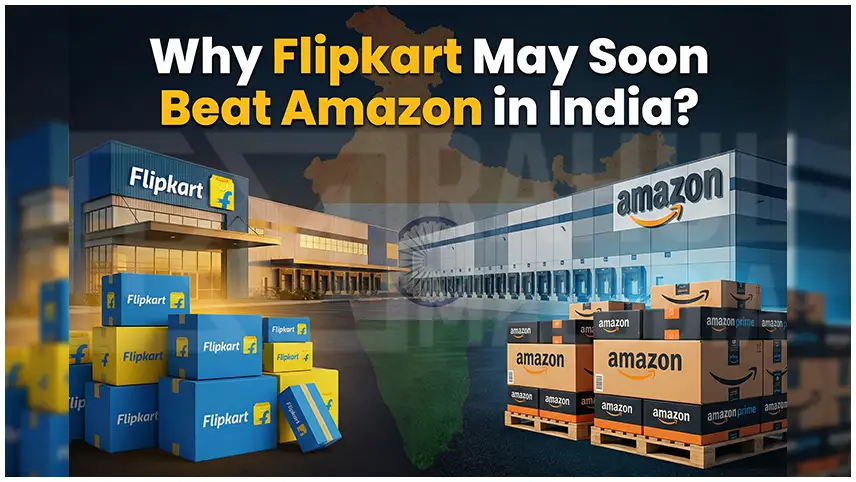
Why Flipkart May Soon Beat Amazon in India?
If you look closely at India’s online shopping world, something interesting is happening. Amazon came to India with huge power, global experience, and massive money. Flipkart started in a small Bengaluru apartment with two founders packing books by hand.
Yet today, Flipkart is not only standing strong but may soon overtake Amazon in the Indian market. The rivalry is no longer just about discounts. It is about who understands India better.
And the more you study this, the more it becomes clear that Flipkart might be the one holding the stronger cards.
India Is Not One Market, Flipkart Learnt This Early
One of the biggest reasons Flipkart may beat Amazon is simple. Flipkart understood that India is not one uniform market. It is a mix of thousands of small towns with different habits, incomes, and expectations.
While Amazon followed a more global-style approach, Flipkart focused deeply on Tier 2 and Tier 3 cities. This early understanding helped Flipkart capture customers from places Amazon took longer to reach.
According to market research published in 2024, more than 65 percent of Flipkart’s new users come from smaller towns, proving that the platform built loyalty where the next big wave of online shoppers actually lives.
Flipkart Speaks the Language of Indian Shoppers
Every Indian shopper has one thing in common. They love value. They love deals. And they love when a brand feels like it understands them. Flipkart knew this from the beginning. It created sales events that felt like festivals.
The Big Billion Days became a cultural moment across India. Families sat together, waited for price drops, and bought everything from phones to clothes. During the 2023 Big Billion Days, Flipkart recorded almost 1.4 billion visits.
This pushed the platform ahead of Amazon in many product categories. When a sale becomes an event, not just a discount, you win more hearts. And Flipkart mastered that emotion way earlier.
Stronghold in Fashion and Lifestyle Gives Flipkart a Big Advantage
Amazon shines in electronics and appliances, but Flipkart quietly built its empire in fashion, lifestyle, and everyday shopping. This is where most Indian customers spend the maximum money in a year.
Flipkart owns Myntra and also operates Ajio’s biggest competitor in mass retail categories. Fashion contributes more than 50 percent of all online shopping in India. Flipkart’s deep hold in this segment gives it a huge advantage.
For example, insider reports from 2024 showed that Flipkart controls nearly 60 percent of India’s online fashion market through its combined platforms.
When you win the category with the biggest spending, it becomes easier to dominate the entire market.
The Power of Cash on Delivery and Easy Returns
Many e-commerce companies hesitate to offer cash on delivery because it is risky. But Flipkart understood it was necessary for trust in India.
Customers in small towns prefer paying when they receive the product. Flipkart not only kept cash on delivery alive but made return and refund processes simple.
This built massive trust. A 2023 survey showed that more than 70 percent of first-time online shoppers in smaller cities prefer buying from Flipkart because they trust its return policy. Trust always beats advertising, and Flipkart used this truth to grow faster.
Walmart’s Money and Supply Chain Strength Changed the Game
When Walmart bought Flipkart in 2018 for $16 billion, the world was shocked. But Walmart did not just bring money. It brought expertise in supply chain, logistics, and retail operations. India is a complex country.
Transporting a package from one corner to another is not easy. Walmart helped Flipkart create stronger warehouses, faster deliveries, and a more stable backend. Because of this, Flipkart reached 95 percent of India's pin codes by 2024.
When your supply chain becomes strong, your customer experience becomes smooth. And when customer experience gets better, people choose you again and again.

Flipkart Knows the Power of Affordable Smartphones
Smartphones changed online shopping in India. And most Indians buy budget or mid-range phones, not premium ones. Flipkart understood this very early and partnered with brands like Xiaomi, Realme, Poco, Motorola, and Infinix.
These partnerships made Flipkart the first choice for buyers who wanted affordable phones. During 2022 and 2023, Flipkart controlled almost 70 percent of India’s online smartphone sales in the budget segment.
And once someone buys a phone from a platform, they come back to buy cases, clothes, chargers, and many other things.
This repeat traffic created a cycle that pushed Flipkart ahead in customer loyalty.
Amazon Plays Global. Flipkart Plays Local.
Amazon has a global blueprint. And that blueprint works perfectly in many developed countries. But India is different. India needs local solutions. India needs flexible payment options. India needs regional language help.
India needs emotional connection. Flipkart kept its brand voice closer to Indian culture. It used local languages. It partnered with Indian companies. It designed schemes that connected to daily life.
Because of this, Flipkart feels like a familiar Indian brand, while Amazon sometimes feels like a formal global corporation.
When a customer relates to your brand, they choose you more often without thinking twice.
Flipkart’s Focus on Sellers Strengthened Its Base
India has millions of small businesses. Many of them joined e-commerce for the first time through Flipkart. The company created easy onboarding, lower commissions for certain categories, better seller training, and faster payouts.
According to a 2024 seller survey, more than 60 percent of small and mid-size sellers preferred Flipkart over Amazon due to easier policies.
When sellers grow, the platform automatically grows because more products and better prices come to customers. Flipkart understood this connection deeply.
The Indian Government’s Push Toward Local Commerce May Shift the Market
There is a strong push from the Indian government to support local e-commerce frameworks and small businesses. Flipkart fits more comfortably into this approach because it is seen as a more “India-first” platform after Walmart’s involvement.
Amazon has faced regulatory challenges in India related to competition rules. Flipkart, while not free of issues, is still seen as more aligned with India’s long-term e-commerce goals. This shift could play a major role in who wins the market in the next few years.
The Future May Belong to the Platform That Understands India Better
When you compare everything, customer base, fashion dominance, smartphone partnerships, seller ecosystem, supply chain reach, and emotional appeal, it becomes clear why Flipkart may beat Amazon soon.
The fight is still ongoing. Both companies are investing heavily. But the winner of the Indian market will not be the one with the biggest global brand.
It will be the one who understands Indian customers more deeply. And right now, Flipkart seems to be closer to that understanding.
Conclusion: A New Chapter in India’s E-Commerce War
The question is not whether Amazon is strong. It is. The question is who fits India better. Flipkart has made millions of Indian shoppers feel comfortable, understood, and valued. Its decisions, partnerships, and strategies feel tailored to the Indian way of buying.
That makes it a powerful contender for the top spot. The coming years will show how this battle unfolds.
But one thing is clear. In the world’s fastest-growing e-commerce market, Flipkart is not just catching up. It is quietly getting ready to lead.
- BusinessGrowth
- StartupGrowth
- Personal Development
- becoming a ceo
- Businessman
- Ecommerce business model
- Business Case study



Rahul Malodia is a leading business coach in India, a Chartered Accountant, and the creator of the transformational Vyapari to CEO (V2C) program. With a mission to empower MSMEs, he has trained over entrepreneurs to systemize operations, manage working capital, and scale their businesses profitably.
Known for transforming traditional business owners into confident CEOs, Rahul delivers India’s top business coaching programs through bootcamps, workshops, and online courses. His practical strategies and deep industry insights have made him a trusted name among entrepreneurs seeking sustainable and scalable growth.
