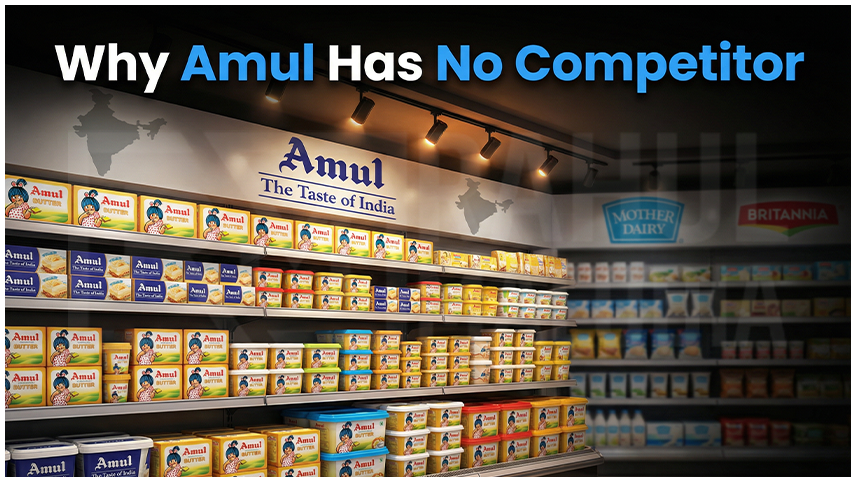
Why Amul Has No Competitor? The Untold Business Truth
If you look around your kitchen right now, you’ll most likely find at least one Amul product sitting quietly on a shelf. It could be butter, milk, cheese, ghee, paneer, ice cream, or maybe even chocolate. What’s interesting is that Amul never tries too hard to be seen. Yet it lives in almost every Indian home. And when you think about it, very few Indian brands enjoy this kind of trust. So a big question appears. Why does Amul have no real competitor? Why can no other dairy brand match what Amul has built? The answer is bigger than taste, bigger than marketing, and bigger than price. It’s a story every Indian entrepreneur must understand.
The Movement That Became a Brand
The Amul story didn’t begin as a business plan. It began as a protest. In 1946, farmers in Gujarat were struggling. Middlemen controlled prices and kept farmers poor. Milk was sold cheap, but profits were taken away. When farmers finally came together, they formed a cooperative. That cooperative became the Gujarat Cooperative Milk Marketing Federation, better known as GCMMF. And that cooperative became Amul. This is important because Amul was born not from a boardroom, but from people. It was built on fairness and dignity. This emotional foundation gave Amul a loyal base long before marketing became a trend.
A Brand Owned by 36 Lakh Farmers
Today Amul is owned by more than 36 lakh dairy farmers across Gujarat. Every family that pours milk into the system is a part-owner of the brand. This is not a company where profit goes to a few people. Profit goes back to farmers. So when you buy Amul butter, you are helping a family in a village. This creates a trust loop that no private company can copy. Competitors might match price or packaging. But they cannot match the emotional connection of a brand owned by the people. This cooperative model is the backbone of why Amul runs faster and stronger than anyone else.

The Best Supply Chain in India That Works Like a Machine
Milk is the only product in the world that spoils within hours. Managing milk is harder than managing petrol, mobiles or clothes. But Amul cracked this complex supply chain decades ago. It collects around 2.8 crore litres of milk every single day, according to GCMMF data. That milk is collected, tested, cooled, processed, packed, and shipped within hours. It moves from a small village to a big city with speed and accuracy. Competitors cannot match this scale. Creating such a cold chain system needs money, land, networks, and trust. And building that takes decades, not years.
When Other Brands Raised Prices, Amul Raised Production
One thing customers love about Amul is its fair price. Even when inflation hits the country, Amul tries to keep prices stable. The reason is simple. Amul does not chase profits for a few shareholders. It chases stability for farmers and customers. So it increases productivity instead of price. It invests in better processing plants, better machines, better chilling centres and better animal care programs. This helps Amul increase supply without raising rates. In 2023 and 2024, when many private milk brands raised prices sharply, Amul kept increases controlled. This won more loyalty from consumers and more trust from farmers.
The ‘Taste of India’ Identity That No One Else Can Copy
Amul is not just a dairy company. It is part of Indian identity. From the Amul girl cartoons that have commented on everything from cricket to politics for more than 55 years, to the famous “Utterly Butterly Delicious” line, the brand has created a soft emotional place in the Indian mind. When a mother buys butter, she reaches for Amul automatically. When someone makes tea, they add Amul milk. When friends meet, they eat Amul ice cream. This emotional presence is not built in a year or two. It is built over decades. And no new brand has the patience or the trust to replace that feeling.
Consistency That Makes People Forget Competitors
In India, milk is not just food. It is trust. If milk is bad even once, the customer moves away forever. Amul understands this deeply. That is why its quality checks are strict. Every litre of milk is tested for fat content, SNF levels, purity, and safety multiple times before packaging. Farmers are paid based on quality, so they do not mix water or impurities. This strict quality system makes Amul consistent. And consistency builds habit. A habit becomes loyalty. And loyalty kills competition.
Distribution That Covers Every Corner of India
One of the biggest reasons Amul has no competitor is its distribution strength. Amul supplies products to over 10,000 distributors and more than 20 lakh retail outlets across India. From small paan shops to big supermarkets, Amul is everywhere. If you live in a tier-1 city, tier-2 town, small village or even a remote mountain region, you will find Amul products. No other dairy brand in India has such deep reach. And without reach, no competitor can replace Amul in daily life.
A Marketing Style That Works Without Big Budgets
Amul does not depend on celebrities. It does not run expensive ad campaigns. Its simple, bold, fun and relatable hoardings do more work than any TV commercial. People wait for the next Amul topical. It has become a part of Indian humour. This low-cost, high-impact marketing helps Amul stay visible without burning money. While other brands wait for ad agencies to create campaigns, Amul creates magic with one simple cartoon.
A Business That Makes Both Farmers and Consumers Win
Many private dairy companies want to increase profit. But Amul tries to increase fairness. Farmers get better prices because they are the owners. Customers get better prices because there is no middleman. This balanced model avoids greed. That is why Amul grows even in tough times. During the COVID lockdown, when many supply chains broke, Amul increased milk procurement by 17 percent. It helped farmers survive and helped India stay supplied with milk. No private competitor had the ability or heart to do this.

Why No Competitor Can Replace Amul
When you look at all these pieces together, trust, scale, supply chain, pricing, consistency, reach, emotional branding, farmer ownership, you realize one truth. Amul is not a dairy company. It is an ecosystem. It is a movement. It is a lifeline for farmers. It is a habit for consumers. It is a structure that took almost eight decades to build. And no brand can copy eighty years of work with a quick campaign or a new product line.
Conclusion: The Empire Built on Trust, Not Tricks
Amul has no real competitor because it is more than a business. It is a promise. It is the connection between a farmer in a small village and a family in a big city. It is the bridge between need and trust. And trust, once built at this scale, is almost impossible to break. That is why when Indians buy milk, butter, or cheese, they do not ask who is cheaper. They simply pick Amul. Because Amul is not just the taste of India. It is the trust of India.
- soaicl media marekting
- becoming a ceo
- Business Ideas
- BusinessSuccess
- LeadershipDevelopment



Rahul Malodia is a leading business coach in India, a Chartered Accountant, and the creator of the transformational Vyapari to CEO (V2C) program. With a mission to empower MSMEs, he has trained over entrepreneurs to systemize operations, manage working capital, and scale their businesses profitably.
Known for transforming traditional business owners into confident CEOs, Rahul delivers India’s top business coaching programs through bootcamps, workshops, and online courses. His practical strategies and deep industry insights have made him a trusted name among entrepreneurs seeking sustainable and scalable growth.
