IPO vs FPO vs SME IPO: Understanding the Types of Public Offerings in India
Every entrepreneur in India dreams of seeing their company’s name flash across the stock market ticker one day. It’s not just about prestige, it’s about growth, recognition, and unlocking a new world of opportunities. But before a business reaches that stage, it must choose its path to the market, through an IPO, FPO, or SME IPO. These three terms may sound similar, but each carries a different story of a company’s journey toward expansion.
What Exactly Is an IPO?
Let’s start with the term most people know, IPO, or Initial Public Offering. It’s the moment when a private company decides to go public for the very first time. Think of it as the company opening its doors to the public and inviting investors to become part-owners by buying its shares.
A company chooses to launch an IPO mainly to raise funds for expansion, repay debt, or build new facilities. In India, we’ve seen several iconic IPOs in recent years, like Zomato in 2021, Nykaa in 2021, and Policybazaar in 2021, all of which captured massive public attention. Zomato’s IPO alone received bids worth over ₹2.13 lakh crore, signaling how much faith investors had in India’s growing startup ecosystem.
The Power of an FPO
Once a company is already listed on the stock exchange, it may still need more money to grow further. This is where the FPO, or Follow-on Public Offer, comes in. In simple terms, an FPO is when a company that’s already public issues more shares to raise additional capital.
Think of it like this, a restaurant that’s already open and popular decides to add more tables to serve more customers. It doesn’t need a new grand opening; it just expands its capacity. That’s what companies like Yes Bank and Power Grid Corporation have done in the past through FPOs.
In July 2020, Yes Bank’s FPO made headlines when it aimed to raise ₹15,000 crore to strengthen its balance sheet after financial troubles. It was one of India’s largest FPOs, showing how companies use this route to regain market confidence and fuel recovery.
The Rise of SME IPOs in India
Now comes the third type, SME IPO, or Small and Medium Enterprise Initial Public Offering. This is one of the most exciting developments in India’s business scene. SME IPOs are designed for smaller businesses that are not yet big enough to list on main exchanges like NSE or BSE but still want to raise funds and build credibility.
India’s startup and MSME ecosystem is booming, and the SME IPO platform, through exchanges like NSE Emerge and BSE SME, gives these ambitious businesses a chance to tap into public markets. In 2024 alone, over 250 SMEs went public, collectively raising more than ₹5,500 crore, a record-breaking year for India’s small business listings.
For instance, Drone Destination Ltd, India’s first drone training company, launched its SME IPO in July 2023 and saw an oversubscription of over 200 times, reflecting investor trust in India’s tech-driven future.
The Key Difference: Size and Stage
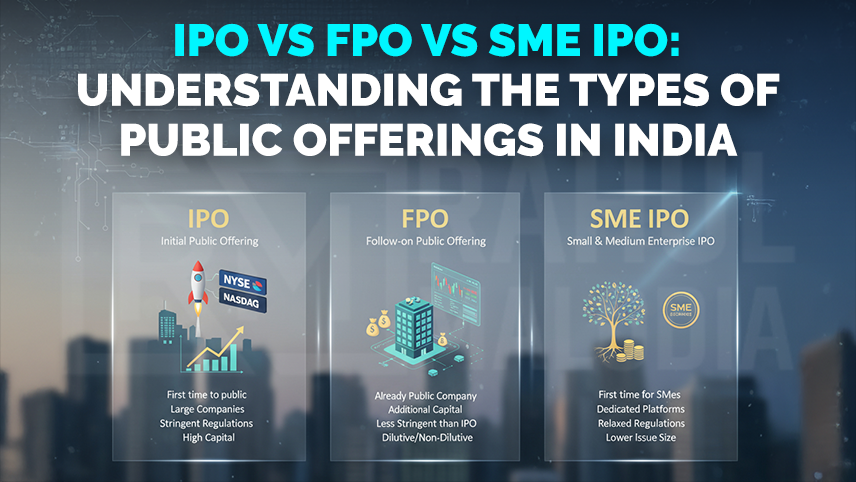
The simplest way to understand the difference between IPO, FPO, and SME IPO is by looking at when and why they happen. IPOs mark a company’s first step into the stock market. FPOs are about growth after already being listed. And SME IPOs are the entry gates for smaller businesses that are ready to make their mark.
In essence, an IPO is the beginning, an FPO is an expansion, and an SME IPO is the small player’s big leap.
Why Do Companies Go Public?
For any company, going public is not just about raising money, it’s about transformation. It means more visibility, more trust, and easier access to capital in the future. When a company lists on the stock exchange, it suddenly becomes accountable to the public, regulators, and investors.
In India, this journey is more than financial, it’s emotional. From family-run businesses in Ahmedabad to tech startups in Bengaluru, listing publicly represents years of hard work and the dream of scaling beyond limits.
Take Honasa Consumer Ltd, the parent company of Mamaearth, for example. When it launched its IPO in November 2023, it wasn’t just about fundraising, it was about cementing its position as a leading D2C (Direct-to-Consumer) brand.
The Investor’s Angle
From the investor’s side, these offerings open doors to new opportunities. IPOs often attract heavy excitement because investors believe they can get early access to the next big success story. But they also carry risk, as seen with some IPOs that later struggled to maintain their listing price.
FPOs, on the other hand, usually offer more stable prospects because the company’s performance is already public and easier to assess. SME IPOs come with high potential but also high risk, since smaller businesses are more vulnerable to market swings. Yet, investors who identify strong SMEs early can see massive returns.
A good example is Raghav Productivity Enhancers Ltd, which debuted on the NSE SME platform in 2016 at ₹39 per share, and by 2024, its stock had risen over 1,000%, proving that SME IPOs can indeed create wealth for bold investors.
The Regulatory Backbone: SEBI’s Role
All these public offerings are strictly monitored by SEBI (Securities and Exchange Board of India), which ensures transparency and protects investors. Before any IPO or FPO hits the market, SEBI checks every detail, from financial disclosures to business risks.
This regulatory framework has played a key role in making Indian markets more trustworthy. That’s one reason why India now ranks among the top five countries globally in terms of IPO volume, according to a 2024 EY report.

India’s IPO Boom and What’s Next
If you’ve been following financial news, you know that 2024 was an explosive year for IPOs in India. From Tata Technologies to Go Digit Insurance, companies across sectors are rushing to the market. The total IPO fundraising in 2024 crossed ₹70,000 crore, a sign that India’s equity markets are maturing rapidly.
And it’s not just big names. SME IPOs are creating a silent revolution in Tier-II and Tier-III cities. Businesses that once relied on bank loans are now using public markets to scale faster. This trend shows that India’s growth story is not just about unicorns, it’s about thousands of small and medium companies daring to dream big.
The Final Takeaway
Understanding IPOs, FPOs, and SME IPOs is essential for anyone serious about business growth or investment in India. Each represents a different phase of ambition, the start, the expansion, or the breakthrough.
As India marches toward becoming a $5 trillion economy, public markets will play an even bigger role in fueling that growth. Whether you’re a business owner eyeing the next step or an investor seeking the next opportunity, knowing how these offerings work gives you a front-row seat to India’s financial evolution.
So, the next time you hear about a company “going public,” remember, it’s not just a financial event. It’s the story of dreams, growth, and India’s unstoppable march toward economic power.
- government schemes
- stock market business
- Business Case study
- Ecommerce business model
- Financial Freedom
- focus on money



Rahul Malodia is a leading business coach in India, a Chartered Accountant, and the creator of the transformational Vyapari to CEO (V2C) program. With a mission to empower MSMEs, he has trained over entrepreneurs to systemize operations, manage working capital, and scale their businesses profitably.
Known for transforming traditional business owners into confident CEOs, Rahul delivers India’s top business coaching programs through bootcamps, workshops, and online courses. His practical strategies and deep industry insights have made him a trusted name among entrepreneurs seeking sustainable and scalable growth.
