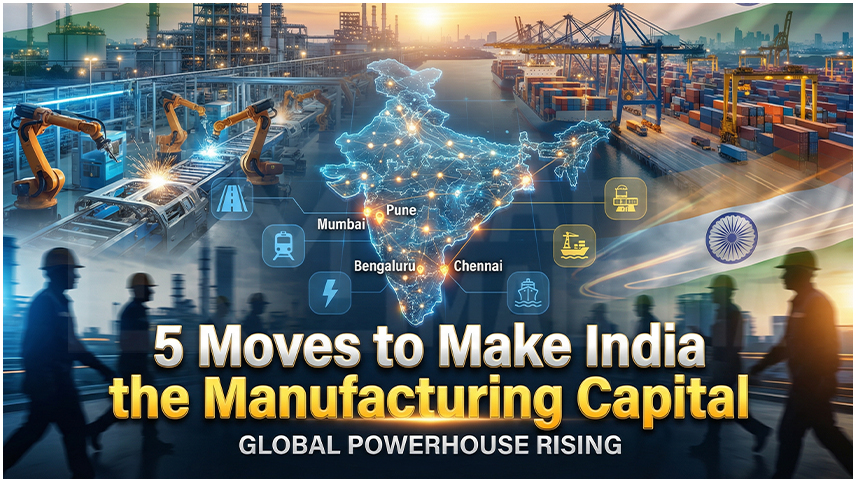
The 5 Moves That Can Make India the World’s Manufacturing Capital
If you look closely at how the world is shifting today, you will notice something big happening. Countries that once ruled manufacturing are slowing down. Costs are rising. Supply chains are breaking. Markets are moving. And right in the middle of this change, India has a rare chance. A chance that does not come every decade. A chance to become the world’s manufacturing capital.
But here is the truth most people don’t see. This path is not about copying what China did. It is about understanding what the world needs today and how India can respond faster, smarter, and stronger. The opportunity is real. The numbers are real. And the next decade can change India forever.
Why the World Is Looking at India Right Now
Over the past few years, global manufacturers have started moving away from single-country dependence. China’s manufacturing output is still huge, but labour costs there have grown almost 12 times since 2000. Many companies want a second base. India fits into this gap with a young workforce, fast-growing infrastructure, and a large domestic market.
In 2024, India became the fifth-largest economy. The manufacturing sector already contributes about 17% to India’s GDP, and the government aims to push this to 25%. These numbers show that the world is not only watching India but also expecting it to rise.
Move 1: Building a Skill Force, Not Just a Workforce
One of the biggest strengths India has is its young population. More than 65% of Indians are below 35. But youth alone is not enough. The real game lies in creating a skilled force that can handle advanced manufacturing.
Imagine a young worker from a small town in Gujarat learning robotics, CNC machines, and high-tech assembly lines. This is already happening in states like Tamil Nadu and Karnataka. Companies like Foxconn, Tata Electronics, and Samsung have set up advanced training centres where thousands learn modern factory skills.
If India can scale this across states, we can produce a generation of workers who are not just low-cost labour but high-value talent. And this is exactly what global companies want today.
Move 2: Fixing Logistics So Products Travel Faster Than Promises
Manufacturing does not succeed inside factories alone. It succeeds on roads, railways, ports, and digital networks. And this is one area where India is improving faster than many people realize.
The Delhi–Mumbai Industrial Corridor, the Dedicated Freight Corridors, the expressway boom, and the expansion of major ports are already cutting travel time sharply. Logistics costs in India are still around 13–14% of GDP, while countries like the US and Germany operate at 8–9%. If India manages to reduce this gap even by a small percentage, exports will rise sharply.
Think about it. A smartphone made in Noida should reach Dubai or Jakarta with the same speed and cost-efficiency as one made in Shenzhen. This is possible, and the journey has already begun.
Move 3: Making India a Powerhouse for Electronics and High-Tech Manufacturing
There was a time when India was known only for IT services. But today, electronics manufacturing is turning into a powerful engine for growth. India’s mobile phone production rose from almost nothing in 2014 to more than 33 crore units in 2024. Apple alone exported more than ₹1 lakh crore worth of iPhones from India last year.
This shift is not small. It shows that the world now trusts India with high-value products. The next step is to expand into semiconductors, advanced batteries, medical devices, defence equipment, and electric vehicles. Gujarat is building India’s first major semiconductor plant, and several states are creating EV zones.
If India can scale even two of these sectors, we will not just manufacture products. We will manufacture the future.
Move 4: Creating a Business Environment Where Ideas Move Faster Than Files
Ask any entrepreneur what slows India down, and they will say paperwork, approvals, and unpredictability. This is changing, but the pace needs to be faster.
Today, many states allow online business registration, single-window clearances, and faster GST refunds. India jumped from rank 142 to 63 in the World Bank’s Ease of Doing Business index in just five years. But to truly become the world’s manufacturing capital, India needs a system where starting a factory feels as simple as starting a shop.
When companies spend less time on files and more time on production, output grows. Jobs grow. Exports grow. And global confidence grows even faster.
Move 5: Strengthening ‘Brand India’ in the Global Market
A country becomes a manufacturing capital not only because it produces a lot but because the world trusts its products. Japan built trust through quality. Germany built trust through precision. China built trust through scale. India needs to build trust through reliability.
From Tata to Mahindra to Bajaj to Maruti to Hero, Indian companies are already known for durable and cost-effective products. If India pushes deeper into global markets with strong branding and consistent quality standards, the world will start looking at Indian products the way it once looked at Japanese products in the 1980s.
Imagine a world where “Made in India” stands for trust, value, and innovation. That is the brand India must build.
How Entrepreneurs and Business Owners Can Ride This Wave
If you run a business, this shift in manufacturing is not just a national opportunity. It is your opportunity. You can enter supply chains, become vendors, explore exports, and tap into new global demand. Even small units can supply parts to automotive, electronics, textile, and FMCG giants who are expanding operations here.
This is the moment to upgrade skills, invest in better machinery, adopt digital tools, and align with global standards. When India grows, those who adapt early grow even faster.
The Road Ahead: A Chance India Should Not Miss
Every country gets a window where the world opens its doors. India’s window is open right now. Global tensions, shifting supply chains, rising costs in other countries, and India’s improving ecosystem have all created a perfect moment.
If India executes these five moves with focus, the next decade will belong to us. Factories will rise. Jobs will rise. Exports will rise. Confidence will rise. And the dream of becoming the world’s manufacturing capital will no longer feel like a dream.
It will feel like India’s natural place in the world.
- Businessman
- Innovation



Rahul Malodia is a leading business coach in India, a Chartered Accountant, and the creator of the transformational Vyapari to CEO (V2C) program. With a mission to empower MSMEs, he has trained over entrepreneurs to systemize operations, manage working capital, and scale their businesses profitably.
Known for transforming traditional business owners into confident CEOs, Rahul delivers India’s top business coaching programs through bootcamps, workshops, and online courses. His practical strategies and deep industry insights have made him a trusted name among entrepreneurs seeking sustainable and scalable growth.
