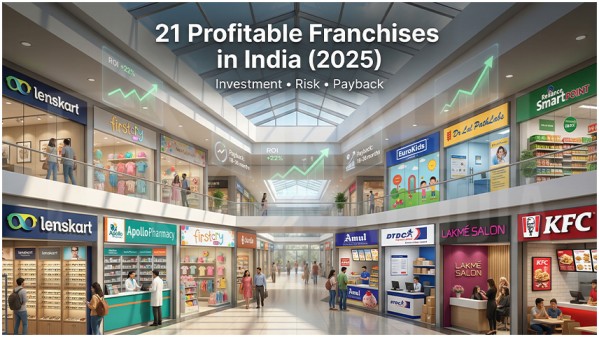
21 Profitable Franchises in India 2025: Investment, Risk & Payback
Profitability in franchising is widely misunderstood in India.
Most people assume that a famous brand automatically means high profit. That assumption is responsible for thousands of failed franchise outlets across the country, especially in food, retail, and education.
A profitable franchise is not defined by brand popularity or footfall alone. The relationship between investment size, fixed operating costs, city economics, owner involvement, and realistic payback discipline defines it.
In many cases, a less glamorous brand in the right city with the right cost structure outperforms a national brand in a high-rent location.
This is why franchise selection is not a marketing decision. It is a capital allocation decision.
Many franchises look attractive on brochures but collapse under rent pressure, staff churn, royalty leakage, or unrealistic sales assumptions. The wrong franchise choice does not just reduce profit. It locks capital, time, and mental bandwidth for years.
This guide is meant for people actively evaluating franchise investments, not those browsing brands casually. The focus is on capital protection, realistic payback, and execution risk.
How to Compare These 21 Franchise Businesses
Every franchise in this guide is evaluated using the same four lenses.
The first is investment versus payback period. Some franchises recover capital quickly but cap upside. Others take longer but scale better.
The second is city dependency. A model that works in Mumbai may fail in Indore. City economics matter more than brand strength.
The third is owner involvement. Some franchises demand daily presence. Others can be manager-driven once stabilized.
The fourth is risk level. Risk comes from brand dependency, location sensitivity, and operational complexity.
Ignoring even one of these variables leads to poor outcomes.
| Evaluation Lens | Description |
| Investment vs Payback | Short / Medium / Long capital recovery timelines |
| City Dependency | Metro, Tier-2, Tier-3 suitability |
| Owner Involvement | Active vs Manager-driven |
| Risk Level | Brand, location, and operational risk |
Types of Franchise Models in India
Job franchises are owner-operated models with low setup costs. Income depends directly on the owner’s time and effort.
Investment franchises require higher capital. They can scale but carry higher fixed costs and risk.
Distribution franchises operate on margin-driven resale. Profitability depends on volume and territory control.
Business format franchises offer end-to-end systems, branding, and processes. Execution discipline decides results.
Conversion franchises convert an existing business into a branded franchise to improve systems and margins.
Understanding the model is more important than admiring the brand.
| Model Type | Description |
| Job Franchise | Owner-operated, low setup cost, income depends on personal effort |
| Investment Franchise | Higher capital, scalable, higher fixed costs and risk |
| Distribution Franchise | Margin-driven resale, profit depends on volume and territory control |
| Business Format Franchise | End-to-end franchisor system, execution discipline crucial |
| Conversion Franchise | Existing business converted into a franchise for systems and margins |
Franchise Evaluation Template
The following 21 franchise options are evaluated strictly using business logic, not marketing claims.
| # | Franchise | Core Business Logic | Investment (₹) | Ideal Market | Payback | Risk | Expected Monthly Net Profit |
| 1 | Lenskart | High repeat optical demand with supply-chain control | 30–40L | Tier-1/2 | Medium | Medium | ₹1.5–3.5L (5–9%) |
| 2 | Apollo Pharmacy | Non-discretionary healthcare consumption | 25–35L | All tiers | Medium | Low | ₹1.2–2.5L (4–7%) |
| 3 | FirstCry | Trust-driven baby essentials with repeat cycles | 20–30L | Tier-1/2 | Medium | Medium | ₹1.3–3L (6–10%) |
| 4 | Amul Outlet | Daily consumption, volume-led margins | 6–10L | All tiers | Short | Low | ₹40k–90k (4–6%) |
| 5 | DTDC Courier | E-commerce driven logistics demand | 5–8L | Tier-2/3 | Short | Medium | ₹50k–1.2L (8–12%) |
| 6 | Patanjali Store | Mass FMCG with price sensitivity advantage | 7–15L | Tier-2/3 | Short | Medium | ₹60k–1.5L (6–10%) |
| 7 | Jawed Habib Salon | Skill + repeat grooming services | 20–30L | Tier-1/2 | Medium | Medium | ₹1–2.8L (7–11%) |
| 8 | Lakmé Salon | Premium beauty services with high fixed operating costs | 50–70L | Tier-1 | Long | High | ₹1.8–4.5L (4–8%) |
| 9 | KFC | Footfall-dependent QSR with high fixed costs and royalty pressure | 1.5–2.5Cr | Tier-1 | Long | High | ₹4–10L (3–6%) |
| 10 | Subway | Compact QSR with operational sensitivity | 60–90L | Tier-1/2 | Medium | High | ₹1.5–4L (5–8%) |
| 11 | Kidzee | Predictable early-education demand | 15–25L | Tier-2/3 | Medium | Medium | ₹1–2.2L (10–15%) |
| 12 | EuroKids | Premium preschool positioning | 20–30L | Tier-1/2 | Medium | Medium | ₹1.2–2.8L (9–14%) |
| 13 | Dr Lal PathLabs CC | Asset-light diagnostics aggregation | 5–10L | All tiers | Short | Low | ₹60k–1.5L (12–18%) |
| 14 | IndianOil Petrol Pump | Volume-driven guaranteed demand | 1–2Cr | All tiers | Long | Medium | ₹3–7L (2–4%) |
| 15 | Reliance Smart Point | High-frequency grocery basket | 15–25L | Tier-2/3 | Medium | Medium | ₹1–2.5L (6–9%) |
| 16 | DTDC Master Franchise | Territory aggregation economics | 50–75L | Tier-2 | Medium | Medium | ₹3–6L (8–12%) |
| 17 | Monginis Bakery | Fresh product + impulse buying | 15–25L | Tier-2/3 | Short | Medium | ₹1.2–3L (10–14%) |
| 18 | H&R Block | High-margin seasonal financial services | 5–10L | Tier-1/2 | Short | Low | ₹80k–2L (15–25%) |
| 19 | Urban Company Partner | Platform-driven service demand | 3–5L | Tier-1 | Short | Medium | ₹40k–1.2L (10–18%) |
| 20 | Tumbledry Laundry | Process-led recurring household need | 18–30L | Tier-2/3 | Medium | Medium | ₹1–2.8L (7–11%) |
| 21 | Ferns N Petals | Event-triggered premium gifting | 20–30L | Tier-1/2 | Medium | Medium | ₹1.5–4L (8–14%) |
“Profit figures are indicative industry ranges based on operator interviews, disclosed margins, and public disclosures. Actual profitability varies significantly by city, rent, execution quality, and owner involvement.”
Comparison Sections
Low Investment Franchises (Below ₹15 Lakhs)
Low-investment franchises usually operate in services, diagnostics, logistics, or daily-need retail. Capital risk is lower, and payback periods are typically shorter. However, scalability is limited and owner involvement is usually mandatory.
These models suit first-time entrepreneurs who prefer learning-by-doing and want faster capital recovery rather than long-term brand building.
Medium Investment Franchises (₹15–50 Lakhs)
Medium-investment franchises form the largest and most competitive segment in India. Retail, education, salons, and grocery formats dominate this range.
These franchises balance growth potential with manageable risk, but only when location selection and working capital planning are done correctly. Poor execution in this range leads to long payback delays.
High Investment Franchises (₹50 Lakhs+)
High-investment franchises include QSR chains, fuel stations, and premium service formats. These businesses require patience, professional management, and strict compliance with brand systems.
Returns are highly sensitive to location quality, lease terms, and cost overruns. These are not beginner-friendly models.
Service-Based vs Retail Franchise Comparison
Service-based franchises generally require lower setup costs and deliver higher gross margins. However, revenue depends heavily on daily execution and owner presence.
Retail franchises offer higher revenue visibility but demand continuous working capital, inventory discipline, and staff control. Profitability emerges only when volume stabilizes.
Choosing between the two depends on how involved you want to be in daily operations.
| Segment | Investment Range | Typical Franchises | Payback | Risk Level | Owner Involvement |
| Low | <15 L | Amul, DTDC, Patanjali, H&R Block, UrbanClap | Short | Low-Medium | Active |
| Medium | 15–50 L | Lenskart, FirstCry, Reliance Smart, Jawed Habib, Kidzee, Monginis | Medium | Medium | Active |
| High | 50 L+ | Lakmé Salon, Subway, KFC, IndianOil, DTDC Express | Medium-Long | High | Professional / Manager-driven |
Service-Based vs Retail Comparison
| Franchise Type | Setup Cost | Revenue Visibility | Operational Demand | Scalability |
| Service-Based | Low | Medium | High (hands-on) | Moderate |
| Retail | Medium-High | High | High (inventory & staff) | High |
Common Franchise Mistakes
The most common mistake is choosing brand over location. A strong brand cannot compensate for weak footfall economics.
Another frequent error is ignoring working capital needs. Many franchises fail not because sales are low, but because cash flow is mismanaged.
Brochure profit numbers are often accepted at face value. These numbers usually assume ideal conditions that rarely exist in real markets.
Daily operational involvement is underestimated. Many franchise models demand active supervision, especially in the first 12–18 months.
Franchising punishes passive optimism and rewards operational realism.
| Mistake | Explanation |
| Choosing brand over location | Strong brand cannot compensate for poor footfall or city economics |
| Ignoring working capital | Cash flow mismanagement can collapse even profitable outlets |
| Believing brochure numbers | Assumptions often differ from real market performance |
| Underestimating daily involvement | Most franchises demand active supervision for the first 12–18 months |
Actual profitability varies widely based on rent, staffing discipline, and owner involvement. These numbers should be used for comparison, not guarantees.
Final Conclusion
Now you think that which franchise will be the best choice for you.
Profitability depends on alignment between capital, city economics, risk tolerance, and time involvement.
The right franchise is not the one with the biggest brand name, but the one that fits your execution capacity.
Franchising rewards discipline, not hope.
FAQ’s
1. What is the most profitable franchise business in India?
There is no single “most profitable” franchise in India. Profitability depends on investment size, city economics, fixed costs, and owner involvement. A low-investment franchise in a Tier-2 city can outperform a high-brand franchise in a metro with high rent and staff costs.
2. How much investment is required to start a profitable franchise in India?
Profitable franchises in India can start from as low as ₹3–5 lakhs (service-based models) and go up to ₹2+ crore for large QSR or fuel station franchises. Higher investment does not guarantee higher profit. Payback discipline matters more than brand size.
3. Which franchise is best for beginners in India?
For beginners, low to medium investment franchises with simple operations are safer. Examples include Amul outlets, courier franchises, diagnostics collection centers, and service-based models. High-investment QSR or premium retail franchises are not beginner-friendly.
4. Are food franchises more profitable than service franchises?
Not always. Food franchises generate high revenue but have thin margins, high wastage, and strict operational control. Service franchises usually require lower capital and offer higher margins but demand active owner involvement. Profitability depends on execution, not category.
5. How long does it take to recover franchise investment in India?
Payback periods typically range from 12–24 months for low-investment franchises, 24–36 months for mid-range franchises, and 4–6 years for high-investment franchises. Unrealistic payback promises in brochures should be treated with caution.
6. Is city selection more important than brand name in franchising?
Yes. City economics and location quality often matter more than brand strength. A strong brand cannot compensate for high rent, low local demand, or poor footfall. Many franchise failures occur due to wrong city and location selection, not weak brands.
7. Can franchise businesses run without owner involvement?
Some franchises become manager-driven after stabilization, but most require active owner involvement for the first 12–18 months. Passive ownership expectations are one of the biggest reasons franchise outlets underperform in India.
8. Are franchise profit numbers shown by brands reliable?
Franchise brochures usually show ideal-case projections. Actual profit depends on rent, staffing efficiency, working capital control, and local demand. Investors should evaluate downside scenarios, not just projected best-case numbers.
9. Is taking a franchise safer than starting an independent business?
Franchises reduce brand and system risk but introduce fixed costs, royalty obligations, and operational restrictions. Franchising is safer only when the business model fits the investor’s capital, city, and involvement capacity.
10. What is the biggest mistake people make while choosing a franchise?
The biggest mistake is choosing a brand emotionally instead of evaluating cost structure, payback period, and daily execution requirements. Franchising rewards discipline and realism, not brand obsession.
- StartupGrowth
- BrandBuilding
- Franchise India
- Business Ideas
- Investment Ideas


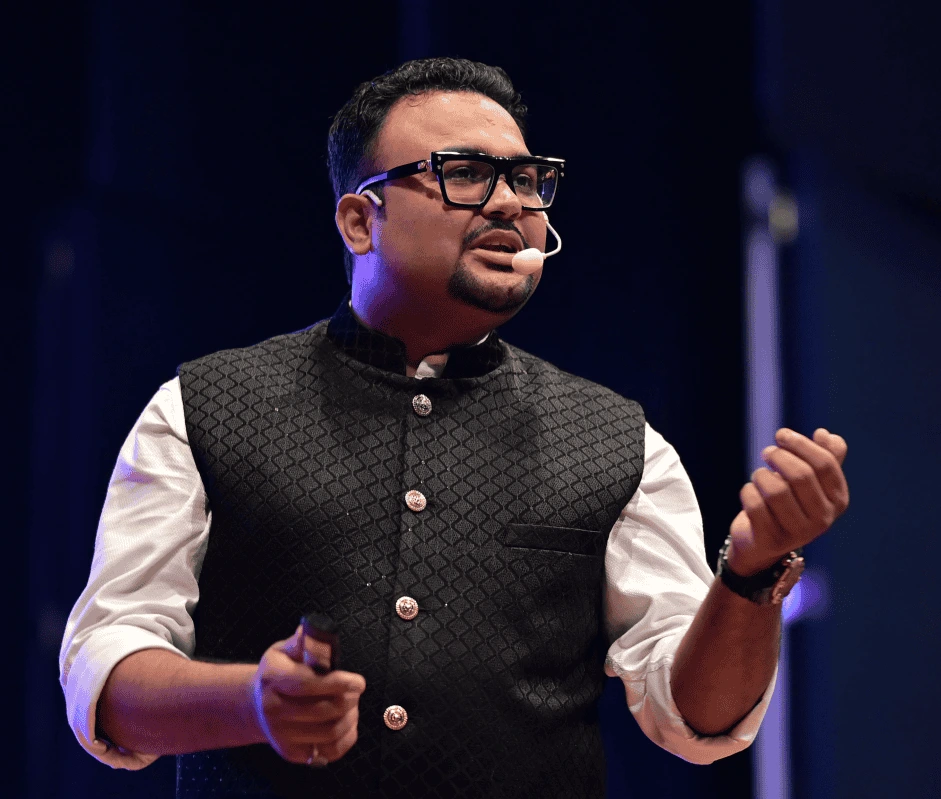
Rahul Malodia is a leading business coach in India, a Chartered Accountant, and the creator of the transformational Vyapari to CEO (V2C) program. With a mission to empower MSMEs, he has trained over entrepreneurs to systemize operations, manage working capital, and scale their businesses profitably.
Known for transforming traditional business owners into confident CEOs, Rahul delivers India’s top business coaching programs through bootcamps, workshops, and online courses. His practical strategies and deep industry insights have made him a trusted name among entrepreneurs seeking sustainable and scalable growth.
