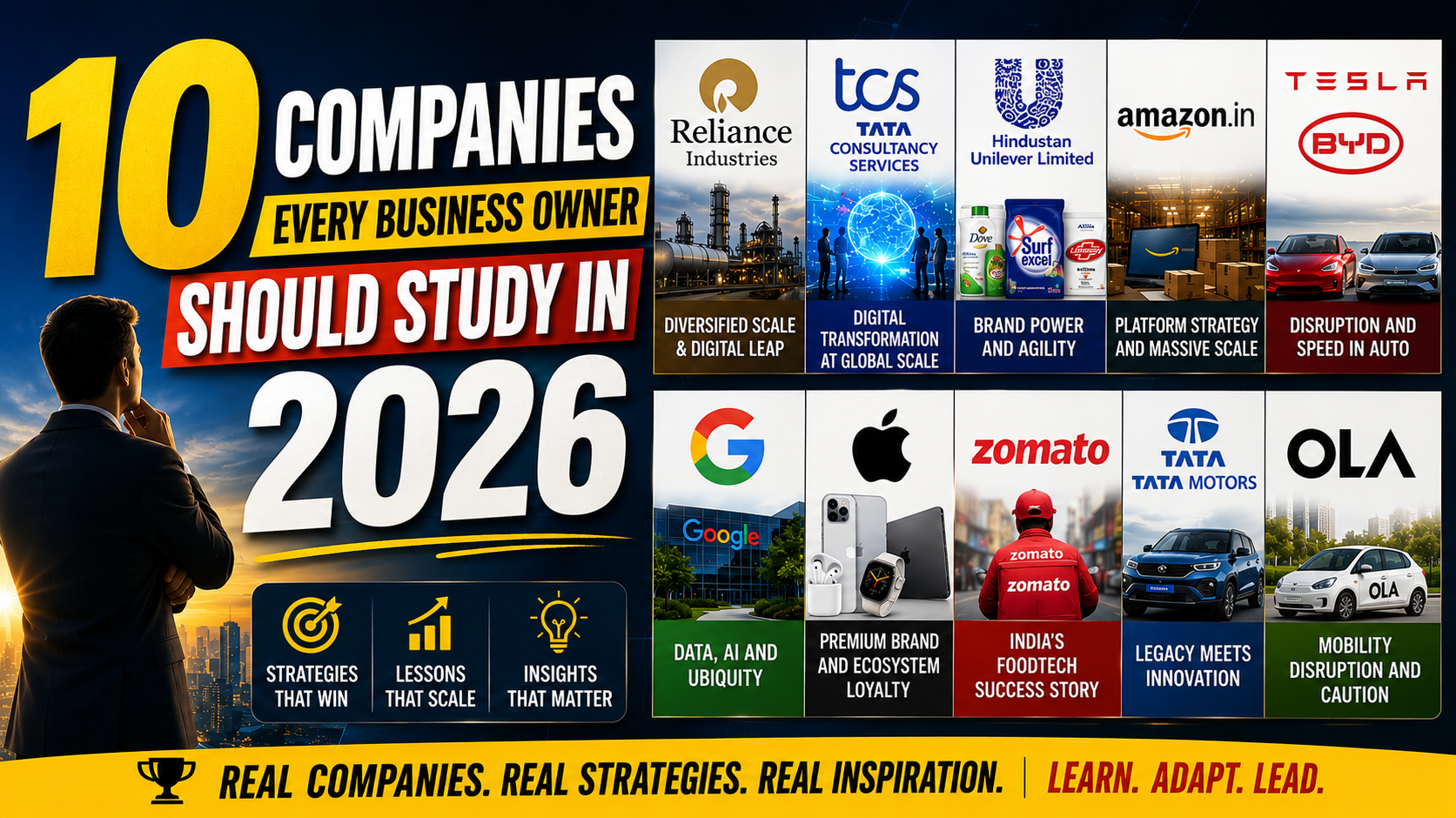
10 Companies Every Business Owner Should Study in 2026
In today’s fast-changing market, Indian entrepreneurs need both local insight and a global perspective. From digital revolutions to consumer trends, certain businesses have mastered strategies worth emulating. The companies below offer lessons in scaling, innovation and resilience, real-world examples every business owner can learn from. They grew through data-driven decisions, bold investments or customer obsession. Reading their stories shows how clear vision and execution create growth.
Reliance Industries, Diversified Scale & Digital Leap
Mukesh Ambani’s Reliance shows how bold bets pay off. Reliance’s retail arm hit ₹3,06,848 cr revenue (FY24, +17.8% YoY) with ₹23,082 cr EBITDA.
Its strength lies in combining businesses: Jio’s telecom and Reliance Retail’s shops drive each other. Jio jumped early into 5G; India now has ~430 million 5G subscriptions, while Retail leverages cashless payments and data from telecom.
Compared to rivals like Bharti Airtel or new Adani ventures, Reliance leads by investing across sectors.
Entrepreneurs can learn that investing in platforms (like Jio’s network) and tying offerings together (digital services plus products) unlocks new markets. Vertical integration (owning the customer’s journey end-to-end) drove Reliance’s rapid growth and set industry benchmarks.
TCS, Digital Transformation at Global Scale
Tata Consultancy Services (TCS) exemplifies taking an Indian IT firm global. TCS topped $30.18 billion in FY2025 revenue, a +3.8% increase, while keeping a 24% operating margin.
Its growth is led by digital and cloud services, think AI, fintech modernisation, and infrastructure for enterprises.
In contrast, Infosys (its major rival) is smaller (₹1.63 lakh cr or ~$20 billion revenue) and growing ~6%. Both compete globally (Accenture, IBM), but TCS’s edge is scale and long client relationships. TCS reinvests in talent (skilling for AI), which kept its net margin ~19%.
For business owners, the lesson is clear: focus on emerging tech demand and maintain quality at scale. TCS shows disciplined financials; even in slow markets, it remained profitable by diversifying clients across geographies and industries. A simple comparison table of FY2025 revenues highlights this scale:
| Company | FY2025 Revenue | YoY Growth |
| TCS | ~$30.18 billion | +3.8% |
| Infosys | ~₹1,62,990 crore (≈$19.9B) | +6.1% |
This shows how TCS’s $30B+ engine dwarfs peers; learning to streamline processes and win large contracts drove that scale.
Hindustan Unilever (HUL), Brand Power and Agility
Consumer markets are tough, but Hindustan Unilever Ltd (HUL) thrives by strong brands and distribution. FY2024-25 turnover was ₹60,680 cr (+2% underlying growth), with PAT ₹10,644 cr (≈17.5% margin).
Even as rural incomes stagnated, HUL grew by premiumizing products (skincare, hygiene) and acquiring fast-growing local brands. It pioneered sustainable practices (like waterless products and solar plants), building trust with environmentally-conscious Indians.
In contrast, local players like Patanjali (natural products) grabbed headlines but saw uneven results. HUL’s lesson: invest in understanding customer habits across India’s diverse market, then tailor products and price points.
By expanding smaller urban shops to digital kirana models, HUL kept volume up despite inflation. For comparison, many FMCG peers struggled with raw-material inflation, but HUL’s EBITDA margin of 23.5% remained strong.
Business owners learn that brand equity and adaptive distribution (rural, urban and online) can sustain growth even in slowdowns.
Amazon India, Platform Strategy and Massive Scale
Amazon’s playbook highlights customer-centric scale. In India, Amazon has ~150 million active users (2025) and about ₹25,406 cr revenue in FY24.
This made Amazon India the largest foreign investor ($40 billion) in India. Its marketplace outperformed local rivals in revenue growth: Amazon grew +14.5% YoY (to ₹25,406 cr) while Flipkart’s marketplace grew ~21% (₹17,907 cr).
Together, they still split ~79% of India’s online retail (Flipkart 48%, Amazon ~32%). Amazon gained loyalty through low prices (Prime discounts) and logistics (41 crore same-day deliveries in 2024). It’s now profitable on an adjusted basis, controlling costs (loss was cut 28.5% to ₹3,470 cr).
The e-commerce market itself is booming: India’s sector was $125 billion in 2024 and is projected to hit $345 billion by 2030. The table below illustrates this rapid growth:
| Year | India E-Commerce Market Size (US$ billion) |
| 2022 | 84 |
| 2024 | 125 |
| 2030 | 345 |
| 2035 | 550 |
Amazon and Flipkart ride this wave by innovating (voice commerce, vernacular interfaces) and investing (Amazon announced a $35B India investment by 2030).
The takeaway: platforms that obsess over customers (fast delivery, choice) dominate. Business owners should note Amazon’s focus on efficiency (1.14 Rupee to earn a rupee of revenue) and marketplace leverage.
It also shows how scale is built: Amazon’s units delivered to 100% of India’s pin codes, impossible without deep local networks.
Tesla (with BYD), Disruption and Speed in Auto
Tesla’s rise is a masterclass in disruption. In 2023, it delivered ~1.81 million vehicles. It seized 15–20% of global EV sales that year, while the Chinese giant BYD sold ~3.02 million vehicles.
Together, Tesla+BYD commanded ~35% of all electric car sales in 2023, more than any group of traditional automakers. Tesla did this by vertical integration (making batteries and software), a direct-to-customer model, and constantly improving products via over-the-air updates.
BYD’s example complements Tesla’s lesson: focus on localising production. BYD rapidly cut costs by making its own batteries (the “Blade Battery”) and offered models at various price points, helping it outsell Tesla globally. In contrast, older carmakers like Toyota or VW are scrambling to catch up.
Lesson for entrepreneurs: innovation and owning critical tech (software or hardware) can create huge advantages. Just as Tata Motors studies Tesla’s direct-sales approach, Indian startups should watch how Tesla builds brand fanaticism and charging networks. Meanwhile, BYD shows that scaling manufacturing and optimising supply chains is equally powerful.
Alphabet/Google, Data, AI and Ubiquity
Google’s parent Alphabet continues to flourish by capturing data and applying AI. In FY2025, it generated $402.8 billion in revenue (15% growth from $350B). Most of this came from Google Search ads and YouTube, with YouTube alone surpassing $60B yearly.
Another growth driver is Google Cloud: up 48% to $17.7B in 2025 as enterprises rush to AI infrastructure. This contrasts with peers: Amazon’s AWS is roughly $80B annual run-rate, Microsoft Azure over $100B, and Google shows it can play among the giants. Google’s strategy for business owners to note: build platforms that keep users (and data) inside your ecosystem.
Android (owned by Google) powers most Indian smartphones, feeding Google Search and Maps.
Learning from Google, companies should invest in AI capabilities (as Indian banks now use Google’s Gemini AI for fraud detection) and consider data as an asset. Competition is tough (Apple controls devices, Amazon and Microsoft compete in cloud), but Google’s model, focus on search, AI assistants and enterprise, shows how to evolve with technology.
Apple, Premium Brand and Ecosystem Loyalty
Apple leads by selling an experience, not just devices. FY2025 revenues reached $416.2 billion, a record for the company. Tim Cook highlights “very high levels of customer satisfaction and loyalty” and an “installed base of active devices at a new high”.
Apple’s secret sauce is tight integration: hardware (iPhone, AirPods, Watches) with software (iOS, App Store, Apple Music). That lets Apple charge premium prices; its iPhone sales alone are enormous (Q4’25 iPhone revenue was a quarterly record). By contrast, Samsung and other Android OEMs often end up in price wars.
Apple also built Services (App Store, iCloud, etc) into $109B/year. Key lesson: own the user’s full experience.
Like Apple, business owners can focus on creating “sticky” products that encourage repeat usage and build communities (for example, fitness apps and hardware). And while Apple’s model requires R&D and brand-building, it shows how margins can stay high even when growth slows. In India, this means finding your own niche and value proposition. Apple’s fan base is small in % but huge in ₹.
Zomato, India’s Foodtech Success Story
Zomato’s journey from startup to profitability offers many insights. In FY2023–24, it booked ₹12,114 cr in revenue (71% YoY growth) and turned net profit of ₹351 cr for the first time.
Zomato grew by expanding beyond just food delivery: it acquired quick-commerce player Blinkit and invested in Hyperpure (restaurant supplies) and dining-out services.
This diversified ecosystem boosted orders (40% GOV growth in delivery) and helped improve margins.
Comparatively, its domestic rival Swiggy (backed by SoftBank) still fights losses despite a similar scale.
Zomato’s Indian context shows the power of adapting to market needs. Lessons for entrepreneurs: diversify revenue streams around your core (Zomato went from pure marketplace to full-stack foodtech), and use data (delivery patterns, menu trends) to refine services.
Also, patience in market share battles matters; Zomato’s IPO was rocky, but its focus on profitability paid off.
For MSMEs, the takeaway is to prioritise unit economics: Zomato introduced a platform fee in Q2FY24 to improve take rates and focus on higher-value orders.
In short, learning from Zomato means thinking bigger than one product and building network effects step by step.
Tata Motors, Legacy Meets Innovation
Tata Motors blends century-old brands with new mobility. Its commercial vehicle division delivered FY2025 revenues of ₹75,100 cr with PBT ₹6,600 cr (≈37.7% ROCE), record profits driven by strong pricing and efficiency.
Even Jaguar Land Rover (now part of Tata) reported a £2.5 billion profit before tax in FY25, the highest in a decade. In contrast, many competitors (like Mahindra or Toyota India) saw smaller growth.
Tata introduced dozens of new vehicles, including EVs (ace electric trucks) and even hydrogen-truck trials, showing a clear bet on future tech. For business owners: Tata Motors teaches that scale doesn’t mean inflexibility.
It runs huge plants (of trucks and SUVs) but still rolls out innovations rapidly. Also, balancing global and local markets paid off: while JLR stabilised post-Brexit, Tata’s India business marched on.
This suggests that investing in R&D (Tata’s ₹18,000 cr five-year capex plan) can yield market leadership.
Entrepreneurs should note how Tata used its brand trust to launch new segments (like EV trucks) and combined them with strong after-sales networks, a model Indian manufacturers can emulate.
Ola, Mobility Disruption and Caution
Ola shows both ambition and challenges in India’s mobility space. By FY2023, it reported revenue of ₹2,799 cr but a net loss of ₹772 cr. Ola grew rapidly by expanding ride-hailing to 250+ cities and even launching an electric scooter arm.
Early on, it became India’s #1 taxi app, seizing market share from global Uber. However, its push into new areas (Ola Money fintech, Ola Electric) has required massive capital.
This speaks to a key lesson: high growth often means high burn. Ola’s experience reminds business owners to watch unit economics; adding more riders or scooters only helps if each trip or scooter sale eventually turns a profit.
For context, Uber’s revenues dwarf Ola’s, but it too runs losses. In 2025, Ola Electric went public at a $7.4B valuation, but the share price later sank sharply. The takeaway is to innovate but stay lean.
Entrepreneurs should balance expansion with careful cost control. For example, Ola invested in charging networks for its EVs and cut unprofitable services, demonstrating course-correction. In India’s price-sensitive market, even market leaders must keep an eye on fundamentals.
Each of the companies above earned its position by blending strategy with local insight. Studying their paths, from aggressive market entry to shrewd partnerships, can inspire business owners to manage scale, competition and innovation in 2026 India and beyond.
- BusinessSuccess
- Businessman



Rahul Malodia is a leading business coach in India, a Chartered Accountant, and the creator of the transformational Vyapari to CEO (V2C) program. With a mission to empower MSMEs, he has trained over entrepreneurs to systemize operations, manage working capital, and scale their businesses profitably.
Known for transforming traditional business owners into confident CEOs, Rahul delivers India’s top business coaching programs through bootcamps, workshops, and online courses. His practical strategies and deep industry insights have made him a trusted name among entrepreneurs seeking sustainable and scalable growth.
