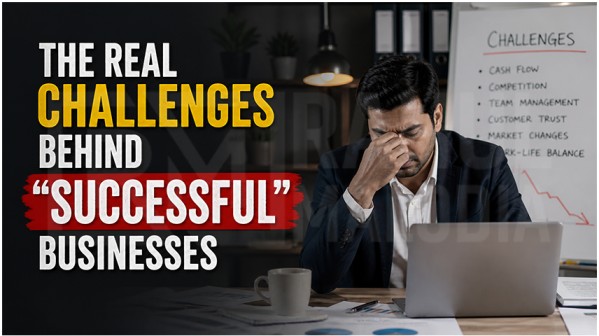
The Real Challenges Behind Successful Businesses
The Real Challenges Behind "Successful" Businesses
For Indian entrepreneurs, MSME owners, startup founders & decision-makers
Everyone sees the revenue. The press release. The "we crossed ₹100 crore ARR" LinkedIn post. What they don't see is the 2 a.m. founder call, the key employee who quietly resigned, or the cash flow crisis that nearly ended everything three months before the milestone.
The Gap Between Image and Reality
India now has over 6.3 crore MSMEs. Together, they contribute roughly 30% of the country's GDP and employ more than 11 crore people. On paper, that sounds like a thriving ecosystem of successful businesses.
In practice, around 90% of Indian startups fail within five years. The ones that survive rarely talk openly about what survival actually costs them.
This gap, between how businesses look from the outside and what they genuinely deal with on the inside, is wider than most people admit. And closing it starts with an honest conversation.
| 6.3Cr+ MSMEs in India (2025) |
| 90% Startups fail within 5 years |
| 30% GDP contribution by MSMEs |
| ₹20.8L Cr MSME sector output value |
Cash Flow Is the Quiet Killer
The number one reason businesses fail is not bad products or weak marketing. It is cash flow. A company can show ₹5 crore in revenue on its P&L and still default on payroll. This happens when receivables are stretched, credit cycles are misaligned, and working capital is tied up in inventory or in delayed invoices.
According to data from SIDBI, nearly 40% of MSMEs in India cite delayed payments from larger clients as their single biggest operational challenge. The government's MSME Samadhaan portal registered over 1.07 lakh delayed payment cases as of early 2025. The problem is structural, not individual.
Note: {Ground reality
A Pune-based auto-component supplier with ₹12 crore annual revenue nearly shut down in 2023, not because orders stopped, but because a large OEM client delayed payments by 90+ days. The founder had payroll to run, GST to file, and rent to pay. Cash flow is not an accounting problem. It is a survival problem.}
Growth That Outpaces Systems
Many businesses hit a revenue milestone and immediately celebrate. But fast growth without matching operational systems is one of the most dangerous phases a company can enter. Orders double. The team stretches. Quality dips. Customers notice. Reputation suffers.
A founder who bootstrapped her D2C brand from Jaipur once described it precisely: "We went from ₹15 lakh a month to ₹60 lakh in four months. We were not ready. The supply chain, the team, the customer support, everything cracked at once."
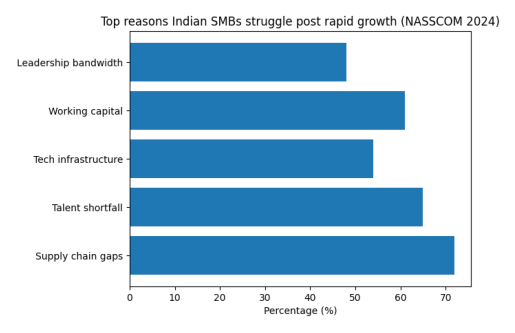
The Talent Problem Nobody Talks About Clearly
Hiring in India's competitive landscape has become one of the highest hidden costs of growth. Attrition in the startup sector averaged 25–35% annually between 2022 and 2025, according to data from TeamLease.
For every ₹1 spent on training a mid-level employee, businesses often absorb ₹3–5 in productivity loss and re-hiring costs when that person leaves within 18 months.
Founders often mistake early-stage loyalty for long-term commitment. The first ten employees who hustle alongside you in a cramped office are not necessarily the people who scale with you to a 200-person company.
Managing that transition, gracefully, without damaging culture, is one of the hardest invisible challenges in Indian business growth.
The company that looks like it has everything figured out is often the one quietly building its third leadership team in two years.
Compliance: The Cost You Cannot See on a Revenue Chart
GST, TDS, EPF, ESI, FSSAI, BIS, Shop Act, labour codes, the compliance burden on Indian businesses, especially MSMEs, is enormous. Since the GST Council's 2017 rollout, over 54 major amendments have been made. Businesses must continuously adapt.
A 2024 KPMG India report found that small businesses spend an average of 64 hours per month on tax and compliance-related tasks. That is nearly 8 working days every month not spent on selling, building, or improving.
For a founder already stretched thin, this cost is invisible on a revenue slide but very real on the ground.
| Area | What it looks like publicly | What it costs internally |
| Revenue growth | ₹X crore milestone, press coverage | Cash flow strain, margin compression |
| Team size | "We're 100+ people now" | High attrition, culture dilution |
| Compliance | Clean filings, GST registered | 64+ hrs/month, ₹2–5L annual cost for SMBs |
| Expansion | New city launch, product line added | Stretched operations, cash burn spike |
Public perception vs. internal business reality in growing Indian companies
Founder Mental Health: The Conversation We Keep Skipping
In 2024, the iCall mental health initiative (Tata Institute of Social Sciences) reported a 38% rise in founders and CXOs seeking support compared to 2022. Anxiety, burnout, and decision fatigue are not buzzwords. They are real, measurable, and increasing.
The Indian entrepreneurship culture still glorifies the 18-hour workday. Vulnerability is seen as weakness.
Founders rarely share that they questioned their decisions at 3 a.m., that they felt completely alone despite leading a team, or that they almost gave up six months before their biggest win. This silence makes the challenge worse for those coming next.
Note: A shift worth noting
Some of India's most respected founders, from Zepto, Razorpay, and Licious, have begun speaking openly about pressure, therapy, and redefining what success feels like day to day. This shift matters because it normalises honesty in a culture that has traditionally rewarded only results.
}
What "Sustainable" Actually Means in the Indian Context
Many Indian businesses are built for short-term momentum rather than long-term durability. A founder who chases a ₹100 crore valuation in three years may end up with a company that has no moat, no process rigour, and no ability to withstand a market slowdown.
| Metric | India average (MSME sector) | Global best practice benchmark |
| Net profit margin | 4–7% | 12–18% |
| Customer retention rate | 55–65% | 75–85% |
| Debt-to-equity ratio | 1.8–2.5x | 0.5–1.0x |
| Digital tool adoption | ~38% of MSMEs | 70–80% (EU, US SMBs) |
Indian MSME performance vs. global SMB benchmarks (Sources: SIDBI, World Bank SME Finance Report 2024)
Contrast India's 38% digital tool adoption among MSMEs with Germany's Mittelstand, where over 75% of mid-size companies have integrated ERP, CRM, and supply chain digitisation. The gap is not about ambition; it is about resources, awareness, and trust in systems.
The Comparison Trap and Misreading the Market
Every founder benchmarks against competitors at some point. That is healthy. But in India's hyper-visible startup ecosystem, comparison often becomes distorting. When a competitor announces a ₹50 crore Series A, founders panic and start making decisions driven by fear rather than fundamentals.
Swiggy vs Zomato. Meesho vs the vertical e-commerce players. OYO vs legacy hotel chains. Each of these comparisons tells a partial story. Zomato posted a net loss of ₹971 crore in FY22, yet was celebrated as a success story.
Meesho's path to profitability came after years of burning capital. Comparing your cash-generating ₹10 crore business to a loss-making ₹500 crore unicorn is not just misleading, it is harmful.
The Decision Fatigue of the Everyday Founder
On any given Tuesday, an Indian MSME founder makes decisions about pricing, people, procurement, production, payments, and partnerships, often before lunch. Research on executive decision-making (APA, 2023) shows that the quality of decisions degrades by up to 40% after sustained high-stakes decision-making with inadequate rest.
Most small business owners in India do not have a COO, a CFO, or a board to share this load. They carry it alone.
And over time, that weight shows up not in a dramatic collapse, but in slow drift, slightly worse decisions, slightly less energy, slightly more risk aversion, exactly when boldness is needed.
The most dangerous phase for any growing Indian business is not the early struggle. It is the middle stage, when things look fine, but the foundations are quietly straining.
What Separates the Businesses That Last
The businesses that endure in India, whether it is a third-generation kirana that evolved into a modern retail chain or a SaaS company that stayed lean through the 2023 funding winter, share a few common traits.
They built processes before they scaled. They hired for character alongside competence. They tracked cash, not just revenue. And they were willing to say, internally at least, "we are not doing as well as it looks."
| Common pitfall | What durable businesses do instead |
| Chase valuation milestones | Track unit economics and cash runway |
| Hire fast during growth spurts | Build talent pipelines ahead of need |
| Avoid compliance until a crisis | Systematise compliance from year one |
| Benchmark against funded competitors | Benchmark against their own past metrics |
| The founder handles everything alone | Build a decision-sharing inner circle early |
Common pitfalls vs. practices of durable Indian businesses
None of this is complicated in theory. All of it is hard in practice. The difference between a business that survives its own success and one that collapses under its weight is rarely strategy.
It is execution, consistency, and the courage to face uncomfortable truths before they become unavoidable crises.
The real story of any successful Indian business is not the headline. It is everything that happened before, between, and despite the milestones. That story is worth understanding, not to feel discouraged, but to be genuinely prepared.
Head to our blog for more practical insights on business growth, leadership, and building a business that actually works for you.
- BusinessSuccess


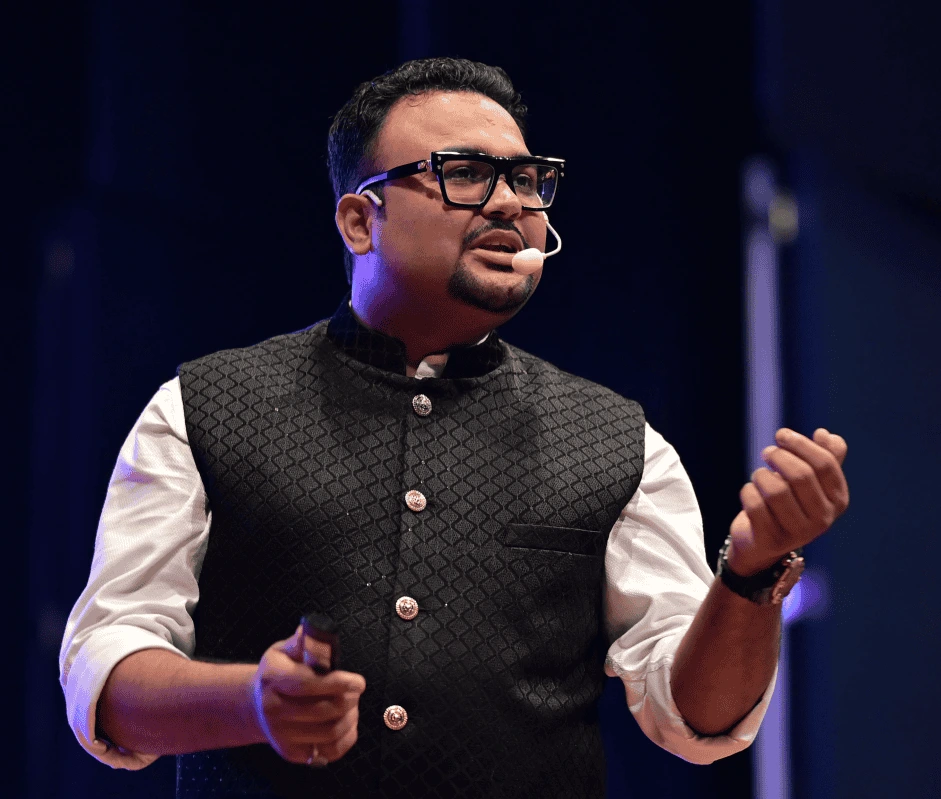
Rahul Malodia is a leading business coach in India, a Chartered Accountant, and the creator of the transformational Vyapari to CEO (V2C) program. With a mission to empower MSMEs, he has trained over 5,00,000+ entrepreneurs to systemize operations, manage working capital, and scale their businesses profitably.
Known for transforming traditional business owners into confident CEOs, Rahul delivers India’s top business coaching programs through bootcamps, workshops, and online courses. His practical strategies and deep industry insights have made him a trusted name among entrepreneurs seeking sustainable and scalable growth.
